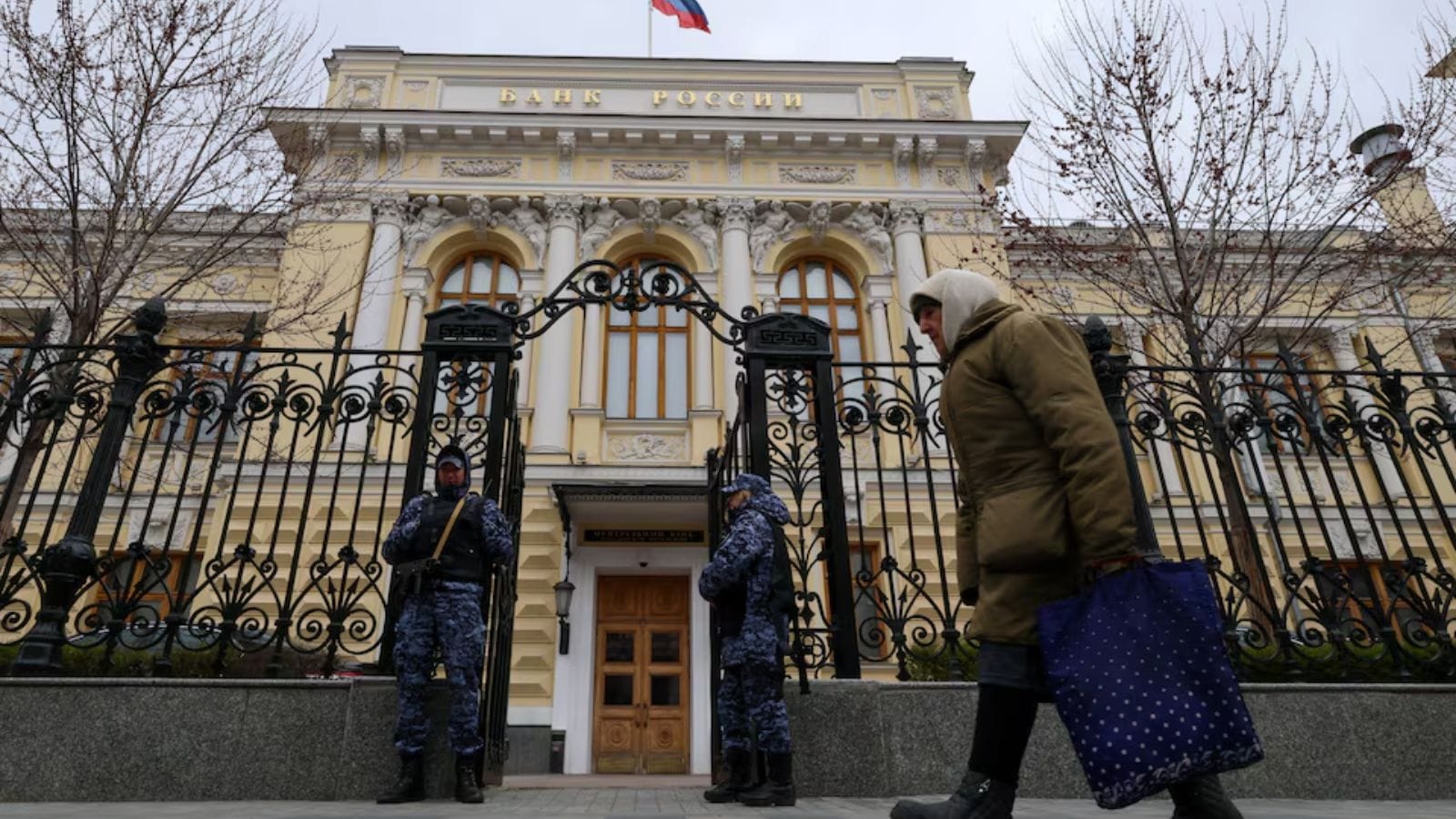
The Russian banking system is balanced on the edge of an explosive systemic crisis, masked only by state-backed accounting tricks and aggressive military spending. A leaked European intelligence report warns that the Kremlin has forced domestic lenders to shoulder the financial burden of a prolonged war economy, creating structural rot that a new wave of Western sanctions could ignite. While official Moscow data paints a picture of resilient growth, the underbelly of Russia’s financial sector reveals a different reality. Non-performing corporate loans have crossed critical thresholds, corporate defaults are mounting, and consumer debt has reached a breaking point.
The Illusion of Financial Stability
For four years, the Kremlin has boasted about its ability to withstand Western sanctions. This narrative relies heavily on superficial metrics like gross domestic product, which expanded on the back of relentless military factory production. Yet, this war-driven expansion has come at a staggering cost to the country's financial architecture.
A confidential European state intelligence brief titled "Note on the probability of a banking crisis in Russia in 2026" peels back the layers of state propaganda. The report indicates that the Kremlin has increasingly leaned on domestic banks to prop up the state budget and absorb industrial risk. Lenders have been coerced into issuing massive volumes of subsidized loans to defense contractors, strategic enterprises, and homebuyers.
These programs create a dangerous illusion. On paper, credit is flowing and factories are busy. In reality, these loans are flowing to entities that cannot survive without continuous government life support. When the state artificially suppresses borrowing costs for favored sectors, the financial system loses its ability to price risk accurately.
The Mounting Bad Debt Mountain
The true condition of Russian bank balance sheets is deteriorating rapidly. Independent assessments and internal documents show that problematic assets have quietly surpassed a crucial benchmark.
According to data from the Center for Macroeconomic Analysis and Short-term Forecasting, the share of non-performing and doubtful corporate loans in the Russian banking system has climbed past 10%, with some sectors seeing bad debt ratios exceed 11%. Under international standards established by the International Monetary Fund, crossing the 10% threshold is the traditional indicator of a latent, systemic banking crisis.
This distress is not confined to obscure regional institutions. By March 2026, the number of loss-making banks in Russia jumped to 60, up from 34 at the start of the year. This means roughly one in five Russian financial institutions is now burning through capital. Prominent entities including Pochta Bank, Sinara, and UBRIR have all posted significant financial losses over recent quarters.
The corporate bond market is facing similar strain. Overdue intercompany receivables—money companies owe to each other for goods and services already delivered—surpassed 8 trillion rubles, equivalent to nearly 4% of the country’s total economic output. Nearly half of all domestic enterprises report severe payment delays from their business partners. This chain reaction of unpaid bills threatens to drag down the very banks that financed these supply chains.
Retail Debt and the Consumer Bankruptcy Surge
The vulnerability extends far beyond factory floors and heavy industry. Everyday citizens are heavily indebted, driven by government incentives and inflation fears to take out loans they have little hope of repaying.
State-backed credit initiatives encouraged over 13 million Russians to hold at least three loans simultaneously. This aggressive credit push has triggered a wave of personal insolvencies. More than 500,000 Russian citizens declared bankruptcy last year alone, a spike of nearly 30% compared to the previous twelve months. For several major retail lenders, non-performing consumer loan ratios have climbed as high as 15%.
A severe lack of confidence in the formal financial system has compounded the problem. Russian central bank data shows that cash held outside the banking system has surged by more than 17% year-on-year, reaching over 19 trillion rubles, or roughly $243 billion. Citizens are hoarding physical banknotes under mattresses and in private vaults. This massive drain of physical currency deprives commercial banks of the stable deposit base they desperately need to fund their ongoing operations, forcing them to rely on expensive short-term liquidity from the central bank.
The Central Bank Inescapable Dilemma
The Bank of Russia is trapped between competing economic realities. It must manage a volatile domestic environment where loose fiscal policy clashes directly with the requirements of monetary stability.
To combat rampant inflation driven by military spending and labor shortages, the central bank held its benchmark interest rate at a punishing 21% for a prolonged period, before gradually easing it to 14.5%. Even with this reduction, real borrowing costs remain exceptionally high for businesses operating outside the defense sector. The central bank's own projections suggest that further rate cuts are hitting an absolute floor.
This tight monetary policy acts as a tightening vice on the civilian economy. While defense companies receive subsidized loans at nominal rates, ordinary businesses must borrow at exorbitant market rates. The result is a highly fragmented economy. A booming military sector competes directly for workers and raw materials with a suffocating civilian sector.
Furthermore, the fiscal cushions that previously protected the state have largely eroded. At the start of the invasion in 2022, Russia's National Wealth Fund held liquid assets equivalent to 6.5% of GDP, serving as a buffer against external shocks. By mid-2026, those liquid reserves have dwindled to just 1.8% of GDP. In the first quarter of this year alone, the federal budget deficit reached 4.6 trillion rubles, completely overshooting the government’s full-year deficit target in a matter of months. With the sovereign wealth fund depleted, the state cannot easily bail out the financial system if multiple large lenders fail simultaneously.
The Looming Shock of Global Restrictions
European diplomats are currently finalizing a 21st package of sanctions intended to exploit these exact financial vulnerabilities. The upcoming measures aim to blacklist nearly 90 additional Russian financial institutions, which would bring the total number of sanctioned lenders to over 100. This represents more than half of the country’s internationally connected banking institutions.
Executives at major state banks, such as Sberbank, publicly downplay these developments, claiming that the domestic market has adapted to isolation. They argue that because major institutions have been restricted since 2022, additional penalties carry little psychological or operational weight for everyday consumers.
However, this public confidence ignores the compounding nature of financial pressure. Previous sanctions targeted international transactions and foreign asset access. The new measures focus on domestic mechanisms, secondary sanctions against foreign intermediaries, and cryptocurrency networks used to bypass standard payment channels.
If Western actions successfully disrupt the informal clearing networks that Russian banks use to conduct trade with partners in Asia and the Middle East, the domestic banking sector will face a sudden drop in transaction fee revenue and trade finance liquidity. An unexpected halt in trade settlement could turn a hidden balance sheet problem into an active banking panic.
The Stabilization Factors Keeping Collapse at Bay
A total collapse of the Russian financial sector is not a certainty. Understanding the limits of sanctions requires looking at how a authoritarian state manages economic stress.
The high degree of state ownership provides the Kremlin with powerful tools to delay a crisis. Because the largest banks are controlled by the government, the central bank can perpetually extend emergency loans, waive regulatory capital requirements, and permit lenders to hide bad assets indefinitely. Depositors are unlikely to stage a classic bank run on institutions like Sberbank or VTB because they understand the state will print rubles to guarantee those deposits.
External trade partners also provide a critical lifeline. Non-aligned economies continue to buy Russian commodities and provide alternative financial plumbing. As long as oil revenue flows through non-Western banking channels, the system receives a constant influx of foreign currency that helps stabilize the broader economy, even if the internal banking sector remains deeply strained.
The danger for Moscow is not a sudden, dramatic crash, but rather a slow, irreversible decay of asset quality that starves productive industries of investment. The banking sector has been converted into an extension of the defense ministry, leaving the rest of the economy to wither under the weight of high interest rates and uncollectible debts. The structural foundation has been hollowed out, leaving the system highly vulnerable to any major external economic disruption.