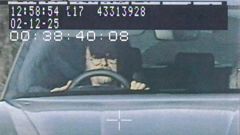
Former Top Gear and The Grand Tour host Richard Hammond was recently convicted at Telford Magistrates’ Court for speeding offences committed in a Porsche and a Bentley across Herefordshire, resulting in a £999 fine, seven penalty points, and a total financial penalty of £1,771 including costs and surcharges. But the real story is not about a TV presenter driving too fast. It is about how wealth shields public figures from accountability while exposing the farcical administrative burdens placed on modern police forces.
The Anatomy of a High-Speed Paper Chase
Let us look at the timeline. On December 2 of last year, a West Mercia Police officer clocked Hammond driving his Porsche Taycan Cross Turismo at 68 mph in a 50 mph zone on the A40 in Pencraig. Twenty days later, on December 22, his Bentley Continental GT was logged doing 82 mph in a 70 mph zone on the A50 Rudhall Overbridge.
Standard procedure for ordinary motorists involves a straightforward Notice of Intended Prosecution arriving in the mail within a fortnight. For Hammond, the process spiraled into a bureaucratic ghost hunt. West Mercia Police spent weeks mailing notices to a rotating portfolio of multi-million-pound properties. Letters bounced back marked "addressee gone away" from a Grade II-listed Herefordshire castle and a rural farm estate. Officers were forced to track him down to a £2 million Welsh mansion where more than 30 vehicles are registered.
Police initially added failure-to-respond charges to the docket. Those charges vanished after Hammond's solicitor produced a letter claiming the presenter posted the response himself via First Class mail. The contrast is stark. A delivery driver missing a single postal notice faces immediate escalation and potential court summons for failure to furnish details. A celebrity with a sprawling real estate empire benefits from institutional confusion until law enforcement runs out the clock on administrative patience.
The Economics of Impunity
The financial penalty handed down by Magistrate Ann Minton paints a vivid picture of deterrence failure. Hammond received two separate fines of £333 and £666, alongside £240 in costs and a £532 victim surcharge, totaling £1,771.
To a man who built a multi-million-pound career sliding supercars sideways across global television screens, £1,771 is a rounding error. It costs less than a single set of replacement tires for a Bentley Continental GT. Fixed fines act as a minor administrative tax for the affluent rather than a genuine deterrent. When motoring penalties do not scale dynamically with net worth, speed limits become optional rules reserved for those who watch their bank balances.
Critics argue for income-proportional fines utilized in Nordic nations, where traffic infractions sting billionaires just as sharply as they hurt minimum-wage workers. In the current British framework, wealthy petrolheads view speeding tickets as a subscription fee for the privilege of driving fast.
The Irony of the Hamster’s Heavy Foot
The psychological profile of Hammond behind the wheel has always been a subject of public fascination. Decades ago, the presenter nearly lost his life during a 320 mph jet-dragster crash for a television stunt, an accident that resulted in severe brain trauma. Years later, he and former co-host Jeremy Clarkson suffered temporary driving bans in France after police caught them driving at excessive speeds during television production.
One might assume that cheating death at jet-propelled speeds leaves a permanent mark on a driver's risk calculus. Yet the data suggests otherwise. High-performance machinery is engineered to isolate drivers from the sensation of velocity. A modern Bentley Continental GT glides at 82 mph with the effortless acoustic isolation of a luxury boardroom. The physical feedback that warned motorists of danger in older vehicles has been scrubbed away by computer-controlled suspension, sound-damped cabins, and effortless horsepower.
Hammond is not an isolated bad actor. He is the symptom of an automotive ecosystem that builds high-end GT cars capable of triple-digit speeds while public infrastructure remains choked by antiquated limits and underfunded policing.
The Broken System
What remains deeply unsettling about the Telford magistrates' session is how ordinary the entire spectacle was. Hammond was just one of 39 defendants convicted of driving infractions during that specific court docket. Automated speed enforcement handles the heavy lifting, snapping pictures of rear license plates while real-world enforcement units waste weeks playing hide-and-seek with multi-home property owners.
When police forces must expend precious investigative hours tracking down television personalities across feudal real estate holdings just to deliver a speeding ticket, the system is misallocating resources. Road safety policy in the United Kingdom relies heavily on voluntary compliance and the fear of detection. When detection yields a four-figure bill that can be paid from a glove compartment stash, the deterrent value evaporates into exhaust fumes.
The cameras caught the cars. The courts processed the paperwork. The fines were paid. Nothing changes, the horsepower keeps climbing, and the open road remains a playground for those who can afford the toll