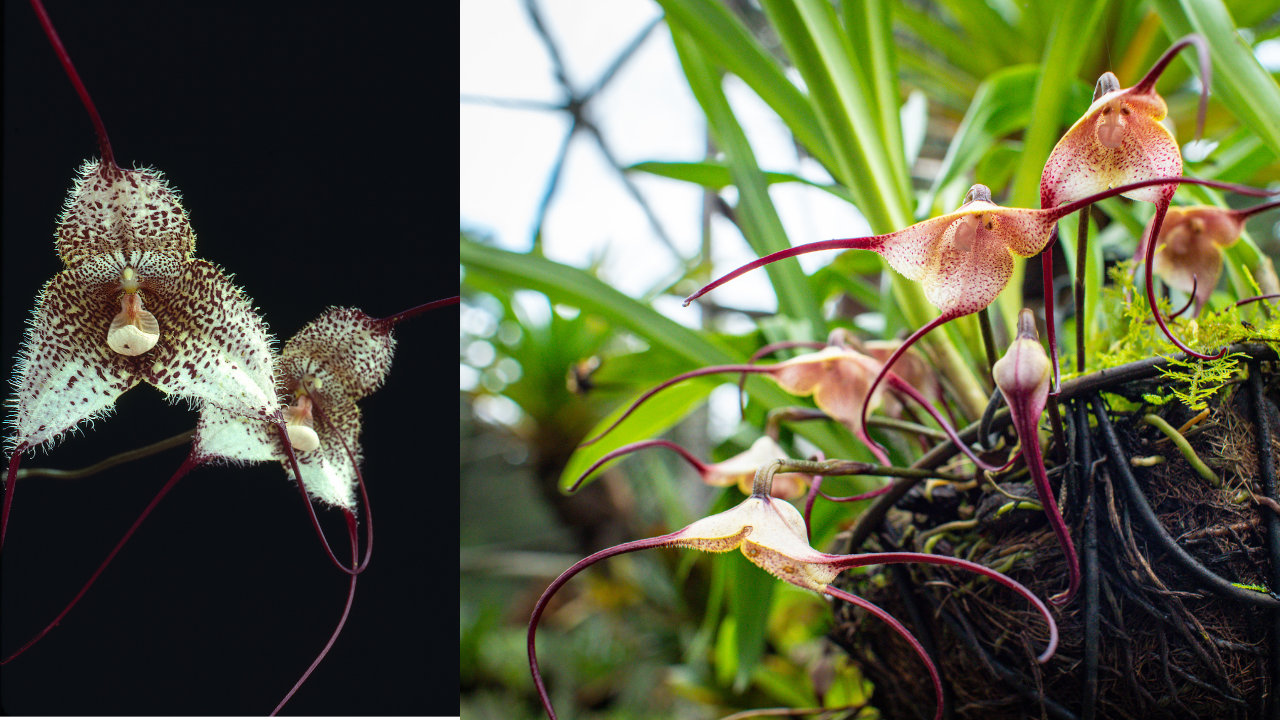
In an unassuming climate-controlled glasshouse in Cheshire, England, a collection of dark, brooding flowers has just earned National Plant Collection status from Plant Heritage. These are Dracula orchids, a genus of cloud-forest epiphytes famous for blood-red petals, long whisker-like tails, and an uncanny resemblance to bats, monkeys, and Victorian vampires. The recognition of Chester Zoo’s living archive is far more than a horticultural trophy. It is an urgent, high-stakes genetic lifeboat for a group of hyper-specialized plants disappearing from the cloud forests of Central and South America faster than botanists can catalog them.
Mainstream coverage of this designation loves the novelty hook. Reporters lean heavily on the Halloween aesthetics—the "little dragon" etymology of the genus name Dracula, the spooky monkey-faced blooms of Dracula simia, the gothic allure of near-black petals. That surface-level fascination misses the real story. Beneath the theatrical taxonomy lies a brutal ecological reality: these plants are evolutionary prisoners of extreme microclimates, and the very traits that make them famous are the exact mechanisms driving them toward extinction.
The Evolutionary Trap of Cloud Forest Specialization
To understand why Chester Zoo’s collection matters, you have to look at how a Dracula orchid survives in the wild. Unlike hardy garden perennials that tolerate swings in temperature and moisture, members of the genus Dracula are native almost exclusively to the high-altitude cloud forests of Ecuador, Colombia, Peru, and Central America. They grow perched on moss-covered tree trunks at elevations between 1,500 and 2,500 meters, bathed in near-constant mist and cool, moving air.
They do not have pseudobulbs—the thick, water-storing stems that allow many other tropical orchids to survive dry spells. Without that internal reservoir, a Dracula orchid cannot endure drought or prolonged heat. Even a few days of warm, stagnant air can trigger cellular collapse and fungal rot.
This physiological fragility is paired with one of the most bizarre pollination strategies in the plant kingdom. Most orchids use bright colors and sweet nectar to bribe bees or butterflies. Dracula orchids went in the opposite direction. Many species evolved a specialized lip, or labellum, that mimics the gills of a forest mushroom, both in textured appearance and chemical scent. They emit volatile compounds—specifically short-chain alcohols and ketones like 1-octen-3-ol—that smell precisely like fresh fungi. Tiny fungus gnats (Zygothrica species) land on the flower expecting a place to lay their eggs, brush against the reproductive column, pick up pollen packets, and fly off to repeat the mistake on the next bloom.
It is an astonishing piece of evolutionary engineering. It is also a death sentence when the surrounding forest changes.
If logging or agriculture clears even a partial canopy in the Andes, the local humidity drops and daytime temperatures climb. The moss dries out. The wild mushrooms disappear, taking the fungus gnats with them. Even if a mature Dracula orchid clings to a remaining tree, its reproductive cycle breaks down immediately. No gnats means no seed pods. The plant becomes a living dead end.
What National Plant Collection Status Actually Changes
When Plant Heritage—the UK’s leading cultivated plant conservation charity—grants National Plant Collection status, it is not handing out a decorative plaque. The designation places a rigorous, legally and professionally audited mandate on the holding institution.
For Chester Zoo, which maintains over 60 species and distinct varieties of Dracula—representing roughly half of the entire known genus—this status requires meticulous documentation, strict biosecurity, and long-term succession planning. Every specimen must be accurately verified down to its taxonomic lineage and geographic provenance where known. If a keeper retires or funding shifts, the collection cannot simply be broken up or neglected; the institution is bound to maintain the genetic integrity of the archive.
Why does a zoo in northwest England hold one of the most significant collections of Andean cloud-forest orchids on the planet? The answer lies in the mechanics of modern conservation.
For decades, botanical conservation relied heavily on seed banks—freezing seeds in sub-zero vaults for future reintroduction. That model fails miserably with orchids. Orchid seeds are microscopic, dust-like specks that lack an endosperm, the nutrient-rich tissue that feeds a germinating embryo in almost all other flowering plants. In the wild, an orchid seed can only germinate if it is infected by a specific mycorrhizal fungus that supplies the embryo with sugars and nutrients until it grows leaves.
Because orchid seeds are notoriously difficult to store long-term without losing viability—and because their fungal partners are equally finicky—living collections are indispensable. You cannot simply freeze a Dracula orchid and thaw it out in fifty years. You have to keep it alive, cool, misted, and breathing every single day.
Inside the Glasshouse Engineering
Keeping dozens of high-altitude Andean species alive at sea level in Cheshire requires fighting the local climate twelve months a year. If you walk into a standard tropical conservatory, you are hit with heavy, stifling heat. Walk into Chester Zoo’s Dracula facility, and the air feels brisk, damp, and constantly moving.
Horticulturists there have to replicate an ecosystem that naturally exists several thousand feet above sea level. That means running industrial chilling units during British summers to keep daytime temperatures below 20°C (68°F) and dropping them down toward 10°C (50°F) at night. High-pressure fogging systems inject ultra-fine water droplets into the air to maintain relative humidity above 80 percent, while banks of oscillating fans ensure the air never sits still. Without constant airflow, high humidity quickly breeds Botrytis and bacterial soft rot, which can wipe out a rare specimen in forty-eight hours.
Water quality is another silent killer. Because Dracula orchids grow as epiphytes clinging to bark, their roots are exposed directly to rainwater and mist. Tap water, loaded with dissolved calcium, magnesium, and chlorine, rapidly burns their delicate root tips and alters the pH of the potting medium. Collections like Chester’s rely entirely on reverse-osmosis or collected rainwater, supplemented with trace amounts of specialized fertilizer measured in parts per million.
Most species in the collection cannot even be grown in standard plastic pots. Many Dracula orchids produce downward-growing flower spikes—a trait known as geotropism. In the wild, the bloom pushes straight down through the mossy mat beneath the plant so it hangs open beneath the branch, sheltered from heavy rain and perfectly positioned for low-flying fungus gnats. Put one in a solid pot, and the flower spike hits the bottom, curls into a knot, and rots. Growers have to mount them on slabs of cork bark or plant them in open wire baskets lined with live sphagnum moss so the blooms can emerge out the bottom.
The Dark Side of the Orchid Trade
The romantic narrative around rare botanical collections often glosses over an uncomfortable truth: the global horticultural market is both a primary threat to these species and, paradoxically, one of the few ways they survive outside the wild.
The Convention on International Trade in Endangered Species (CITES) lists every single orchid species on earth under Appendix I or Appendix II, heavily restricting cross-border movement. In theory, this stops poachers from stripping cloud forests bare to supply collectors in Europe, North America, and Asia. In practice, enforcement in remote Andean valleys is nearly nonexistent.
Whenever a botanist describes a striking new species of Dracula—especially one with dramatic markings or a pronounced "face" like Dracula gigas or Dracula vampira—demand spikes among hardcore hobbyists within weeks. Poachers strip wild populations from accessible forest edges, stuffing hundreds of plants into sacks for smuggling. Because wild-collected plants are already stressed and stripped of their native microclimate, mortality rates in transit routinely exceed 70 percent.
Here is where accredited collections like Chester Zoo’s play a quiet, subversive role in disrupting the illegal market.
By maintaining verified, legal parent stock, conservation institutions can propagate rare species artificially in sterile laboratories through asymbiotic seed germination. Technicians sow microscopic seeds onto nutrient-rich agar jelly in glass flasks, bypassing the need for wild fungi entirely. A single seed pod can yield thousands of genetically distinct seedlings. When legally propagated plants enter the botanical network—and eventually the specialist trade—they crash the black-market price of wild-collected specimens. Why pay a smuggler hundreds of dollars for a diseased, wild-ripped plant when a healthy, flask-grown seedling is legally available?
Yet that strategy has strict limits. Asymbiotic propagation produces plants without their native mycorrhizal fungi, and many species raised in sterile flasks struggle to adapt if they are ever returned to wild forest conditions. Furthermore, tissue culture—cloning a single prized specimen—creates thousands of genetically identical copies. If a collection relies too heavily on cloning, it creates a genetic monoculture that lacks the resilience to survive new diseases or shifting climates.
The Limits of Ex-Situ Conservation
It is tempting to look at a prestigious National Plant Collection and assume the species inside are safe. That would be a dangerous miscalculation.
Botanists call living zoo and garden archives ex-situ conservation—preserving a species outside its natural habitat. It is an emergency brake, not a permanent solution. Keep any wild plant in cultivation for ten or twenty generations, and unintentional artificial selection begins to warp its genetics. Plants that tolerate slightly warmer greenhouse temperatures or standard potting bark survive and get propagated; plants that require exact wild conditions die off. Over time, the captive population becomes domesticated, subtly losing the wild traits it would need to survive back in the Andes.
Worse, an ex-situ collection cannot preserve the web of relationships that defines a cloud forest. Chester Zoo can keep Dracula chestertonii alive and blooming in Cheshire, complete with its warty, mushroom-scented lip. It cannot house the specific South American fungus gnat that pollinates it, the cloud-forest trees that anchor it, or the fungal networks woven through the canopy bark.
And then there is the sheer vulnerability of centralized collections. A single catastrophic chiller failure during a summer heatwave, an undetected viral outbreak like Cymbidium mosaic virus, or a sudden institutional budget cut can erase decades of meticulous horticultural work in a matter of days. That is precisely why Plant Heritage pushes collection holders to distribute backup propagations to partner gardens across the country—creating a decentralized safety net rather than putting every rare specimen under one roof.
What Happens Next on the Cloud Forest Floor
Back in Ecuador and Colombia, the timeline for wild Dracula orchids is compressing rapidly. Deforestation for cattle pasture, illegal gold mining, and expanding road networks continues to fragment the narrow elevation bands where these plants live. Climate models tracking the tropical Andes show that cloud-base altitudes are steadily rising as global temperatures climb.
For a mobile animal, rising temperatures mean migrating uphill. For an epiphyte glued to a moss-covered tree trunk, migration takes generations—and at the top of an Andean ridge, there is eventually nowhere higher to go. Plants caught below the rising cloud line slowly dehydrate; those pushed toward the summits run out of mountain.
In the face of that trajectory, grassroots conservation groups in South America—such as Fundación EcoMinga in Ecuador—are racing to buy up private cloud-forest reserves specifically to protect micro-endemic orchids that exist on single mountain ridges. Meanwhile, institutions like Chester Zoo are shifting their role from passive display gardens to active genetic repositories and technical training hubs, sharing propagation protocols and taxonomic data with researchers working on the ground in Latin America.
The public will always show up to stare at a flower that looks like a miniature bat or a howling monkey. That curiosity gets people through the glasshouse doors. What keeps these plants from vanishing entirely is far less theatrical—a relentless, daily battle against heat, stale air, and disappearing forests, fought one chilled misting cycle at a time.