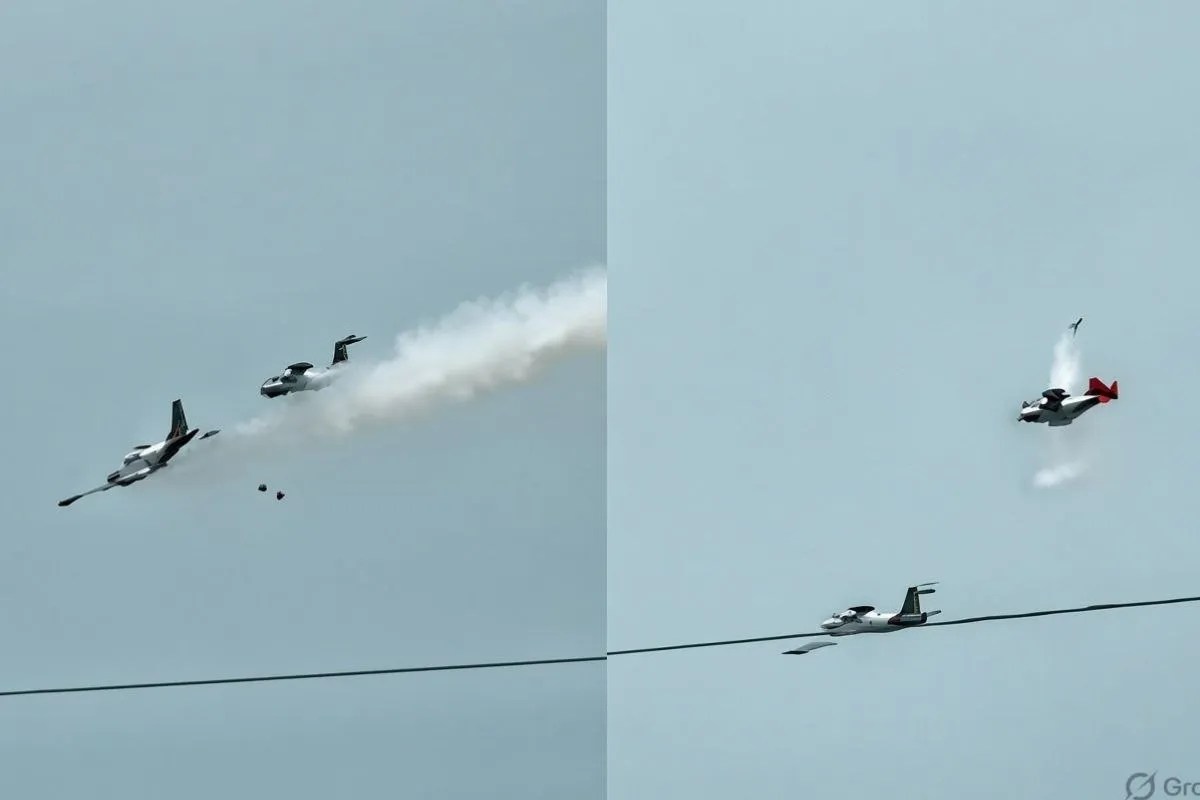
Reports of a Philippine Air Force incident involving two training jets crashing and four pilots losing their lives point to a recurring fault line in military aviation. When two aircraft go down during a training evolution, the immediate public reflex is to blame pilot error or sudden mechanical failure. Years covering defense procurement, flight safety boards, and air force modernization across Southeast Asia tell a far grimmer story. Training crashes rarely stem from a single broken bolt or a momentary lapse in judgment. They are usually the final receipt on a long tab of stretched airframes, compressed flight syllabi, underfunded simulator hours, and regional geopolitics pushing forces to fly faster than their logistics tails can support.
The Anatomy of a Dual-Jet Training Loss
Two jets going down on the same training cycle is not a statistical coin flip. In military flight operations, training missions are tightly choreographed to strip out variables before they become lethal. Instructors brief routes, weather minimums, fuel reserves, and emergency recovery fields long before a canopy is lowered. When two aircraft fail or collide or go off-profile during training, investigators look first at systemic friction rather than isolated bad luck.
Consider a hypothetical example involving a two-ship formation exercise over coastal terrain. Suppose Flight Lead and Wingman are practicing basic fighter maneuvers or low-level navigation under a tight sortie quota. If a hidden maintenance snag forces a last-minute aircraft swap, or if afternoon convective clouds build faster than forecast over mountainous coastlines, small margins evaporate quickly. In tight formation or high-workload intercepts, a split-second misread of closure rate or spatial orientation leaves almost no altitude to recover.
When a small air force loses two training jets and four aviators in a single training evolution, the shock is measured not just in hull losses and grief, but in the sudden evaporation of instructor capacity and institutional memory.
Four fatalities in a training crash hit a military service in a way combat losses do not. Combat carries an accepted baseline of risk tied to an active threat. Training is supposed to be the controlled crucible that prepares crews for that threat. Losing four pilots—whether two instructors and two students, or crews across two jets—removes months or years of instructional bandwidth from the squadron line.
Why Small Air Forces Fly on Thin Margins
Every air arm in the Indo-Pacific faces a version of the same equation. Budgets are finite, threats are growing, and modern sensors and weapons cost more every procurement cycle. For the Philippine Air Force, the pressure is magnified by geography and fleet history. An archipelago spanning more than seven thousand islands demands long overwater transits, unpredictable tropical weather, and dispersed basing. Yet for decades, fighter and supersonic capability was thin or absent, leaving a legacy gap in high-speed jet operations and institutional maintainer depth.
Modernizing a force under fiscal constraints creates a structural squeeze. Buying aircraft is the headline event that politicians celebrate at ceremonies. Funding the flight-hour budget, spare parts pipelines, ground support equipment, and high-fidelity flight simulators is the quiet grind that actually keeps people alive.
A jet on the ramp does not stay airworthy by sitting still. Elastomers dry out, hydraulic seals weep, avionics buses throw intermittent faults, and corrosion thrives in tropical salt air. When spare parts arrive late or maintenance crews are rotated across too many airframes, technicians spend their shifts chasing recurring faults instead of building deep predictive familiarity with each tail number.
The Pressure to Build Hours Fast
Political pressure and strategic urgency often collide with the pace of safe skill acquisition. When a defense establishment wants to demonstrate readiness—whether to deter gray-zone intrusions in contested waters or to integrate newly acquired platforms—flight hours become a scorecard.
More hours in the air can mean sharper crews. It can also mean fatigue. Pilots fly complex briefings, pre-flight checks, high-G or high-attention sorties, and post-flight debriefs under relentless schedules. If instructors are stretched thin, a student pilot or a newly transitioning aviator may advance through syllabus gates on paper while still carrying unexamined weaknesses in task saturation or emergency procedures.
Simulation is supposed to absorb the riskiest repetitions. Engine flameouts, hydraulic failures, spatial disorientation, and mid-air conflict avoidance can be drilled dozens of times in a full-motion simulator with zero risk to life or hardware. Yet many air forces still struggle with simulator availability, fidelity, or integration into daily squadron habits. When simulators are scarce or down for maintenance, high-risk drills migrate into real airspace over real terrain.
Weather, Geography, and the unforgiving Cockpit
Tropical flying looks deceptively routine on a clear morning. By mid-afternoon, coastal sea breezes, mountain ridges, and rapid vertical cloud development can turn a textbook training sector into a trap.
In training jets, workload spikes fast. Managing navigation, radios, fuel state, airspace boundaries, and aircraft handling simultaneously leaves a narrow cognitive buffer. Add a sudden weather shift or an unexpected warning light, and task saturation sets in. Experienced pilots train specifically to recognize when the jet is getting ahead of them—to knock it off, climb clear of terrain, declare an emergency early, and trade mission pride for survival.
Still, doctrine on paper is harder to execute at low level or during dynamic maneuvering. Ejection envelopes have limits. Airspeed, sink rate, pitch attitude, and altitude above ground all dictate whether a crew can punch out cleanly or whether the margin has already run out. Even when a crew initiates ejection, survival depends on conditions at that exact fraction of a second.
What Investigators Actually Look For
When a board of inquiry convenes after a crash involving training jets, the public usually waits for a neat cause. A cracked turbine blade. A bird strike. Pilot disorientation. Real accident boards know that neat answers are often incomplete answers.
Investigators reconstruct the timeline from every available fragment. They examine maintenance logs going back weeks or months to see if the same write-up kept reappearing and getting cleared with a reset. They review air traffic control tapes, radar tracks, telemetry or flight data if equipped, and weather observations at nearby stations. They look at crew rest records, recent sortie tempo, and whether the mission profile matched the crews' currency and recent experience.
Crucially, serious safety investigators examine organizational normalization. If pilots routinely fly with minor deferred faults, or if briefing times get squeezed to meet takeoff slots, those shortcuts slowly become the new normal. Nothing bad happens on dozens of flights—until the day conditions align against the crew and there is no buffer left.
Accountability Without scapegoating
A major tension in military aviation after a fatal crash is balancing accountability with candor. If investigations become witch hunts aimed at blaming junior pilots or ground mechanics to protect command reputations, crews stop speaking candidly about near-misses and system flaws.
Effective flight safety depends on protected reporting and brutal honesty from the top down. Command has to ask hard questions about its own scheduling, spares allocation, and training standards. Did we ask too much of these crews given the support available? Were weather minimums conservative enough for the profile being flown? Were maintenance shifts staffed to handle the sortie rate?
The Counter-Argument on Modernization and Risk
Not everyone views training accidents through a lens of systemic neglect. A counter-argument from defense planners is that aviation is inherently hazardous and that zero-risk training is an illusion. To build credible deterrence and combat readiness, air forces must practice realistic profiles—formation work, tactical maneuvering, low-level transit, and demanding intercepts—rather than flying gentle sightseeing hops in benign weather.
There is real weight to that point. Overly sanitized training produces pilots who freeze when real-world friction hits. Every modern air force accepts some baseline of operational risk as the price of maintaining a credible deterrent.
Where that argument breaks down is when acceptable risk slides into unacknowledged fragility. Flying demanding profiles with well-maintained jets, ample spares, thorough simulation, and rested crews is calculated risk. Flying demanding profiles while parts backlogs linger, instructor benches are thin, and schedules run hot is gambling with lives.
The Cost Beyond the Crash Site
A crash involving two military aircraft ripples far beyond the impact zone. Families absorb a loss that no ceremonial medal or statement can mend. Squadrons lose brothers-in-arms and mentors whose voices usually steady the room during tense briefings.
Operationally, grounding a fleet or pausing training sorties slows pilot production at the exact moment forces need qualified aviators most. Each pilot who does not graduate on schedule creates a downstream hole in operational squadrons years later. Replacement aircraft cost tens of millions of dollars—money that has to come out of future acquisitions, upgrades, or sustainment.
For defense leadership in Manila and across regional capitals, the lesson of a dual-jet training tragedy is sobering. Buying newer hardware does not automatically buy safety or readiness. Readiness is built day by day in maintenance hangars, flight simulators, debrief rooms, and disciplined command decisions that value margin over speed.
Audit the real ratio of flying hours to maintenance hours, simulator hours, and instructor bandwidth before the next training wave launches.