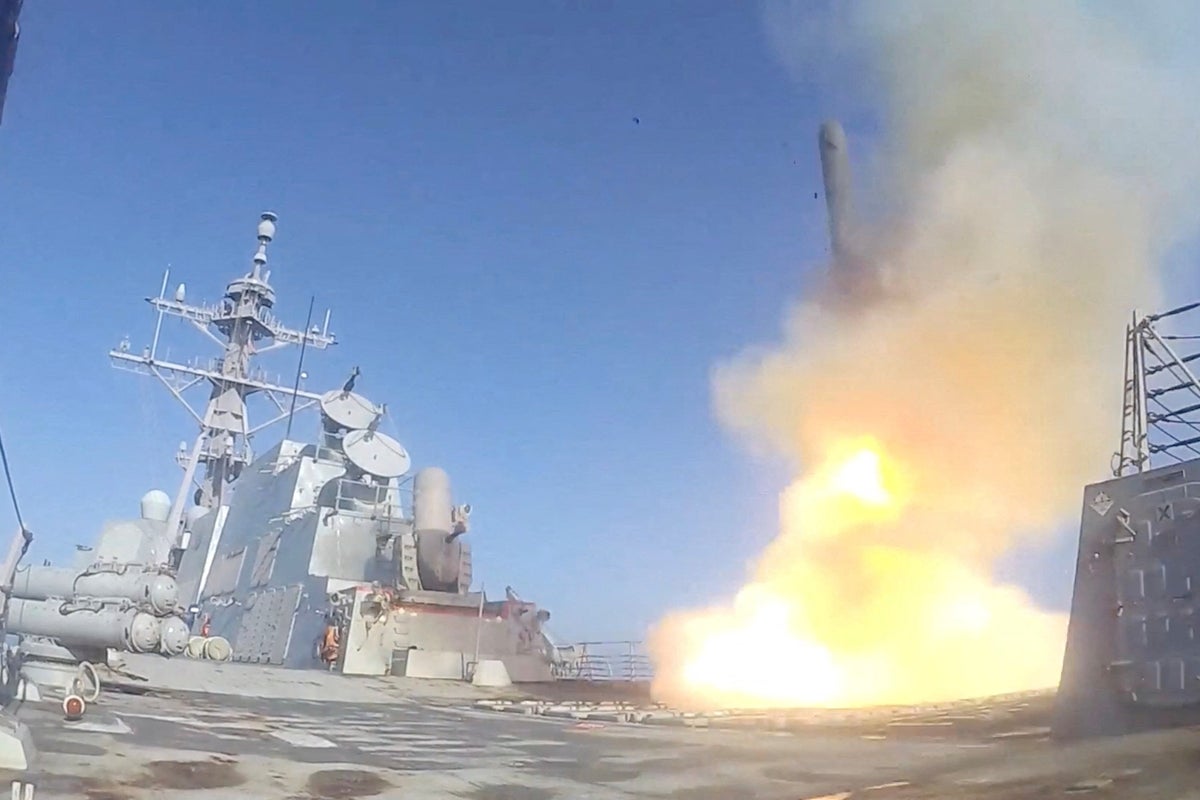
President Donald Trump recently took to social media to insist that the United States possesses "virtually unlimited amounts" of mid-to-high-grade ammunition, aggressively dismissing media reports detailing a depleted military inventory amid the ongoing conflict with Iran. Yet behind the political posturing lies a far more fragile industrial reality. Decades of optimized, lean manufacturing principles have left the American defense apparatus ill-equipped for sustained high-intensity combat against peer adversaries.
The Physics of Attrition
Modern high-precision warfare burns through capital assets at a staggering velocity. When surface-to-surface tactical missiles or advanced air defense interceptors cost upwards of a million dollars per unit and take months to assemble, inventory mathematics become unforgiving.
Consider a hypothetical scenario involving a regional conflict in the Middle East or the Pacific. A single battery of interceptors can exhaust its ready-to-fire magazine within hours of an aggressive saturation strike.
The defense industrial base operates on peacetime efficiency models. Factories are built to fulfill modest, predictable annual procurement contracts for the Department of Defense, not to sustain a multi-theater war of attrition. When Washington transfers massive blocks of ordnance to overseas partners—such as the extensive shipments previously directed to Ukraine—the baseline cushion evaporates.
The Manufacturing Bottleneck
The structural flaw in America's military readiness is not a lack of funding. It is the acute absence of surge capacity.
- Specialized solid rocket motors are produced by only a tiny handful of domestic contractors.
- Rare earth elements and critical chemical precursors depend heavily on extended, fragile global supply chains.
- Skilled engineering and machining labor pools cannot be expanded overnight by executive order.
When political leadership claims that production is running at historic highs, it describes a system operating at maximum efficiency under current peacetime constraints. Maximum efficiency, however, is entirely distinct from infinite scalability.
Strategic Risk in the Pacific
The drawdown of long-range precision munitions carries profound implications for global deterrence. Military planners have long warned that a major conflict in the Indo-Pacific would consume high-end cruise missiles and anti-ship systems within the opening week of hostilities.
If current operations in the Middle East continue to siphon off these finite reserves faster than domestic assembly lines can replace them, the margin for error narrows dangerously. Public declarations of absolute abundance offer immediate political reassurance, but they obscure the stark ledger of logistics. The capability of a superpower is ultimately measured by its factory floors, and those floors are running flat out just to stay even.
Trump says US has 'virtual unlimited' missile supply amid reported shortages
This short video clip highlights President Trump's public statements regarding ammunition reserves alongside the contrasting warnings issued by military analysts regarding ongoing stockpile pressures.