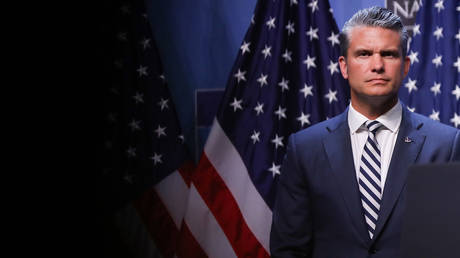
US Army Secretary Dan Driscoll has submitted his resignation to President Donald Trump following months of escalating friction with Defense Secretary Pete Hegseth, marking a profound leadership fracture at the top of the nation's largest military branch. Driscoll, who took office in February 2025, walked away from the post after a direct clash over military transformation, personnel purges, and the strategic direction of the armed forces. His exit lays bare an institutional civil war inside the Pentagon, pitting traditional corporate-style modernization strategies against an aggressive overhaul of the military's top brass.
The immediate casualty of this infighting is stability. With Driscoll's departure and the earlier removal of Army Chief of Staff General Randy George, the service is temporarily missing its top two Senate-confirmed leaders.
The Anatomy of a Breakdown
Friction between political appointees in Washington rarely stays hidden for long. In this case, the fault lines ran deep between Hegseth's vision of a rigid, loyalty-driven warrior culture and Driscoll's background as an Iraq War veteran, venture capitalist, and close confidant of Vice President JD Vance.
Driscoll arrived at the Pentagon with a mandate to shake up traditional procurement. He championed low-cost interceptors and venture-capital-inspired acquisition models like the FUZE program, designed to bypass slow-moving defense primes and rapidly field cheap drone technology. These efforts were meant to mirror lessons learned from modern conflicts abroad. Yet, they repeatedly ran into roadblocks erected by the Office of the Secretary of Defense.
Behind closed doors, the tension intensified when Hegseth began cleaning house. The Defense Secretary ousted roughly two dozen generals and admirals across the armed services, including nine senior Army officers. Among them was General George, whom Driscoll viewed as an essential partner in driving the Army Transformation Initiative. Driscoll made little secret of his frustration, openly telling lawmakers that he adored the general. When Hegseth blocked promotions and sidelined officers responsible for modernization, Driscoll argued that the institutional knowledge of the force was being hollowed out.
Clash of Philosophies on Procurement
The disagreement went far beyond personality clashes. It exposed a fundamental contradiction in how the current administration attempts to reform the military industrial complex.
On one side stood a push for Silicon Valley agility. Driscoll wanted to dismantle legacy systems where multi-million-dollar missiles are expended to shoot down cheap commercial drones. He argued that if legacy defense primes could not adapt to a high-tempo, low-cost paradigm, their decline would be a welcome success.
On the other side stood a traditionalist command structure prioritizing absolute deference and a top-down chain of command. Observers close to the building noted that Hegseth expected a degree of personal alignment that Driscoll, backed by his independent political anchor to the Vice President, was unwilling to offer. The friction multiplied when Driscoll took on diplomatic assignments outside the traditional purview of an Army Secretary, including playing a high-profile role in brokering negotiations between Russia and Ukraine. That international footprint, combined with his domestic reform agenda, made him a lightning rod.
The Vacuum at the Top
The departure of a service secretary leaves institutional scars that take years to heal. The Army is currently navigating complex global commitments, including active operations in the Middle East, while its administrative machinery is steered by temporary leadership. General Christopher LaNeve, who served as a senior aide to Hegseth, has stepped in as acting vice chief, but the absence of a confirmed secretary and chief of staff creates an environment of hesitation. Mid-level commanders are left wondering which administrative directives will survive the week and which reform initiatives will be labeled insubordination.
History shows that when civilian leadership at the Pentagon fractures into rival camps, long-term programs stall. Budget execution slows down. Procurement officers freeze up, terrified of backing a program that aligns with an ousted official rather than the current incumbent.
The White House attempted to smooth over the exit with public praise, highlighting Driscoll's focus on readiness and lethality. But the manner of his departure sends an unmistakable signal to the rest of the defense apparatus. Dissent from within the civilian leadership tier will not be accommodated, and the path of least resistance is absolute compliance.
The machinery of the Department of Defense rolls forward, grinding through personnel and policy alike, leaving a transformed command climate where loyalty supersedes institutional innovation.