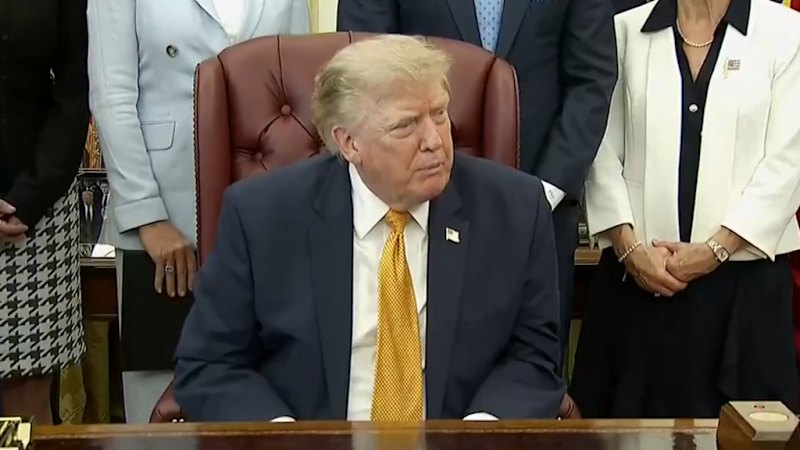
When Donald Trump turned his sharp gaze toward a reporter inside the Oval Office and commanded them to never talk again, the media ecosystem instantly reduced the moment to another viral confrontation. Yet beneath the theater of flashing cameras and shouting questions lies a far more structural symptom of how modern executive power handles accountability. The clash was not merely an isolated outburst. It served as a calculated deflection away from a crumbling narrative regarding the botched multi-million-dollar renovation of the Lincoln Memorial reflecting pool and the sudden collapse of criminal vandalism charges against former Olympic athletes.
Veteran correspondents know that the West Wing press pool operates under a tense, unwritten contract. Access is granted, but obedience is expected. When reality punctures a political narrative—such as government documents proving that a pool liner failed due to sloppy contractor installation rather than malicious civilian sabotage—the immediate response from the executive branch is often hostility toward the messenger.
The Anatomy of Executive Retaliation
Decades of covering Washington have taught me that public reprimands in the Roosevelt Room or the Oval Office are rarely spontaneous. They function as pressure valves. When an administration faces an embarrassing legal retreat, such as U.S. Attorney Jeanine Pirro dropping charges because internal department disclosures left prosecutors empty-handed, the tension inside the executive circle spikes.
President Trump chose to externalize that frustration by attacking the press corps. By labeling straightforward inquiries about personnel changes as fake news, the administration accomplishes two distinct goals simultaneously.
- It shuts down lines of questioning that expose internal administrative fractures.
- It reinforces a loyalist base narrative that mainstream journalists are active combatants rather than objective observers.
The reporter asking about the stability of appointed officials was doing baseline investigative work. The dismissal of that query with a flat prohibition against speaking demonstrates a growing intolerance for institutional oversight.
Beyond the Viral Soundbite
Public audiences often consume these exchanges as entertainment. Short video clips circulate across social media platforms within minutes, generating millions of views and polarized commentary. But this superficial engagement obscures the mechanics of accountability.
When a president tells a credentialed journalist to stay silent, the symbolic weight carries real consequences for how information flows out of the executive branch. Official transparency shrinks into controlled monologues. Briefings transform from fact-finding opportunities into rallies.
Consider the sequence of events leading up to the Oval Office confrontation. Over the span of a weekend, an ambitious public narrative blaming vandals for structural peeling inside a public monument evaporated under judicial review and internal document releases. Prosecutors realized they had no case because the physical evidence pointed squarely at flawed workmanship. Rather than acknowledging a faulty oversight process, the executive response targeted the judiciary, the prosecutors who caved, and the reporters daring to ask about the fallout.
The Long-Term Cost to Institutional Trust
This routine erosion of standard press interactions leaves lasting damage on democratic institutions. Journalism thrives on verifiable facts, timelines, and accountability checks. When the highest office in the country treats basic inquiries as hostile acts, the barrier between the governed and the government grows opaque.
We are witnessing the normalization of executive impunity. Every time an uncomfortable question is met with an order for silence, the public loses a small piece of its right to transparent governance. The theater of the Oval Office will continue to produce dramatic clashes, but the real story remains the systematic dismantling of the questions we are allowed to ask.
Watch Times Now Live White House Coverage to observe how modern presidential press interactions and signing ceremonies are broadcast and managed in real-time.