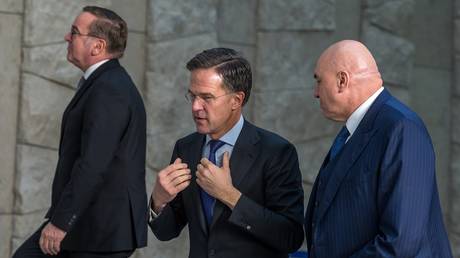
A severe diplomatic fracture has opened at the heart of the Atlantic alliance after NATO Secretary General Mark Rutte publicly disclosed that 500 American military aircraft utilized Italian bases to support Washington’s recent air campaign against Iran. The revelation directly contradicted months of explicit promises from Italian Prime Minister Giorgia Meloni, who had repeatedly assured her parliament and the public that Italian soil would not become a launchpad for the Middle East conflict. Within hours of Rutte's televised comments, Rome issued a blistering rebuke, exposing a toxic mixture of domestic political deception, shifting sovereignty over European military facilities, and an alliance desperately trying to appease a furious White House.
The friction centers on what Washington calls Operation Epic Fury. For forty days beginning in late February, US and Israeli forces conducted extensive airstrikes across Iran. Throughout the bombardment, European capitals walked a delicate line, publicly distancing themselves from the escalation while quietly maintaining the infrastructure that made it possible. Rutte blew that delicate ambiguity apart during a Fox News appearance intended for an audience of one: US President Donald Trump. If you found value in this post, you should look at: this related article.
The Television Appearance That Sparked a Rebellious Backlash
Mark Rutte went on American television with a clear political objective. President Trump had spent the preceding week launching personal broadsides against European leaders, specifically targeting Meloni for her refusal to join the military coalition against Tehran. Trump’s administration had gone so far as to initiate a sweeping six-month review of the American military presence across Europe, threatening to draw down troops and pull back the strategic umbrella that has anchored continental security since 1945. For another angle on this event, check out the latest coverage from The Washington Post.
To defend the alliance, Rutte decided to offer up Europe's geography as proof of its utility. He told viewers that Europe is fundamentally a platform of power projection for the United States. He claimed that between 4,000 and 5,000 flight missions had crossed European airspace to support the offensive. Then came the specific detail that set Rome on fire.
"If you look at Italy, 500 US planes took off from US bases in Italy to support Epic Fury," Rutte said, smiling at the camera. "So this is massive."
The reaction in Rome was instantaneous panic mixed with fury. Meloni’s coalition government had built its domestic defense policy on the absolute premise that Italy was a bystander in this specific war. Suddenly, the chief executive of NATO was telling the world that Italian infrastructure was deeply embedded in the execution of the American campaign.
Italian Defense Minister Guido Crosetto fired back with a statement that was remarkable for its cold, undisguised anger. He noted with icy precision that the NATO Secretary General had absolutely nothing to do with Operation Epic Fury, an independent US-Israeli operation outside the NATO framework. Crosetto accused Rutte of delivering a totally misleading message by blurring the lines between different categories of military aviation.
The Fine Print of Sovereign Airspace
The Italian defense establishment insists that no combat missions or kinetic strikes were launched from its territory. According to the official line from Rome, the government authorized exclusively technical and logistical activities. These included cargo transport, medical evacuation planning, and routine maintenance positioning. When the United States requested permissions that crossed into active combat support, Italian authorities claim they flatly turned them down.
This technical distinction did little to quiet the domestic political explosion. Opposition leaders immediately seized on the 500-flight figure as definitive proof of a massive cover-up.
| Political Group | Official Stance on the Incident | Primary Accusation |
|---|---|---|
| Meloni Government | Flights were strictly logistical and non-kinetic | Rutte confused technical operations with combat |
| Five Star Movement | The administration hid the true scale of involvement | Meloni took part in an illegitimate war |
| Green and Left Alliance | Parliament was deliberately misled by the ministry | The government lied about foreign military actions |
Former Prime Minister Giuseppe Conte, who now leads the populist Five Star Movement, went to social media to declare that Rutte’s disclosure had completely shattered the fairy tales told by the current administration. Left-wing lawmakers began drafting urgent motions demanding that Meloni present a comprehensive, flight-by-flight ledger to parliament. They want dates, tail numbers, and cargo manifests.
The core of the dispute lies in the opaque, decades-old legal architecture governing American military installations on European soil. Italy hosts roughly 120 separate US military facilities, including massive installations like Aviano Air Base in the north and the Sigonella naval air station in Sicily.
These bases operate under a bilateral framework tracing back to 1954. Under these agreements, the United States is granted extensive freedom to move personnel, equipment, and aircraft through Italian territory for regular missions. However, any transition from routine training or logistics into a hot war requires explicit, case-by-case authorization from the host nation’s government.
The reality on the tarmac is rarely so tidy. When an American heavy transport plane takes off from Sigonella laden with spare parts, munitions components, or aviation fuel, it is technically categorized as a logistical flight. But if that cargo is heading directly to an active theater of operations to rearm frontline strike fighters, the line between logistics and combat participation vanishes entirely for the state on the receiving end of those weapons.
Tehran noticed the discrepancy immediately. The Iranian Foreign Ministry issued an aggressive statement accusing NATO of active complicity in what it termed an illegal war of aggression. Tehran demanded formal explanations from both Italy and Romania, warnings that carry severe implications for European commercial shipping and energy corridors.
A Desperate Search for Leverage in Washington
To understand why Mark Rutte threw a major European ally under the political bus, one must look at the immense pressure weighing on the NATO leadership in Brussels. The current White House does not view the alliance as an idealistic brotherhood of democracies. It views it through a strict transactional lens.
Senior diplomats in Brussels admit privately that the alliance is terrified of a total American abandonment. The ongoing six-month review of US forces in Europe has sent shockwaves through military headquarters. NATO officials have realized that their traditional arguments about shared values and historical bonds carry no weight with the current American administration.
Instead, they have pivoted to a brutal, pragmatic counter-argument. They are trying to convince the White House that the US military cannot run its own global operations without its European footprint. The bases in Italy, Germany, Ramstein, and Spain are not gifts to Europe; they are the essential logistical stepping stones that allow the Pentagon to hit targets in Africa, the Levant, and Central Asia.
Rutte’s Fox News interview was an aggressive deployment of this exact thesis. By boasting about thousands of flights and naming Italy explicitly, he was attempting to prove to Trump that the European bases are the single greatest piece of operational value the US possesses. He was offering up Meloni’s domestic political security as collateral to buy goodwill from Washington.
NATO tried to clean up the mess twenty-four hours later. Alliance spokesperson Allison Hart issued a clarifying statement asserting that the Secretary General was merely highlighting how allies carried out existing bilateral agreements regarding overflights and basing. She repeated the magic words, claiming the support referred purely to logistics and technical cooperation.
It was a classic bureaucratic retreat, but the political damage was already done. Foreign Minister Antonio Tajani attempted to dismiss the entire episode as a storm in a teacup, but his performance convinced few inside the Roman parliament. The opposition knows it has found a profound vulnerability in Meloni’s nationalist armor.
The Prime Minister has spent years cultivating an image of fierce national sovereignty, telling her electorate that Italy will never bow to external dictates. Yet Rutte’s comments exposed an uncomfortable truth that every Italian leader has faced since the end of World War II. When the United States decides to wage a massive campaign in the broader Mediterranean neighborhood, the sovereign control Italy exercises over its own territory becomes largely theoretical.
The US military machine moves with such velocity and scale that local oversight mechanisms are easily overwhelmed or bypassed through loose definitions of technical movement. 500 flights in forty days means an American air asset was rolling down an Italian runway every two hours, day and night, for more than a month. Pretending this level of sustained theater support was merely routine logistics is a legal fiction that cannot survive the light of open parliamentary debate.
Meloni now faces an impossible choice. She can move closer to Washington, embrace the reality of Italy's role as a combat platform, and face a massive backlash from an Italian public that remains deeply hostile to Middle Eastern entanglements. Alternatively, she can double down on her restrictions, pick a ruinous public fight with the Trump administration, and watch the US pull critical military assets out of Italian bases, decimating local economies and leaving Rome isolated within an alliance that is already looking past its European dependencies. The transactional era of international security has arrived, and Italy has just discovered exactly how much its geographic loyalty is expected to cost.