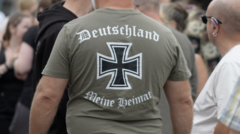
The political architecture built from the wreckage of the twentieth century is cracking along fault lines that mainstream observers spent decades pretending did not exist. When the Alternative for Germany movement secured historic electoral milestones in the eastern states, comfortable commentators in Berlin and Brussels immediately defaulted to familiar reflexes. They diagnosed the surge as a temporary protest vote against inflation, a transient symptom of post-pandemic anxiety, or a simple rejection of urban migration policies. That comforting diagnosis misses the structural rot eating at the core of the republic. The rise of the far right is not merely a rejection of current economic policy. It is a calculated, aggressive assault on the post-war moral consensus that defined modern Germany.
For decades, the Federal Republic derived its legitimacy from an uncompromising obligation known as Erinnerungskultur, the institutionalized culture of remembrance. School children were marched through memorial sites. Politicians bowed their heads in penitence at concentration camp gates. The state founded its identity on the explicit rejection of its darkest chapter, constructing an intellectual firewall designed to ensure that authoritarian nationalism would never again capture the machinery of government. Yet this very architecture of memory has become a primary target of political weaponization. The architects of the modern radical right recognized that public fatigue with decades of institutional contrition could be converted into raw political energy.
The geographic distribution of this political shift reveals a deep institutional fracture that reunification papered over rather than healed. In regions formerly governed by the German Democratic Republic, the mandatory anti-fascism imposed by the communist state functioned as a historical shield. Citizens of the East were taught that fascism was an inherent disease of capitalist Western societies, effectively absolving East German society from direct historical inheritance of Nazi crimes. When the Wall fell, the West exported its model of historical guilt into a society that had never undergone the painful, grassroots psychoanalysis of the 1968 student generation.
To many voters in towns from Thuringia to Saxony, the federal obsession with atonement feels less like a moral duty and more like a patronizing imposition from Bonn and Berlin. The radical right exploited this underlying resentment with surgical precision. Figures within the movement stopped whispering nationalist talking points and began testing the legal limits of historical revisionism. They mocked the culture of guilt, framing national pride as something to be reclaimed from the scrapheap of history. When prominent party figures publicly question whether paramilitary foot soldiers of the interwar period were entirely criminal, they are not making accidental gaffes. They are systematically testing the tolerance thresholds of the electorate.
The mechanics of this normalization process rely on a technique as old as propaganda itself. Extremists push the boundary of acceptable discourse with an outrageous statement, wait for the predictable outrage from mainstream media, and then retreat slightly while claiming persecution by an elite consensus. Each cycle inches the Overton window further to the right. Ideas that were unspeakable in polite society a decade ago are now staple topics of discussion in workplace breakrooms and tavern debates across the country.
Mainstream political parties bear a heavy burden of responsibility for this erosion. For years, traditional Christian Democrats and center-left social democrats treated economic inequality and rural decay as administrative problems rather than structural crises. Infrastructure crumbled in peripheral regions. Public services vanished from small towns. Local post offices, banks, and medical practices closed their doors, leaving populations feeling abandoned by a distant technocracy obsessed with global markets and European integration.
When citizens raised concerns about demographic shifts and community disruption, establishment politicians too often resorted to moral condemnation rather than policy solutions. Dismissing anxious voters as uneducated or bigoted creates a self-fulfilling prophecy. Pushed out of mainstream discourse, alienated voters gravitate toward the only political force willing to validate their grievances, regardless of how toxic the underlying ideology might be.
The institutional safeguards meant to protect the state are now being tested by actors who understand how to exploit legal loopholes from within. Securing blocking minorities in regional parliaments allows extremist factions to paralyze judicial appointments and constitutional courts. They do not need an immediate parliamentary majority to break the system. They merely need enough leverage to demonstrate that democratic institutions are sluggish, dysfunctional, and incapable of defending themselves.
This strategy extends far beyond domestic borders, tapping into a transnational network of populist sympathizers and digital influencers who view Germany's strict historical taboos as an inconvenience. Foreign tech moguls and international commentators routinely visit eastern campaign rallies to amplify the message that the country spends too much time looking backward. They frame national self-reflection as an obstacle to economic dynamism and technological progress. This external validation provides local radicals with a veneer of global respectability, insulating them from domestic isolation.
Reversing this trajectory requires more than hand-wringing and moral superiority from the political establishment. A firewall built purely on social exclusion and legal bans cannot withstand an electorate driven by deep-seated alienation. Traditional parties must confront the structural decay of public services in neglected regions, proving that democratic governance can deliver tangible improvements to everyday life.
History rarely repeats itself in an identical costume. The dangers facing contemporary European democracies do not wear brown shirts or march in organized columns through the capital. They wear tailored suits, manage sophisticated social media campaigns, and win legitimacy through the ballot box. They use the tools of liberal democracy to hollow out its substance from the inside, standing quietly at the gates of power while the guardians of the republic argue over the definitions of the past.