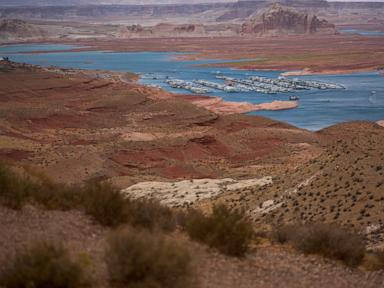
Lake Powell is dying.
The second-largest man-made reservoir in the United States stands on the precipice of dead pool status, a hydrologic cliff where water levels fall too low to pass through the turbines of Glen Canyon Dam. When that threshold arrives, millions of people across the arid Southwest will lose both their primary municipal water supply and the affordable hydroelectric power that stabilizes regional electrical grids. Decades of over-allocation, chronic structural drought, and administrative inertia have driven the Colorado River basin into an existential crisis. The warnings have sounded for years, yet federal agencies and state compacts continue to treat a structural mega-drought as a temporary inconvenience.
Understanding how a gargantuan body of water shrinks from a vital lifeline into a toxic mud puddle requires looking past simple precipitation charts.
The Arithmetic of Exhaustion
Mathematics dictates the crisis at Glen Canyon. The Colorado River Compact of 1922 divided 15 million acre-feet of water annually between the Upper Basin states of Colorado, Wyoming, and Utah, and the Lower Basin states of Arizona, California, and Nevada. The architects of this compact relied on historical flow data from a wet century. They promised more water than the river actually carries.
Average annual natural flow over the past two decades has hovered closer to 12 million acre-feet, and severe warming trends drive higher evaporation and soil absorption rates before runoff even reaches the main channel.
States continued drawing their legal allocations despite the shrinking supply. Lake Powell functioned as the giant bathtub meant to absorb these deficits, storing surplus snowmelt during wet years to feed the Lower Basin during dry spells. That bathtub is now largely empty.
Storage levels fluctuate below twenty-five percent of capacity. Every foot drop brings the surface closer to the intake tubes, threatening catastrophic failure for regional infrastructure.
The Power Grid Vulnerability
Water scarcity triggers an immediate energy crisis. Glen Canyon Dam generates hydropower for roughly five million customers across Arizona, Colorado, Nebraska, New Mexico, Utah, Wyoming, and Nevada. As reservoir elevations decline, water pressure drops, diminishing the generating capacity of the turbines.
Reduced generation forces utilities to purchase replacement power on the open market, passing steep cost increases directly to ratepayers in rural cooperatives and municipal utilities.
A total shutdown at dead pool elevation bypasses the dam entirely. Power production drops to zero overnight. Grid operators must scramble to replace gigawatts of dispatchable renewable energy with fossil fuel generation, spiking regional carbon emissions and destabilizing transmission lines across the Desert Southwest.
Downstream Realities and Agricultural Reckoning
Agriculture consumes roughly seventy percent of the Colorado River's water. Imperial Valley alfalfa farms in California and flood-irrigated acreage in Arizona continue to grow thirsty feed crops under archaic water rights doctrines established over a century ago. The principle of prior appropriation grants senior water rights holders nearly untouchable claims, regardless of modern efficiency standards or ecological realities.
Junior water rights holders in Arizona take the first and deepest cuts. Central Arizona Project canals see reduced deliveries, forcing farmers to fallow fields or pump expensive, increasingly saline groundwater from deep aquifers. Over-pumping groundwater causes land subsidence, cracking canals, damaging foundations, and permanently destroying underground storage capacity.
Negotiations between Upper and Lower Basin states resemble high-stakes poker. Lower Basin states point to Upper Basin consumption and evaporation losses, while Upper Basin officials argue they cannot deliver water that does not exist in the watershed. Federal intervention remains legally fraught, as decades of state-level compacts shield agricultural districts from mandatory federal rationing.
Voluntary compensation programs pay farmers millions to reduce water use, yet these temporary payouts function as expensive band-aids on a severed artery.
Engineering Failures and Geologic Realities
Glen Canyon Dam sits on Navajo sandstone, a soft, highly permeable rock formation. Water seeps into the abutments and foundation of the dam, creating long-term structural engineering challenges that engineers manage through continuous grouting and drainage systems.
As reservoir levels drop, the weight pressing against the dam decreases, shifting structural stress points in ways engineers monitor with extreme anxiety.
Sediment accumulation presents an equally formidable threat. The Colorado River historically carried millions of tons of silt annually, carving canyons and building deltas. Glen Canyon Dam traps that sediment behind the wall, filling the upper reaches of the reservoir with millions of tons of mud and sand.
As the water volume shrinks, this trapped sediment shifts, clogging intake structures and reducing total active storage capacity even further than surface water measurements indicate.
Climate Realities in the Anthropocene
Climatologists classify the current conditions not as a drought, but as an aridification process driven by permanent atmospheric warming. Higher temperatures accelerate snowpack sublimation and melt mountain snow before spring runoff can be captured effectively. Soil moisture depletion across the entire basin sucks up precipitation like a sponge, starving the river tributaries before they merge into the main stem.
Ignoring these physical boundaries courts disaster. Infrastructure designed for a twentieth-century climate regime cannot survive twenty-first-century thermal baselines without radical adaptation.
Emergency releases from upstream reservoirs like Flaming Gorge and Blue Mesa offer temporary relief, but these upstream pockets are finite and shrinking as well. Emptying upper storage to save Lake Powell simply transfers the vulnerability upstream, leaving the entire basin naked to the next dry cycle.
The Path Forward and Hard Choices
Solving the Colorado River crisis requires abandoning historical legal fictions. Water allocations must align with real-time hydrological data rather than political promises made a century ago.
Mandatory reductions in agricultural consumption must replace voluntary cutbacks. Municipalities across Phoenix, Las Vegas, and Los Angeles have made impressive strides in indoor water conservation, yet urban landscaping and swimming pools in the desert remain potent symbols of misplaced priorities.
Desalination and water reuse projects offer marginal relief but introduce heavy energy costs and environmental disposal problems with toxic brine.
Investing in advanced irrigation technology, lining earthen canals to prevent seepage, and transitioning away from water-intensive crops in arid zones are necessary steps. These transformations demand political courage from elected officials who have long preferred kicking the can down a dry riverbed.
Lake Powell will not return to full pool levels under current climatic projections. Managing the decline requires shifting from a model of endless growth and consumption to one of managed contraction, prioritizing human survival, ecological preservation, and grid stability over agricultural subsidies in the desert.
The water is running out, and the margin for error has vanished.