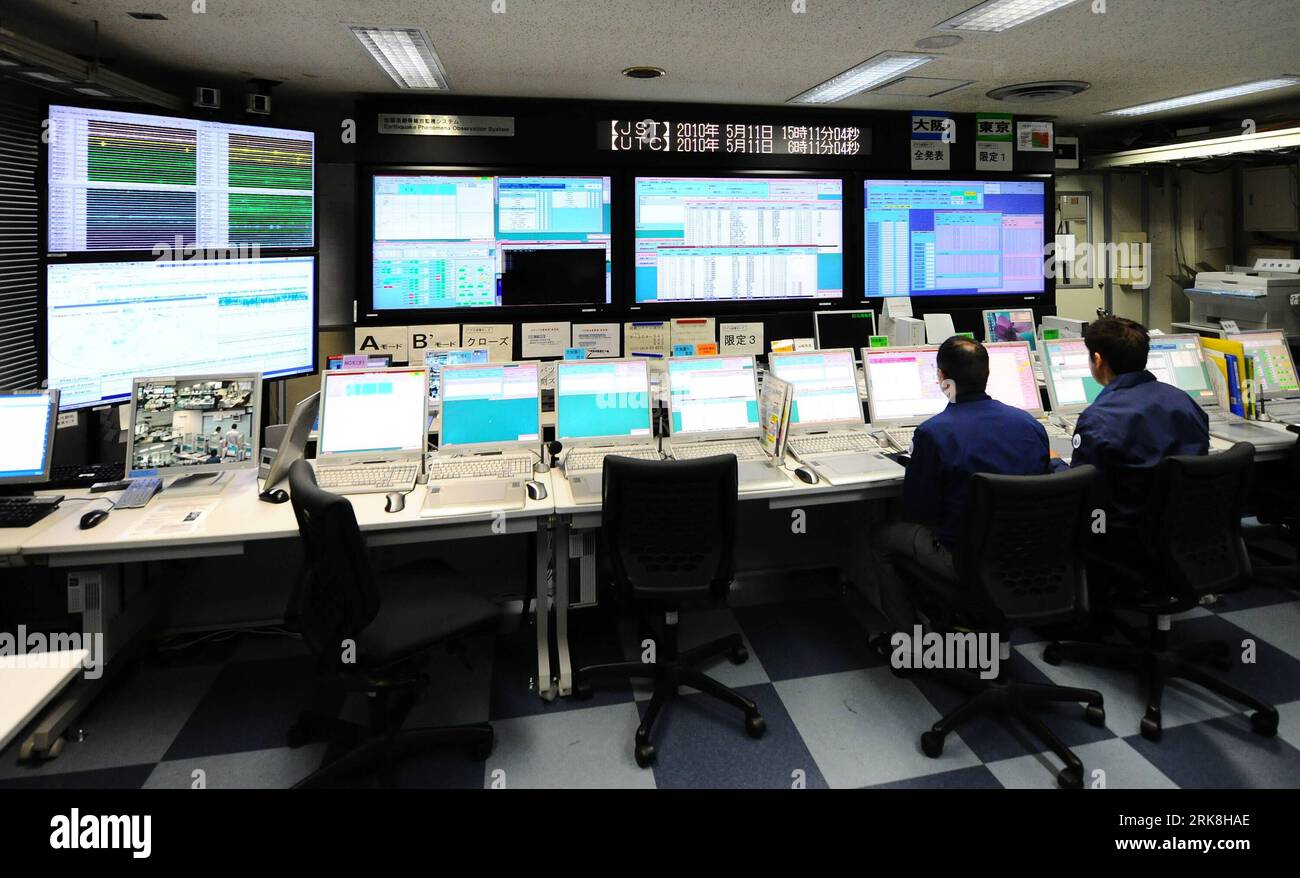
Japan does not prevent earthquakes. It survives them through an unyielding combination of high-speed sensor grids, aggressive structural engineering codes, and automated infrastructure controls that react faster than human biology ever could. When the ground ruptures along the Pacific Ring of Fire, thousands of seismometers distributed across the country immediately register the initial, non-destructive primary waves before the violent secondary waves arrive. This network feeds directly into the Earthquake Early Warning system managed by the Japan Meteorological Agency, broadcasting automated alerts to cell phones, mass media networks, and industrial control centers within seconds.
The widespread misconception is that this technology predicts seismic activity before it happens. It does nothing of the sort. Physics prevents any early warning from arriving before a rupture occurs directly beneath a city. Instead, the entire architecture depends entirely on beating the shockwaves to the punch by riding the milliseconds between the fast-moving P-waves and the destructive S-waves.
The Architectural Evolution Written in Concrete
Modern Japanese structural engineering is a direct artifact of historical trauma. The 1995 Kobe earthquake shattered the illusion that post-war construction standards were sufficient, leveling concrete blocks and wiping out elevated expressways that engineers swore were invulnerable. Out of that rubble came a ruthless overhaul of the Building Standard Law, specifically the 2000 code revisions that fundamentally changed how architects approach gravity and lateral force.
Structures here do not simply stand against an earthquake. They negotiate with it.
Engineers split structural protection into three distinct categories:
- Earthquake-resistant construction: Standard reinforced concrete frames built with dense steel reinforcement and ductile detailing designed to bend instead of snap.
- Base isolation: Heavy rubber and lead bearings placed beneath foundations, physically decoupling the superstructure from the moving earth below.
- Vibration control: Internal damping mechanisms, such as massive pendulum masses installed in skyscrapers to counteract horizontal sway.
Consider a hypothetical twelve-story office building in downtown Tokyo retrofitted with base isolation. When a magnitude seven tremor strikes, the laminated rubber bearings shear horizontally, absorbing the lateral kinetic energy before it travels up the structural columns. Desks rattle and coffee cups slide, but the primary columns remain upright and functional.
The Blind Spots of Automation
Yet, structural mastery and early warnings harbor silent limits. The physics of the system guarantee blind spots. If an epicenter sits directly beneath a metropolitan area, the warning triggers concurrently with the arrival of the shaking. The system offers zero advance notice for locations situated right on top of the fault line.
False alarms remain an operational hazard. When multiple micro-seisms occur simultaneously or electronic noise spikes a single sensor, the automated algorithm occasionally miscalculates intensity magnitudes. The Japan Meteorological Agency continually refines algorithms like the Integrated Particle Filter and the Propagation of Local Undamped Motion method to filter out ambient noise and isolate genuine tectonic shifts.
Beyond algorithms lies the human element. Automated machinery stops bullet trains and halts assembly lines instantaneously upon receiving an alert, but citizens must still translate a piercing cell phone alarm into physical survival within a window lasting less than ten seconds. Education campaigns run deep through schools and corporate offices, transforming rapid response into muscle memory.
The machine works because failure is treated as an engineering variable rather than an act of fate. Every seismic wave that hits the Japanese archipelago is measured, analyzed, and integrated into the next iteration of steel, code, and concrete.
Japan's earthquake resilience explained
This video provides a visual breakdown of the structural engineering mechanics and base isolation techniques used in Japanese infrastructure.