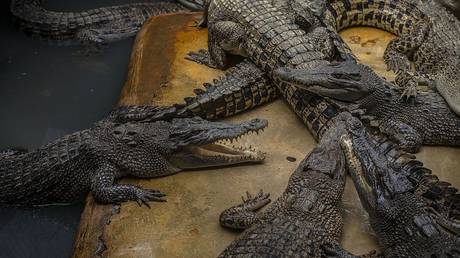
The Jerusalem District Court temporarily froze an extraordinary proposal by National Security Minister Itamar Ben-Gvir to deploy Nile crocodiles in moats surrounding Ketziot Prison in the Negev desert. The administrative injunction, handed down by Judge Avraham Rubin, effectively halts a 21 million shekel ($6.9 million) pilot project designed to use apex predators as living security infrastructure. This legal intervention follows a petition by the animal welfare organization Let the Animals Live and the Environmental Justice and Animal Rights Clinic at Tel Aviv University, targeting a ministerial maneuver that bypassed traditional wildlife protection frameworks.
The friction point of the dispute centers on an administrative pivot executed by Environmental Protection Minister Idit Silman. Silman reclassified the Nile crocodile from a strictly protected wild animal to a "tended" wild animal, a legal sleight of hand meant to clear the path for moving the reptiles into high-security penal institutions. Under standard Israeli statutes, these creatures can only be housed in licensed zoos, research facilities, or specialized sanctuaries. By altering their legal categorization, the ministry attempted to grant itself the authority to authorize prison moats as permissible habitats. For a different look, check out: this related article.
The Mechanics of a Penal Moat
Infrastructure work had already begun at Ketziot Prison, a remote facility in southern Israel holding thousands of Palestinian detainees. Heavy machinery began excavating deep trenches meant to encircle sections of the compound housing prisoners detained from Gaza following the October 7, 2023 events. Proponents of the strategy within the National Security Ministry insisted that the physical and psychological barrier of live crocodiles would establish an insurmountable deterrent against escapes.
Yet, the blueprint reflects a broader, highly controversial global trend in penal architecture. The scheme draws direct inspiration from the South Florida Detention Facility, colloquially dubbed "Alligator Alcatraz," which federal authorities established in the Everglades to manage immigrant populations. By importing medieval-style deterrents into modern state corrections, architects of these plans seek to exploit raw, primal fears. A fence can be scaled or cut. A concrete wall can be tunneled beneath. A moat filled with large, territorial reptiles introduces an unpredictable biological variable that engineering alone cannot easily neutralize. Similar insight on this matter has been published by NBC News.
Bureaucratic Insubordination and Professional Pushback
Long before the court intervened, the project faced intense resistance from professional wildlife administrators. The Israel Nature and Parks Authority maintained a firm, unyielding position against the proposal. Agency officials repeatedly advised the government that no scientific or professional basis exists anywhere in the world for utilizing large, long-lived, non-native predators as prison guards.
Internal friction reached a boiling point when Silman actively snubbed her own ministry's legal advisers. Reports indicate that the ministry's legal counsel explicitly warned her that she lacked the unilateral statutory power to reclassify wildlife for penal utilization. Silman issued the decree anyway, prompting accusations from conservationists that the administrative apparatus of the state was being co-opted to serve short-term political theater rather than sound environmental or security policy.
The Nature and Parks Authority warned that introducing Nile crocodiles into an arid desert prison environment creates severe multi-tiered hazards. Animal welfare advocates stressed that the extreme climate of the Negev desert, characterized by scorching daytime temperatures and sharp nighttime drops, is fundamentally ill-suited for creatures that require specific aquatic and thermal management. Furthermore, experts highlighted the catastrophic ecological risks should an animal breach containment or should maintenance protocols fail within a volatile prison environment.
The Court Steps In
Judge Rubin’s injunction brings an abrupt halt to the construction phase. The temporary order bars authorities from executing any further steps to procure, transport, or house crocodiles at Ketziot until the state files its formal defense and the court renders a substantive judgment. The legal teams representing the state, including the National Security Ministry and the Ministry of Environmental Protection, have been given a tight deadline to justify the administrative reclassification.
The temporary freeze preserves the status quo, but the underlying political momentum behind the project remains potent. Far-right factions within the government have consistently pushed for harsher, more punitive conditions across the prison system, arguing that conventional security measures require radical augmentation. Whether the judiciary will permanently strike down the reclassification or merely demand tighter regulatory oversight will be determined in the coming weeks. For now, the trenches in the Negev sit half-dug, waiting for a legal verdict that could either enshrine living barriers into modern penology or banish the concept back to the realm of dystopian fiction