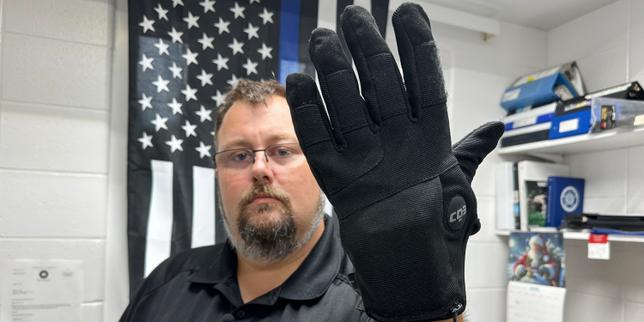
Immigration and Customs Enforcement is quietly moving forward with a procurement plan to spend up to $20 million on electric-shock gloves for its field agents. The device, known commercially as the G.L.O.V.E. or Generated Low Output Voltage Emitter, transforms standard patrol wear into a direct-contact compliance tool via a hidden switch. While federal documents frame the acquisition as a routine equipment upgrade for civil and criminal enforcement operations, the scale of the deployment signals a significant shift in the tactical gear standard for federal immigration agents.
The Mechanics of Compliance
The hardware itself occupies a murky space between traditional hand-to-hand restraint and projectile-based electronic control weapons like Tasers. Manufactured by Kentucky-based Compliant Technologies, the equipment functions as ordinary hand protection until an operator depresses a activation mechanism. Direct skin contact is required to complete the circuit and deliver the electrical impulse.
Proponents argue this requirement provides a distinct tactical advantage during chaotic vehicle extractions or close-quarters resistance inside residential structures. Unlike barbs fired from a distance, the energy discharge does not leave thermal burns or puncture marks on the epidermis.
The Department of Homeland Services defends the multi-million-dollar expenditure through standard operational justifications. Agency messaging emphasizes that field personnel require versatile instruments to safely execute arrest mandates. Yet, the sheer volume of the proposed contract points toward widespread distribution rather than isolated specialty assignment, suggesting that thousands of enforcement personnel could soon carry the shock-capable gear on daily operations.
A History of Scrutiny and Litigation
Every tactical innovation arrives with a paper trail. For this specific product line, that trail includes federal court dockets and internal municipal inquiries that complicate the narrative of unmitigated safety.
A pending civil lawsuit highlights the darker operational boundaries of the technology. The litigation stems from the 2024 death of a 43-year-old man at a Kentucky detention facility, where investigators documented multiple prolonged activations involving both the gloves and a secondary conduction device. Internal reviews of that incident flagged application times that far exceeded manufacturer safety thresholds, underscoring the gap between institutional policy and street-level execution.
Additional legal challenges, though ultimately dismissed, feature claims of injury and unnecessary activation in correctional and public settings. These cases illuminate the persistent friction points of intermediate-force deployment. When pain compliance tools are integrated into daily workflows, the margin for operational error narrows considerably.
Institutional Blind Spots and Vulnerable Populations
Manufacturer guidelines explicitly restrict the application of the technology against specific demographics, including children, pregnant individuals, the elderly, and those with severe cognitive or physical impairments. Operational guidelines similarly prohibit utilizing the electrical mode as a response to mere verbal disrespect, or as an instrument of punitive correction.
Enforcing these boundaries during dynamic immigration enforcement encounters presents a formidable challenge. Field operations frequently occur in high-stress, unpredictable environments where split-second decisions dictate outcomes. Critics, including former federal immigration officials and civil rights attorneys, point out that civil enforcement actions routinely intersect with complex household dynamics where vulnerable family members are present.
State-level officials have already begun drawing lines in the sand. Jurisdictions such as New York have publicly warned that local law enforcement and state legal frameworks will closely monitor federal actions within their borders, setting the stage for jurisdictional clashes over use-of-force standards.
The Broader Trajectory of Federal Policing
The timing of the procurement aligns with an aggressive federal enforcement climate that places immense pressure on operational units to execute rapid removals. Equipping personnel with high-voltage handwear reflects a broader institutional willingness to adopt advanced compliance technology without waiting for a national consensus on its psychological and physical toll.
As the contracting process moves past initial administrative notices toward fulfillment, the debate transcends the hardware itself. It exposes the ongoing tension between operational safety mandates and the systemic risks associated with expanding the threshold of authorized state-administered pain. Accountability measures, internal auditing protocols, and external oversight will ultimately determine whether these instruments function as targeted de-escalation assets or catalysts for escalation in an already polarized enforcement landscape