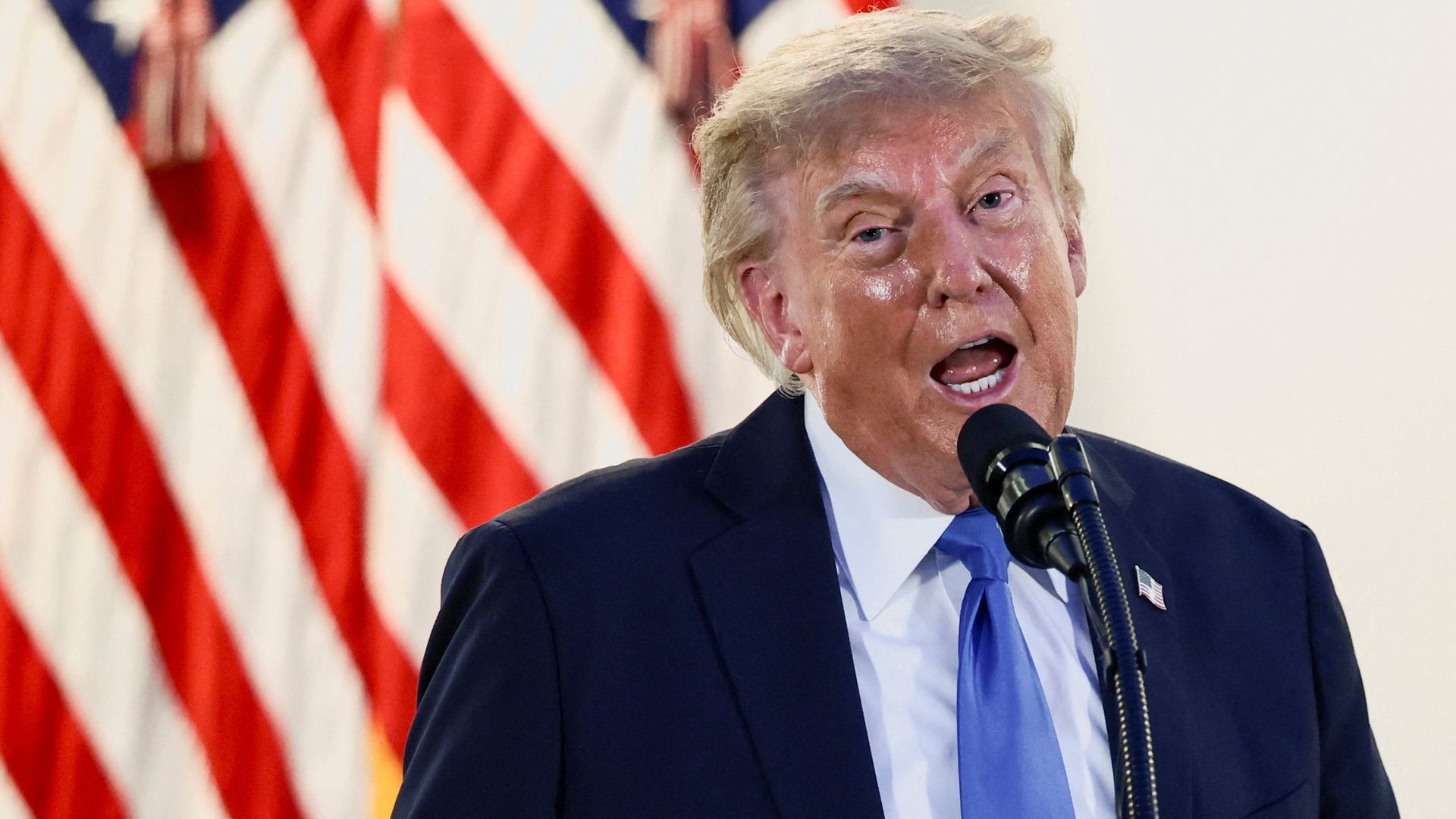
United States President Donald Trump has thrown long-standing transatlantic alliances into turmoil by pointedly refusing to guarantee American support for the United Kingdom in a future conflict over the Falkland Islands, tying his administration's position directly to Britain's refusal to join military operations against Iran. Speaking in a wide-ranging broadcast interview, Trump asserted that the UK was "not there to help me" during the protracted conflict in the Middle East, laying bare a transactional foreign policy doctrine that treats historical security guarantees as conditional IOUs.
The remarks, which immediately preceded a high-profile televised national address by Argentine President Javier Milei regarding the disputed South Atlantic archipelago, mark a volatile departure from decades of official American ambiguity. While Washington has historically maintained a diplomatic tightrope act—formally recognizing British de facto administration while officially neutral on ultimate sovereignty claims—the current White House is weaponizing that neutrality. The underlying message is stark: security partnerships are no longer protected by institutional memory or shared history, but by immediate, ledger-book reciprocity.
The Transatlantic Ledger
Diplomatic friction rarely materializes overnight. Behind closed doors in Washington and London, relations had already grown brittle over resource allocation and defense contributions. Trump zeroed in on those fractures with characteristic bluntness, recalling exchanges with former British Prime Minister Keir Starmer regarding naval deployments to the Strait of Hormuz.
"I asked your former leader, 'Why don't you send a couple of ships?'" Trump recounted. According to the White House, the response was a confession of structural hollowness: Britain simply did not have the available hulls to spare.
For a administration fixated on projection of power and quid-pro-quo alliance management, that admission was unforgivable. In Trump's calculus, if European capitals expect American logistical and diplomatic cover for their sovereign outposts thousands of miles from the mainland, they are expected to share the burden when American interests face acute threats in critical energy corridors.
This transactional framework exposes a severe vulnerability in modern British defense strategy. Decades of procurement cuts, downsizing, and stretched naval capabilities have left the Royal Navy a fraction of its historical self. When challenged on whether Britain retains the sheer capacity to repeat its 1982 projection power in the South Atlantic, Trump expressed open skepticism.
"Your country is not the same country it was twenty years ago, twenty-five years ago," Trump noted. "I just don't know if you have the capacity to do it."
The Milei Factor
The timing of Trump's comments is far from accidental. President Javier Milei has cultivated an aggressive ideological and personal alliance with the American executive, positioning Argentina as Washington's most reliable populist partner in the Southern Cone. Milei's government has steadily ratcheted up rhetoric regarding the islands, locally known as the Malvinas, treating the sovereignty dispute not as a dormant historical grievance but as an active political crusade.
For Buenos Aires, any crack in the traditional Anglo-American security architecture represents a historic opening. During the 1982 conflict, covert and overt American intelligence, logistical support, and satellite communications provided to the Thatcher government proved critical to the British task force's success. Without that invisible umbrella, a distant maritime campaign becomes infinitely more hazardous.
By signaling that Washington might sit on its hands or even review its baseline positioning, Trump effectively removes the deterrent effect that has kept the Falklands secure from adventurism for over four decades. It transforms a localized territorial dispute into a pressure point for broader geopolitical compliance. Downing Street's immediate public reiteration that sovereignty is "unwavering" and that islander self-determination remains paramount sounds increasingly defensive against a backdrop where international law is routinely subordinated to executive whim.
The Shrinking Margin for Error
The fallout from this confrontation extends well beyond the sheep pastures of Port Stanley or the shipping lanes of the Persian Gulf. It forces a brutal reckoning across European capitals that have spent generations outsourcing their ultimate strategic security to the Pentagon.
If alliance commitments are contingent on matching every overseas deployment ordered from Washington, medium-sized powers like Britain face an impossible choice. They can bankrupt their treasuries trying to maintain full-spectrum global power projection, or they can accept a diminished status where their borders and overseas territories are only as secure as their utility to the sitting American president.
The old guard of international diplomacy assumes that shared values and institutional alliances endure through political cycles. Trump's intervention proves that the current era operates on an entirely different frequency. As the South Atlantic temperature rises and Buenos Aires presses its advantage, London is discovering that history buys very little when the bill for current conflicts comes due.