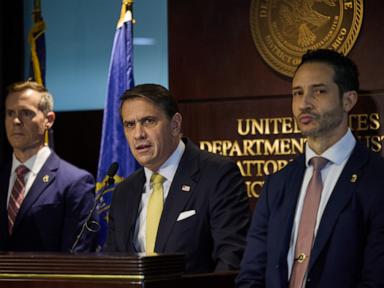
The federal indictment of more than 80 alleged members of the Mayagüez-based gang "Los Baja Deo" reads like a ledger of modern transnational cartel logistics. When Attorney General Todd Blanche touched down in San Juan to trumpet the coordinated sweep by the FBI and local police, the public relations narrative focused on the immediate head count: 70 defendants arrested in a single coordinated dawn operation, a sprawling enterprise dismantled, and public housing blocks reclaimed.
Look past the press conference podiums, and a darker structural reality emerges. The numbers tell a story of an entrenched criminal corporation that generated nearly $50 million while operating with absolute impunity across western Puerto Rico. This was not a loose affiliation of neighborhood corner boys. It was an industrialized operation moving hundreds of kilograms of narcotics, maintaining armories, and feeding a violent underground economy that weaponized public housing projects from Sábalo Gardens to Cuesta Las Piedras.
The Logistics of Empire
For decades, federal law enforcement treated Puerto Rico primarily as a transshipment zone—a convenient island stepping stone where South American cocaine could pause before making the final jump to the continental United States. Los Baja Deo inverted that geographic vulnerability into a localized retail and wholesale powerhouse. They did not just manage transit; they dominated the domestic supply chain of devastation.
Federal prosecutors outline an operation that trafficked cocaine, crack, heroin, marijuana, and a staggering volume of synthetic opioids. The group distributed at least 340 kilograms of fentanyl or fentanyl-laced narcotics, an amount capable of generating millions of lethal doses. What makes this syndicate distinct is how it bridged local street crime with global postal logistics. Court documents reveal that members regularly utilized the United States Postal Service to funnel controlled substances directly from the island to mainland markets.
The postal pipeline represents a quiet vulnerability in domestic security architecture. Millions of packages move between San Juan and the mainland daily without physical inspection requirements equivalent to international freight. Transnational cells realized long ago that domestic mail status acts as a diplomatic pouch for contraband. By utilizing standard shipping channels, Los Baja Deo bypassed maritime interdiction entirely, turning the U.S. postal system into an unwitting courier service for fentanyl distribution.
The Economics of Decay
Governments love mass indictments because they offer clean metrics of success. Eighty-one names on a charging document provide a satisfying punctuation mark to years of investigative legwork. Yet the economic vacuum left by a multi-million-dollar cartel rarely remains empty for long.
Consider the local micro-economy of Mayagüez and surrounding western municipalities. When an enterprise generating nearly $50 million vanishes overnight, it creates an immediate capital shock. The illicit ecosystem—ranging from corrupted local fixers and weapons suppliers to real estate fronts and street-level lookouts—suddenly loses its primary employer.
History shows that decapitating a dominant syndicate often triggers a violent succession crisis. When a monopoly collapses, fragmented factions immediately start shooting to claim the vacant territory. The assertion by federal officials that local families can now sleep safely ignores the volatile transition period that typically follows a high-profile sweep. Younger, more reckless operators rise from the lower ranks to seize control of the remaining drug points, often proving more unpredictable and violent than the leadership they replace.
The Structural Blind Spot
Federal task forces are designed to hunt organizations, but they struggle to dismantle the socio-economic breeding grounds that spawn them. Public housing projects like Franklin Delano Roosevelt and Columbus Landing have spent decades functioning as controlled environments where gangs act as de facto governance. When the state only enters these neighborhoods with tactical gear and arrest warrants, the underlying structural rot remains untouched.
Unemployment, crumbling infrastructure, and a hollowed-out local economy create a continuous stream of fresh recruits who view cartel employment as the only viable career path on an island struggling with fiscal instability. As long as the economic desperation persists, locking up 81 people is merely pruning a weed whose roots run deep into the foundation of the territory's social fabric.
The prosecution of Los Baja Deo marks a tactical victory for the Department of Justice, but it is also a reminder of how deeply embedded transnational logistics have become within domestic American territory. Until federal strategy shifts from reactive mass arrests to starving criminal networks of their financial mobility and plugging postal loopholes, the cycle will repeat. Another syndicate will step into the Mayagüez vacuum, the millions will start flowing again, and a new roster of names will eventually fill the federal docket.


