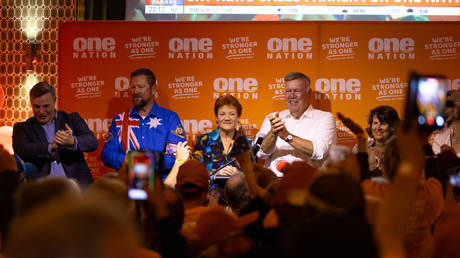
The conventional wisdom governing Australian politics for a century has officially cracked. Right-wing populism is no longer a fringe grievance whispered in regional milk bars; it is leading the national conversation. Recent polling shocks from YouGov and Redbridge place Pauline Hanson’s One Nation ahead of both the ruling Labor government and the devastated Liberal-National Coalition in primary support, capturing up to 30 percent of the electorate. This is not a temporary protest vote. It is a structural realignment driven by an unprecedented convergence of corporate billionaire backing, a severe housing deficit, and working-class abandonment by the major parties.
For decades, the political establishment treated populism as a localized infection, easily quarantined by compulsory voting and the preferential count. That arrogance has backfired. If you enjoyed this article, you might want to look at: this related article.
The Billionaire Backing of the Outcast
The narrative that right-wing populism is purely a grassroots uprising of the left-behind ignores the massive influx of capital rewriting the rulebook. The turning point occurred in late 2025. Following the Coalition’s catastrophic federal election defeat, deep internal fractures culminated in the high-profile defection of Barnaby Joyce to One Nation. This shifted the party from an isolated protest vehicle into a legitimate alternative power center.
More importantly, it unlocked the vault of Australia’s ultra-wealthy. Gina Rinehart, the nation’s richest person, shifted her immense financial and strategic backing toward Hanson. This structural alliance bridges the gap between raw anti-immigration sentiment and the interests of the resources sector. For another look on this story, refer to the recent coverage from The Washington Post.
- The Capital Influx: Multimillion-dollar war chests are funding sophisticated digital operations that bypass traditional media gatekeepers.
- The Policy Paradox: While the base rallies against global elites, the legislative agenda increasingly favors deregulation and tax structures designed to benefit mining giants.
This is not the amateurish One Nation of 1996. This is a well-capitalized, highly professionalized political machine capable of fighting multi-front campaigns across every state.
The Capital Gains Trap
Prime Minister Anthony Albanese attempted to neutralize this rising threat by using his recent federal budget to smash the ultimate sacred cow of Australian wealth accumulation: negative gearing and capital gains tax breaks for property investors. The strategy was clear. By tilting the scales toward young first-home buyers, Labor hoped to drain the pool of economic resentment feeding the right.
Instead, the move detonated a political landmine.
"There is a deep, structural anger when the rules of the economic game are changed mid-match, regardless of the intention."
The Bank of America warned that these tax changes could trigger an 8 percent correction in national property prices. For the 150,000 aspiring buyers Labor targeted, it was a lifeline. For the seven million existing homeowners who watch their property values like a ledger of their self-worth, it felt like an act of economic sabotage.
One Nation immediately seized the initiative. Laundering the grievance through a massive national campaign under the banner "Fire the Liar," they successfully framed a progressive housing policy as an attack on the suburban dream. By breaking an explicit election promise to leave property taxes untouched, Labor didn't save the center; they validated the populist claim that mainstream politicians cannot be trusted.
The New Geography of Resentment
The demographics of this surge reveal a profound shift in who is buying the populist message. The assumption that Hansonism is exclusively the domain of angry, older Anglo-Saxon men is obsolete.
[Traditional Populist Voter] -> Regional, older, Anglo-Saxon, anti-immigration
[The 2026 Populist Coalition] -> Outer-suburban, trade workers, small business owners, asset-poor young men
The current coalition includes outer-suburban mortgagees, small business owners suffocating under persistent inflation, and remarkably, a growing cohort of younger men facing permanent exclusion from the housing market.
In the South Australian state election, One Nation secured 23 percent of the total vote. The party’s candidates are no longer caricatures. One newly elected MP openly discusses his Indonesian Muslim same-sex partner while simultaneously railing against high immigration levels. The message has been decoupled from raw racial animus and hitched to a broader, pragmatic argument about carrying capacity, infrastructure neglect, and economic fairness. When a school has no desks and a hospital has no beds, immigration stops being a cultural debate and becomes a math problem in the eyes of the suburban voter.
The Illusion of the Center
The major parties remain trapped in a collective delusion that the political pendulum will inevitably swing back to the middle. The Liberal Party, currently under the presidency of Tony Abbott, is launching national "listening tours" to claw back its base. Meanwhile, Coalition figures like Angus Taylor hint at potential preference deals or governing alliances with One Nation to salvage a path back to power.
These maneuvers ignore a fundamental truth. Once an electorate realizes that third parties can wield genuine leverage, the psychological barrier to breaking the two-party duopoly vanishes. The structural factors feeding this right-wing surge—sustained inflation, an structurally broken housing market, and institutional distrust—cannot be managed away with slick advertising or minor policy tweaks. The populist right is not about to take over Australia; they have already shifted its axis.