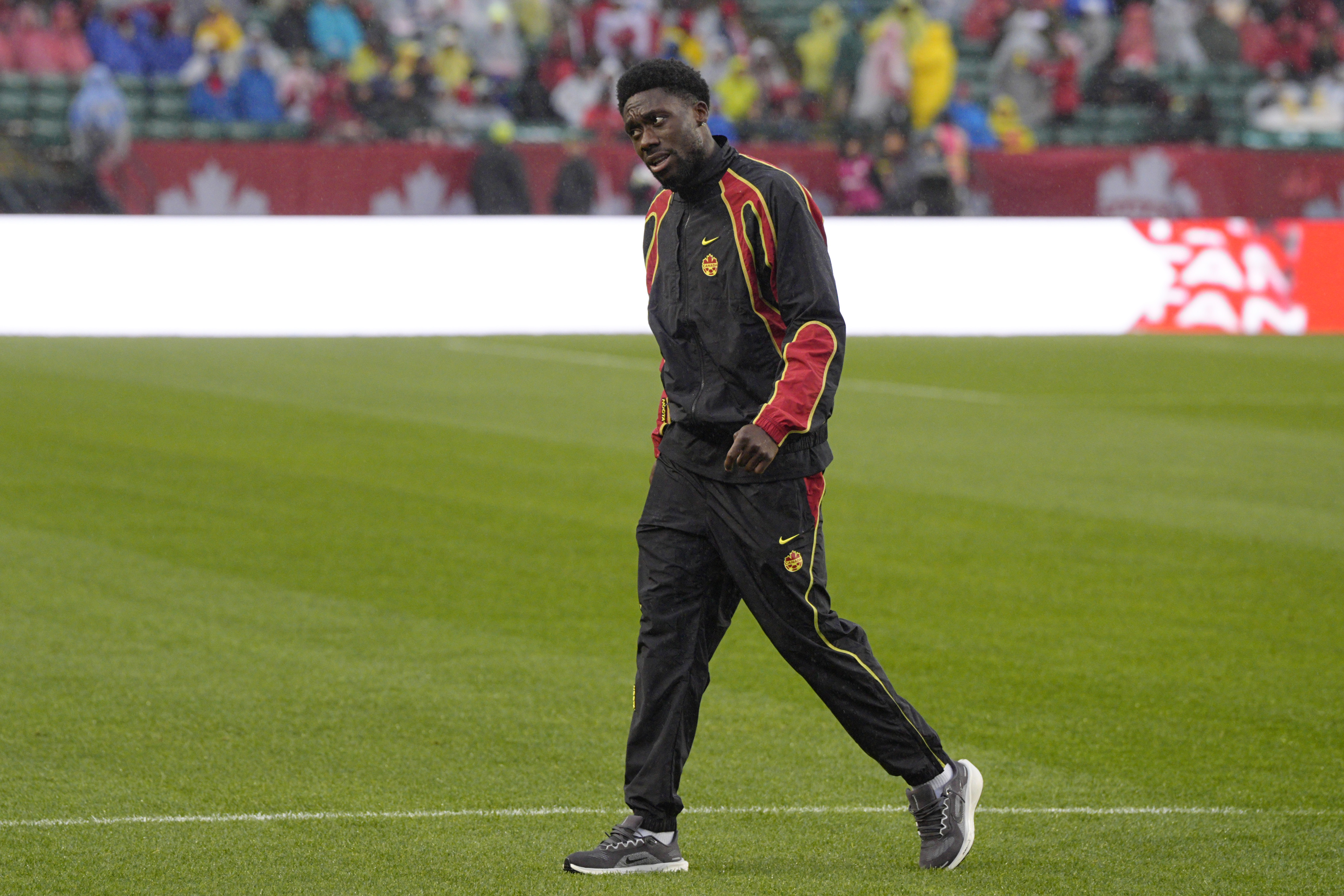
The superficial media narrative surrounding Alphonso Davies is comforting. It paints a picture of a smiling captain jogging under the Edmonton rain, thrilled to be back with his Canadian teammates ahead of the 2026 World Cup. The standard sports page tells you his presence alone provides invaluable motivation to Jesse Marsch’s squad. But behind the optimistic quotes and the calculated public relations updates lies a devastating reality for Canadian soccer. The face of the franchise is broken, and Canada’s home-soil World Cup ambitions are crumbling before the tournament even begins.
On Tuesday, Davies officially confirmed he will miss Canada’s opening match against Bosnia and Herzegovina on June 12 in Toronto. While fans hold onto hope that he might return for later group-stage matches against Qatar or Switzerland, the cold medical data suggests otherwise. Davies is caught in a destructive physical cycle that threatens not just his tournament, but the peak years of his career.
To understand the crisis, one must look past the cheerful soundbites and analyze the brutal 15-month timeline that brought the 25-year-old superstar to this breaking point.
The Tragic Anatomy of a Recurrent Hamstring Injury
Muscular injuries are rarely isolated events. They are the downstream consequences of structural imbalances, often accelerated by premature returns to competitive intensity. Davies has spent far more time in the medical room than on the pitch since March 2025. The root cause of his current physical fragility dates back to a torn anterior cruciate ligament suffered during a Concacaf Nations League match last year.
When an elite athlete tears an ACL, the rehabilitation process focuses heavily on restoring knee stability. However, the hamstring muscle group acts as the primary secondary stabilizer for the ACL, absorbing immense mechanical stress during explosive deceleration and sprinting. If the hamstring is overworked or fails to regain perfect structural symmetry with the quadriceps, it becomes highly susceptible to micro-tearing.
Davies returned to action for Bayern Munich earlier this year, only to quickly suffer a hamstring strain. He was rushed back a second time, culminating in a 22-minute cameo against Paris Saint-Germain in the Champions League semifinal on May 6. He managed a brilliant assist to Harry Kane, but his body paid the price. That brief appearance caused a secondary tear to the same left hamstring. He has not played a minute of football since.
By continuing to run on the pitch in Edmonton to test the muscle, Davies is engaging in a dangerous gamble. Hamstring re-injury rates in elite soccer hover around 30 percent, with the risk skyrocketing if the initial scar tissue has not fully matured. Marsch and the Canadian medical staff find themselves trapped between national expectation and physiological reality.
The Illusion of Depth and the Marsch Tactical Dilemma
Losing a starting left-back would disrupt any international side. Losing Davies fundamentally reshapes how Canada can play. In modern tactical systems, elite full-backs are the primary engine of ball progression, stretching opposition defensive blocks and overloading wide channels. Davies is not merely a defender; he is the tactical focal point that allows Canada to transition from a mid-block defense into a devastating counter-attack.
Marsch has attempted to project confidence by highlighting his 26-man roster, emphasizing a balance between Qatar 2022 veterans like Jonathan David and Cyle Larin, and freshly integrated dual nationals like Alfie Jones and Luc de Fougerolles. But none of these players possess the generational athletic profile of Davies.
Without Davies occupying the left flank, opposition managers can compress their defensive lines. They no longer need to drop their right-back deep to counter Davies's world-class recovery pace. This creates a cascading problem for Canada’s midfield. Ismael Kone and Stephen Eustaquio will be forced to cover more lateral ground to protect the left side of the defense, reducing their ability to support the attack.
The inclusion of raw talent like Promise David or the versatility of Richie Laryea provide structural coverage, but they do not solve the fundamental flaw. Canada’s tactical identity under Marsch relies on high-intensity pressing and verticality. Without their captain, that verticality loses its sharpest edge.
Club Versus Country and the Financial Undercurrents
There is an unspoken tension underlying every major international tournament, particularly when a player’s primary employer is a European superpower. Bayern Munich’s medical staff did not clear Davies to join the Canadian camp in Charlotte, North Carolina last week. Instead, they kept him in Germany under strict supervision until May 31.
The economic reality of modern soccer means Bayern Munich views Davies as a multi-million-dollar asset that requires protection. They are entirely aware that rushing a player back from a recurrent hamstring injury can lead to chronic tendon degeneration. Marsch publicly stated that neither Bayern nor Canada wants Davies to feel pressure, but the institutional goals of the two organizations are fundamentally misaligned.
Canada Soccer needs Davies to deliver a historic knockout-stage run on home soil to justify years of administrative turmoil and secure crucial domestic commercial revenue. Bayern Munich needs Davies healthy for a grueling European domestic campaign. When a player sits in the middle of that tug-of-war, the pressure to declare oneself fit can lead to catastrophic medical decisions. Davies wants to play in front of a home crowd in Toronto and Vancouver, but his body is sending clear warning signs that his brain is trying to ignore.
The Long Road to Vancouver
The Canadian team managed a 2-0 victory over Uzbekistan in their recent friendly, but defeating a heavily rotated Asian side in a rainy exhibition match provides zero indication of how Canada will fare against structured European and South American opposition. The group stage moves fast. If Canada drops points against Bosnia and Herzegovina on June 12, the pressure on the June 18 match against Qatar in Vancouver becomes immense.
If Canada is desperate for points heading into that second match, the temptation to use Davies as a late-game substitute will be overwhelming. Marsch noted that the plan involves a "progression of a few minutes." This is a high-risk strategy. Coming off the bench cold into the high-intensity environment of a World Cup match is precisely how secondary muscle tears occur.
The hard truth is that Canada must learn to survive entirely without Alphonso Davies if they want to preserve his future. Hoping for a miraculous medical recovery in the span of ten days is not a strategy; it is a delusion. The coming weeks will reveal whether Canada possesses the collective tactical maturity to adapt, or if their historic home tournament will be defined by the tragic absence of their greatest talent.