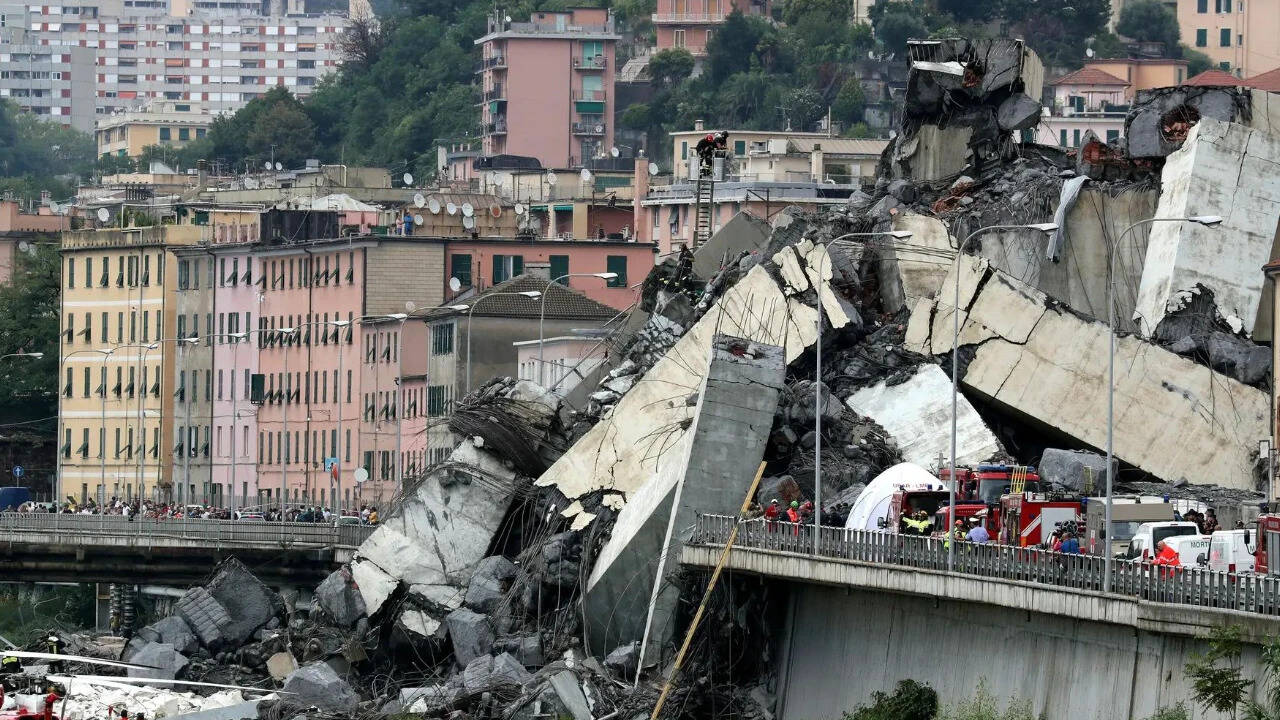
The collapse of Genoa’s Polcevera Viaduct—popularly known as the Morandi Bridge—on August 14, 2018, was not a sudden meteorological anomaly, but the mathematically predictable outcome of a compromised asset management strategy. The first-instance judicial verdicts handed down in Genoa, convicting 32 individuals including former Autostrade per l’Italia (Aspi) CEO Giovanni Castellucci, establish a profound precedent for infrastructure concessionaires worldwide.
To view this disaster merely through the lens of corporate greed or individual negligence misses the structural lesson. The Morandi Bridge collapse represents a fundamental failure in the optimization of concessionaire economic incentives, structural degradation modeling, and regulatory oversight. By deconstructing the systemic failures that led to the tragedy and analyzing the mechanics of the trial, we can identify the warning signs of structural asset failure before they manifest as physical catastrophes. For a closer look into similar topics, we suggest: this related article.
The Economics of Deferred Maintenance: The Broken Incentive Loop
The primary conflict in privatized infrastructure lies in the divergence of interests between long-term asset health and short-term capital efficiency. When Italy privatized its toll road network in the late 1990s, the concession agreements created a highly profitable monopoly. Under this framework, the concessionaire’s profitability was directly linked to a simple economic optimization problem: maximizing toll revenue while minimizing operational expenditures (OpEx) and capital expenditures (CapEx).
The Profit-Preservation Equation
For a privatized toll operator, the financial return on an infrastructure asset is governed by the relation: For broader context on this issue, in-depth coverage can also be found on Financial Times.
$$\text{Net Margin} = \text{Toll Revenue} - (\text{Concession Fees} + \text{OpEx} + \text{CapEx})$$
In this model, every Euro spent on invasive structural remediation or preventative reinforcement represents a direct reduction in EBITDA and distributable dividends to shareholders. When the regulatory oversight mechanism is weak, the concessionaire is economically incentivized to defer CapEx—specifically structural reinforcement—under the assumption that the probability of catastrophic failure ($P_f$) multiplied by the cost of failure ($C_f$) in any given financial year is lower than the guaranteed cost of immediate remediation ($C_r$):
$$P_f \times C_f < C_r$$
This calculation holds true only in the short term. As an asset ages, the probability of failure increases exponentially, while the cost of remediation climbs due to progressive degradation. By postponing essential safety works to maximize immediate payouts, the decision-makers at Aspi and its engineering subsidiary, Spea, essentially shorted their own infrastructure.
The Corporate Protection Shield
During the preliminary phases of the legal proceedings, Aspi and Spea insulated their corporate structures from the worst of the fallout by securing a plea deal. The entities paid a combined administrative penalty of approximately €30 million ($34 million).
| Entity | Role in Infrastructure System | Legal/Financial Fallout |
|---|---|---|
| Autostrade per l'Italia (Aspi) | Toll road concessionaire responsible for asset management | Settled corporate liability for €30M; ownership transferred from Benetton-controlled Atlantia to a state-led consortium. |
| Spea Engineering | Engineering subsidiary tasked with safety monitoring and risk assessment | Corporate settlement alongside Aspi; former CEO Antonino Galatà sentenced to 5.5 years. |
| Ministry of Infrastructure and Transport | State regulatory body responsible for public safety oversight | Exposure of systemic oversight failure; senior official responsible for safety oversight sentenced to 5 years. |
This settlement successfully shielded the corporate entities from a trial that could have resulted in the complete revocation of their public contracts. This dynamic underscores a significant systemic loophole: corporate entities can absorb legal penalties as a cost of doing business, leaving individual executives to carry the criminal liability.
Structural Anatomy of the Failure: The Cable No. 9 Anomaly
The defense during the four-year trial argued that the collapse was caused by an original design defect in the bridge's concrete-encased stay cables, specifically stay cable No. 9. However, the prosecution successfully demonstrated that the structural vulnerabilities of the Morandi Bridge were documented, quantified, and neglected for decades.
[Design Vulnerability: Encased Stay Cables]
                 │
                 ▼
[Internal Tension Corrosion (Invisible to Visual Scans)]
                 │
                 ▼
[Inadequate Diagnostic Tools (1967 Circular Misuse)]
                 │
                 ▼
[Selective Remediation (Pylons 11 & 10 Reinforcement)]
                 │
                 ▼
[Neglect of Pylon 9 (Systemic Failure Point)]
The Creep and Corrosion Mechanism
Completed in 1967, the Morandi Bridge utilized a highly unconventional design: prestressed concrete stays. Unlike modern cable-stayed bridges where high-strength steel cables are exposed and easily inspectable, Riccardo Morandi’s design encased the steel tension cables in concrete. The design relied on the concrete casing to remain in compression, protecting the internal steel strands from atmospheric moisture and industrial emissions from the Genoa port area.
This design suffered from two fatal vulnerabilities:
- Concrete Carbonation and Cracking: Under dynamic traffic loads, the concrete casing developed micro-cracks. Carbon dioxide and moisture penetrated these cracks, initiating carbonation and destroying the alkaline environment that naturally protects steel from corrosion.
- Steel Strand Degradation: The internal steel wires experienced stress corrosion cracking and hydrogen embrittlement. Because the cables were fully encased in concrete, traditional visual inspections were entirely incapable of detecting the loss of steel cross-sectional area.
The Asymmetric Maintenance Failure
The most damning piece of forensic evidence presented by the prosecution was the history of selective maintenance on the bridge. The Polcevera Viaduct featured three primary structural systems supported by pylons 9, 10, and 11.
In 1993, structural degradation was identified in the stay cables of pylons 10 and 11, leading to major reinforcement and external post-tensioning work on those specific sections. However, an identical intervention for pylon 9 was repeatedly delayed.
For twenty-five years, the concessionaire operated under the assumption that the structural integrity of pylon 9 could be managed via passive monitoring, despite knowing that its sister structures had already required emergency stabilization. The court ruled that this failure to extend known technical solutions to identical components of the same system constituted criminal negligence.
Regulatory Capture and the Illusion of Monitoring
The Genoa verdict exposes a failure of regulatory architecture. In privatized public-utility models, the state is supposed to act as an aggressive auditor. In practice, Italy's Ministry of Infrastructure and Transport suffered from classic regulatory capture, delegating its critical safety duties to the very entities it was tasked with monitoring.
The Circular 1967 Exploitation
The court highlighted that monitoring procedures relied heavily on an outdated 1967 Ministry of Public Works circular. By adhering to the letter of a fifty-year-old regulatory guideline rather than adopting modern diagnostic methodologies (such as acoustic emission monitoring, radiographic testing, or magnetic flux leakage sensing), the operators maintained a facade of compliance.
This created a feedback loop of false assurance:
- The operator performed visual-only inspections mandated by outdated guidelines.
- These superficial scans failed to detect deep internal corrosion within the concrete-encased cables.
- The clean inspection reports were submitted to the Ministry, which accepted them without independent verification.
- Capital expenditures for structural replacement were deferred, preserving profit margins.
When the state delegates the development of safety standards and the execution of diagnostics to a profit-maximizing concessionaire without independent, third-party validation, the regulatory system ceases to function as a safeguard. It instead becomes an instrument of liability shielding.
The Strategic Path Forward for Infrastructure Asset Management
The Genoa bridge verdict is a clear warning for public and private managers of civil infrastructure. To prevent catastrophic systemic failure in aging asset portfolios, operators and regulators must transition away from legacy maintenance paradigms.
1. Shift from Time-Based to Risk-Based Inspection Protocols
Relying on static inspection schedules or outdated regulatory circulars is no longer defensible. Operators must implement Risk-Based Inspection (RBI) frameworks where inspection frequency and technology are determined by a dynamic risk matrix:
$$\text{Risk} = \text{Probability of Failure (PoF)} \times \text{Consequence of Failure (CoF)}$$
Assets with high-consequence profiles—such as major arterial viaducts with non-redundant load paths—must be subjected to continuous structural health monitoring (SHM) systems, irrespective of minimum regulatory requirements.
2. Mandatory Redundancy Audits for Non-Redundant Structures
The Morandi Bridge was a "fracture-critical" structure, meaning it lacked structural redundancy. The failure of a single key component—stay cable No. 9—guaranteed the progressive collapse of the entire deck span. Asset managers must systematically catalog all fracture-critical bridges within their networks and prioritize these structures for immediate physical redundancy retrofitting or complete replacement.
3. Establish Absolute Separation Between Inspection and Operation
To eliminate cognitive bias and conflicting financial incentives, structural health monitoring and safety inspections must be completely uncoupled from the concessionaire's corporate structure. Inspections should be conducted by independent, state-appointed engineering firms whose compensation is entirely independent of the asset's operating margin. This ensures that the incentive to identify structural defects is not suppressed by the cost of fixing them.