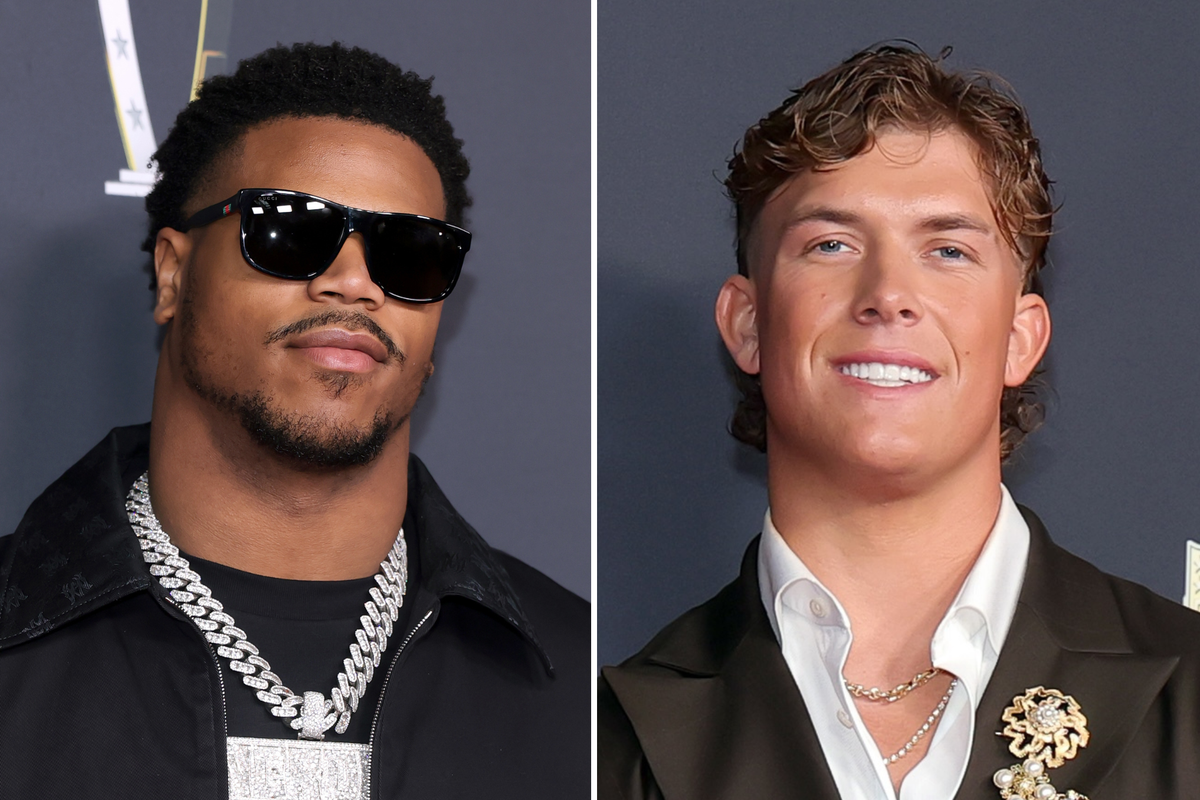
The modern NFL front office views the franchise quarterback as an investment script to be optimized. When the New York Giants used the 25th pick in the 2025 draft on Ole Miss passer Jaxson Dart, they bought into a specific corporate package: a high-efficiency 91.7 passer rating, 24 touchdowns across 12 rookie starts, and a flawless public profile designed to offend nobody in a tri-state media market.
Then came Friday night at the Eugene Levy Fieldhouse in Suffern, New York.
By walking onto a political stage to introduce Donald Trump at a rally for Republican Congressman Mike Lawler, Dart shattered the carefully curated, apolitical shield that franchises spend millions to maintain. The blowback inside the building was instantaneous. On Saturday morning, sophomore pass-rusher Abdul Carter—the foundation of the Giants' defense and the number three overall pick in that same 2025 draft class—posted a video of the appearance to social media with a blunt caption: “Thought this sh!t was AI, what we doing man.”
This is not a routine political disagreement between two young athletes; it is a fundamental clash of leverage and identity within a multi-billion-dollar roster structure. The old-guard sporting axiom dictating that locker rooms are sacred spaces where external realities disappear is dead. The public friction between Dart and Carter exposes the corporate vulnerability of a franchise trying to build a new culture under John Harbaugh while navigating a roster polarized by its own leadership.
The Quarterback Luxury Tax
For decades, NFL quarterbacks operated under an unspoken mandate of corporate neutrality. They sold trucks, smiled in soft-drink commercials, and spoke exclusively in cliches designed to keep every demographic buying jerseys. Dart’s decision to actively endorse a political figure is a calculated risk that alters how he is viewed by the workforce he is paid to lead.
An NFL locker room is a hyper-accelerated corporate environment where a mostly Black workforce risks structural physical damage while quarterback compensation occupies a disproportionate slice of the salary cap. When a young, white quarterback publicly aligns himself with highly polarizing political platforms, it creates immediate friction with teammates who feel those platforms directly oppose their communities.
Former Giants placekicker Lawrence Tynes quickly took to social media to lecture Carter, calling the public call-out "nasty work" and arguing that the locker room is a sacred place meant to bring diverse people together for one goal. That argument belongs to a different era. Expecting athletes to internalize structural friction for the sake of institutional comfort is an outdated concept. Carter’s public response was a direct statement from the defensive anchor of the franchise: the quarterback’s immunity from internal criticism has expired.
The Harbaugh Dynamic and Roster Leverage
The timing of this internal fracture complicates an already high-stakes transition period for East Rutherford. The Giants are coming off a dismal 4-13 season that cost Brian Daboll his job. John Harbaugh was brought in to establish institutional discipline and maximize a roster that paired Dart’s efficiency with Carter’s elite defensive pressure.
Harbaugh now faces an immediate culture test before mandatory minicamp even begins on June 8. Managing a locker room with differing political views is entirely feasible when a team is winning games. When a franchise is rebuilding from the bottom of the NFC East, any variable that erodes trust between the offensive signal-caller and the defensive captain becomes a structural liability.
Consider the baseline metrics of the two pillars involved in this dispute:
| Player | Draft Position | 2025 Production Baseline | Roster Status |
|---|---|---|---|
| Jaxson Dart | No. 25 Overall | 2,272 Passing Yards, 15 TD / 91.7 Rating | Starting Quarterback / Franchise Investment |
| Abdul Carter | No. 3 Overall | 43 Tackles, 4 Sacks, 66 Pressures | Defensive Anchor / Rookie Pressure Leader |
Carter isn't a fringe roster player venting on social media. He led all NFL rookies with 66 pressures last season while starting all 17 games. He holds immense leverage within that defensive unit. When the player responsible for generating the team's pass rush publicly questions the judgment of the player running the offense, the organizational chart splits down the middle.
The Myth of the Distraction-Free Workplace
NFL executives love to treat players like microchips that can be programmed exclusively for maximum athletic output. They view incidents like Dart’s rally appearance or Carter’s social media response as "distractions" to be managed by the public relations staff. This approach misreads the reality of the modern athlete.
The young core of the current NFL grew up in an environment where personal branding and political expression are completely intertwined. Dart knew exactly what he was doing when he stepped up to the microphone in Rockland County to praise the former president's physical stature and leadership style. Carter knew exactly what he was doing when he used his personal platform to push back. Both players are operating with the full awareness of their cultural weight.
The danger for the Giants is not that players hold different political opinions. The danger is the potential breakdown of on-field cohesion. A quarterback relies on the total commitment of ten other men to function in a collapsing pocket. A defense relies on absolute trust in the offense's leadership to sustain morale during a grueling four-quarter game. When the defensive leader views the quarterback's public actions as a betrayal of cultural alignment, that trust begins to fray at the edges.
This situation cannot be resolved by a standard corporate apology script or an administrative ban on social media use. The Giants have tied their long-term competitive future to a quarterback who has chosen to step directly into the center of the American culture wars, and a defensive superstar who refuses to look the other way for the sake of the logo on the helmet. John Harbaugh’s real work this summer won't be designing third-down passing concepts; it will be preventing a divided locker room from pulling the entire franchise apart before the first kickoff in September.


