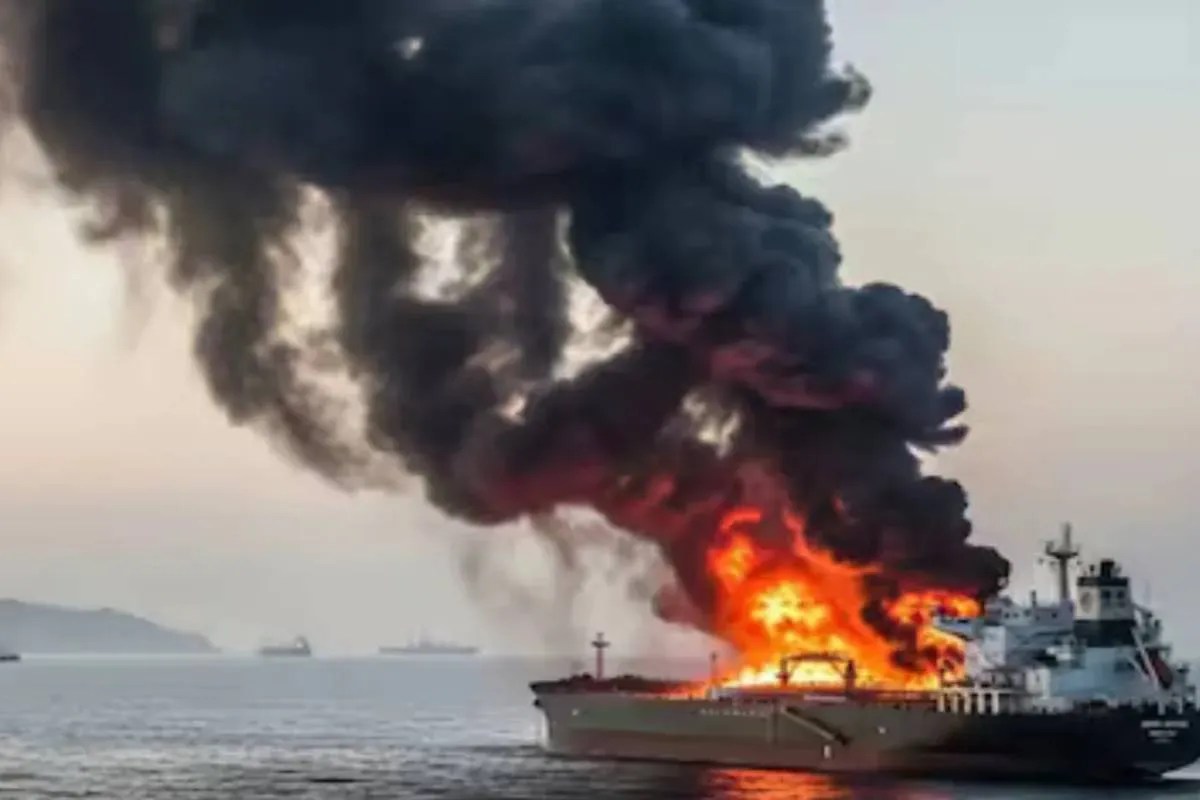
The sirens did not sound until the sky had already split open. For the families living on the jagged edges of geopolitical fault lines, peace is never a permanent state. It is merely a pause between echoes of heavy machinery and distant ordnance. When a military strike lands, the immediate aftermath is measured in shattered glass, smoke, and the abrupt, terrifying silence of disrupted lives. But beneath the rubble lies a heavier, more corrosive reality. It is the realization that the grandest military apparatus on earth is only as stable as the hand steering it.
Power is a fragile illusion. We tend to view global security through the lens of hardware. We count the fighter jets, the aircraft carriers, the defense budgets that swell into hundreds of billions of dollars. We assume that sheer muscle guarantees safety. It does not. A sword is just a heavy piece of metal if the person holding it hesitates, wavers, or worse, uses it as a prop for personal theater. When leadership falters, even the most formidable armor turns to papier-mâché. The world watches, notes the cracks in the facade, and begins to test the boundaries.
Consider the human cost when those boundaries give way. In the fallout of recent strikes, ordinary citizens—including Indian nationals caught in the crossfire of foreign policy blunders—paid the ultimate price for decisions made thousands of miles away in climate-controlled briefing rooms. They were not combatants. They were names on a manifest, workers trying to survive, individuals whose stories were violently interrupted. Their deaths highlight a stark, uncomfortable truth. When a superpower’s leadership appears fractured, chaotic, or easily manipulated, it is innocent bystanders who inherit the chaos.
The Theater of Hesitation
Militaries do not deter adversaries through presence alone. They deter through predictability and resolve. When a government’s signaling becomes a erratic pendulum swinging between isolationism and reckless aggression, the concept of deterrence evaporates. The current political discourse surrounding Donald Trump’s approach to foreign interventions reveals a deeper malaise. Critics argue that his chaotic decision-making process has turned a position of absolute strength into a global question mark.
Imagine a massive, state-of-the-art security system installed in a neighborhood. It features motion sensors, armored doors, and a direct line to armed response. Now imagine the homeowner constantly argues loudly on the front porch about whether they will even bother to turn the system on, or if they might just let a burglar take a few things to avoid a confrontation. The system becomes useless. The neighborhood notices. The predators lock their targets.
This is the exact vulnerability currently playing out on the global stage. Adversaries do not fear a giant that hesitates. They exploit the hesitation. When Washington signals that its alliances are negotiable and its red lines are written in disappearing ink, the global order destabilizes. The recent casualties are not isolated incidents of bad luck. They are the direct consequence of a world that has realized the superpower is distracted by its own internal civil war of egos.
The Cost of the Empty Threat
Every leader faces a choice between the hard work of quiet diplomacy and the instant gratification of loud rhetoric. True authority speaks softly because it knows its weight. Weakness roars. It makes grand pronouncements on social media, threatens fire and fury, and then retreats when faced with the actual complexities of geopolitical chess.
This flip-flop approach leaves allies stranded. Countries that have historically aligned themselves with Western security frameworks suddenly find themselves calculating the risks of their loyalty. If a superpower cannot guarantee the safety of its own operations or the stability of the regions it polices, smaller nations must look elsewhere for protection. The vacuum left behind is never filled by something better. It is filled by opportunistic regimes eager to rewrite the rules of international engagement.
The tragedy of the civilian deaths in these strikes is that they were entirely preventable. They occurred because the lines of communication have broken down, replaced by a style of governance that prioritizes domestic political point-scoring over strategic stability. When military actions are executed to satisfy a news cycle rather than to achieve a coherent long-term objective, the risk of collateral damage skyrockets. The targets become blurred. The intelligence becomes secondary to the optics.
Shifting Sands and Shattered Trust
Trust takes generations to build and mere seconds to demolish. For decades, global markets, trade routes, and diplomatic treaties relied on the assumption that certain lines could not be crossed without triggering an overwhelming, calculated response. That predictability was the bedrock of global economy.
Now, that bedrock is crumbling into sand. The debate shaking the political landscape isn’t just about a single strike or a specific casualty count. It is about the fundamental loss of reliability. When a leader acts on whim rather than strategy, friends and foes alike are left guessing. This unpredictability is often praised by sycophants as a brilliant tactical maneuver. In reality, it is a liability. It creates a volatile environment where miscalculation becomes inevitable. One misread signal, one panicked response from an adversary who doesn't know where the real boundaries lie, and a localized skirmish escalates into a catastrophic conflict.
The families of the victims do not care about political theories or electoral strategies. They are left with empty chairs at dinner tables and the haunting knowledge that their loved ones were collateral damage in a game of political posturing. Their grief is a silent indictment of a system that has forgotten that foreign policy is not a reality television show. It has real blood on its hands.
The lesson here is as old as civilization itself. A nation’s true strength is never found in the size of its arsenal. It is found in the clarity of its purpose, the integrity of its word, and the wisdom of its leaders. Without those, the most powerful military force in human history is nothing more than a giant blundering in the dark, inviting ridicule from its enemies and bringing disaster to those who made the mistake of trusting its shadow.