France just lost one of its own in a way that feels both tragic and frustratingly familiar. The death of Sergeant Anicet Girardin, killed during an ambush in Lebanon, isn't just another headline about military operations abroad. It’s a gut punch to the Marne region and a stark reminder of how dangerous the "Blue Helmet" mission has become. When a soldier dies under the UN flag, the grief often gets buried under layers of diplomatic jargon. Not this time. The national tribute in the Marne wasn't just a ceremony for a fallen soldier. It was a communal outcry for a man who represented the best of his generation.
People are asking why this happened now. They want to know if the mission is still worth the price. To understand the weight of this loss, we have to look past the official press releases from the Ministry of the Armed Forces. Anicet Girardin wasn't a faceless name on a casualty list. He was a son of the Marne, a dedicated member of the 132nd Canine Infantry Regiment (RIC), and his death reveals the shifting, volatile reality of the FINUL mission in Southern Lebanon.
A brutal ambush in the Land of the Cedars
The facts of the ambush are chilling. This wasn't a random accident or a technical failure. Sergeant Girardin was caught in a targeted strike while conducting a routine patrol. In the current climate of Southern Lebanon, "routine" is a word that has lost all meaning. With the border between Israel and Lebanon turned into a tinderbox, French soldiers are frequently finding themselves in the crosshairs of factions that don't respect the UN’s neutral buffer zone.
The 132nd RIC, based in Suippes, is a specialized unit. These aren't just infantrymen. They work with military working dogs, providing a unique layer of detection and protection. When Girardin went out that day, he was doing the groundwork that keeps others safe. The ambush was sudden. It was violent. It left a hole in a regiment that prides itself on its tight-knit culture and specialized expertise.
Critics of the mission often argue that French troops are "sitting ducks" in a conflict they can't control. While the UN mandates are clear on paper, the ground reality is a messy web of asymmetric warfare and shifting allegiances. Girardin knew the risks. Every soldier in the 132nd knows them. But knowing the risk doesn't make the impact of a rocket or a hail of gunfire any less devastating when it hits home.
The Marne stands still for a local hero
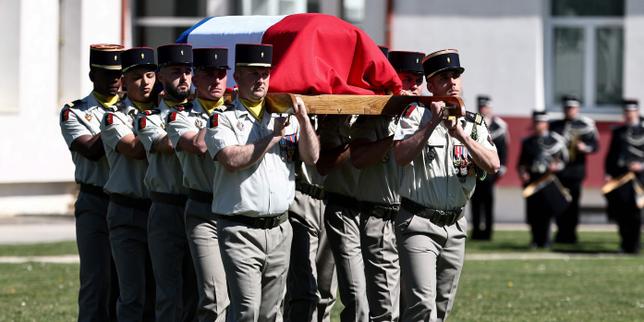
The national tribute held in the Marne served as a moment of collective mourning that went far beyond military protocol. You could feel the tension in the air. This wasn't just about the state honoring a servant. This was a community saying goodbye to one of their own. Local residents in Châlons-en-Champagne and Suippes don't see the military as a distant entity. It’s the heartbeat of their economy and their social fabric.
Flags were at half-mast, but the silence was what spoke the loudest. Seeing the rows of berets and the stoic faces of his comrades from the 132nd Canine Infantry Regiment reminds you that these losses aren't theoretical. They're deeply personal. The presence of high-ranking officials and the distribution of honors like the Legion d’Honneur are important symbols, sure. But they don't fill the empty chair at the family table.
I've seen these ceremonies before, and they usually follow a script. This one felt different. There was a raw edge to it. The Marne has a long, bloody history with conflict, and burying another young man because of a war thousands of miles away feels like a heavy burden to ask one department to carry.
Why the 132nd Canine Infantry Regiment is unique
To understand why Girardin's loss is so significant, you have to understand his unit. The 132e Régiment d'Infanterie Cynotechnique is the only one of its kind in the French Army. Based in the Marne, they manage the entire "dog" capability for the military. These teams are used for everything from tracking insurgents to detecting explosives that would otherwise kill dozens of civilians or soldiers.
- Specialized Training: These soldiers spend years bonding with their animals. It’s a partnership based on absolute trust.
- High-Risk Deployment: Because they are "force multipliers," they are often at the front of every patrol. They go where the danger is highest.
- Technical Skill: Beyond just being soldiers, they are technicians of behavior and scent.
When a sergeant from this unit is killed, the army loses years of specialized training and institutional memory. It's not a loss you can replace with a fresh recruit in six months. Girardin was an expert in a field that requires patience, discipline, and a very specific kind of bravery.
The escalating danger for FINUL forces
The United Nations Interim Force in Lebanon (FINUL) has been around since 1978. That’s a long time to be "interim." Recently, the mission has become a nightmare. French troops are caught between the Israel Defense Forces (IDF) and Hezbollah. Neither side is particularly interested in making life easy for the Blue Helmets right now.
In 2026, the technology of war has changed. We're seeing more drones and more precise indirect fire. The "rules of engagement" that used to protect peacekeepers are being ignored by actors who view the UN as an obstacle rather than a referee. Sergeant Girardin’s death is a symptom of this breakdown. If the UN can't guarantee the safety of its own personnel, the entire premise of peacekeeping starts to crumble.
France currently maintains a significant presence in Lebanon under Operation Daman. It’s one of the largest French deployments abroad. But as the body count rises, the political pressure back in Paris is mounting. Is it fair to keep sending the sons and daughters of the Marne into a situation where they have no power to actually enforce peace?
Lessons we keep refusing to learn
We keep seeing the same pattern. A tragedy occurs, we hold a beautiful ceremony, we talk about "the ultimate sacrifice," and then we send the next rotation of troops into the same meat grinder. Honestly, it’s exhausting. We need to be more honest about what we're asking these soldiers to do.
Peacekeeping isn't some passive activity. It’s active defense in a hostile environment. The death of Sergeant Girardin should spark a real conversation about the equipment and the mandates provided to our troops. Are they armored enough? Do they have the right to strike back when threatened? Or are we just hoping that the UN patch on their shoulder acts as a magic shield? Spoiler: it doesn't.
If you want to honor Anicet Girardin, don't just post a flag on social media. Understand the mission he died for. Look at the map of Southern Lebanon and realize how small the margin for error is. Support the families left behind in the Marne who have to navigate life after the cameras leave and the trumpets stop playing.
What happens to the mission now
The French government has signaled that they aren't pulling out of Lebanon yet. They argue that a total withdrawal would lead to a full-scale regional war. Maybe they're right. But that strategic "necessity" is cold comfort to the 132nd RIC.
The next few months will be telling. Watch for changes in how patrols are conducted. You’ll likely see more heavy armor and fewer foot patrols with dogs—at least in the high-risk zones. This is a tactical loss as much as a human one. When the military has to pull back its specialized units for safety, the quality of intelligence and protection on the ground drops. It’s a vicious cycle.
If you’re following this story, don't let it fade away. Keep an eye on the official reports regarding the investigation into the ambush. We owe it to Girardin to know exactly who pulled the trigger and what failures in intelligence allowed that patrol to be compromised. Real tribute isn't just about medals; it’s about accountability.
Stay informed by checking the latest updates from the French Ministry of the Armed Forces and independent military analysts who cover the Middle East. Don't rely on soundbites. Read the full reports. Support local veterans' organizations in the Marne that provide long-term care for the brothers-in-arms who return with scars we can't see.