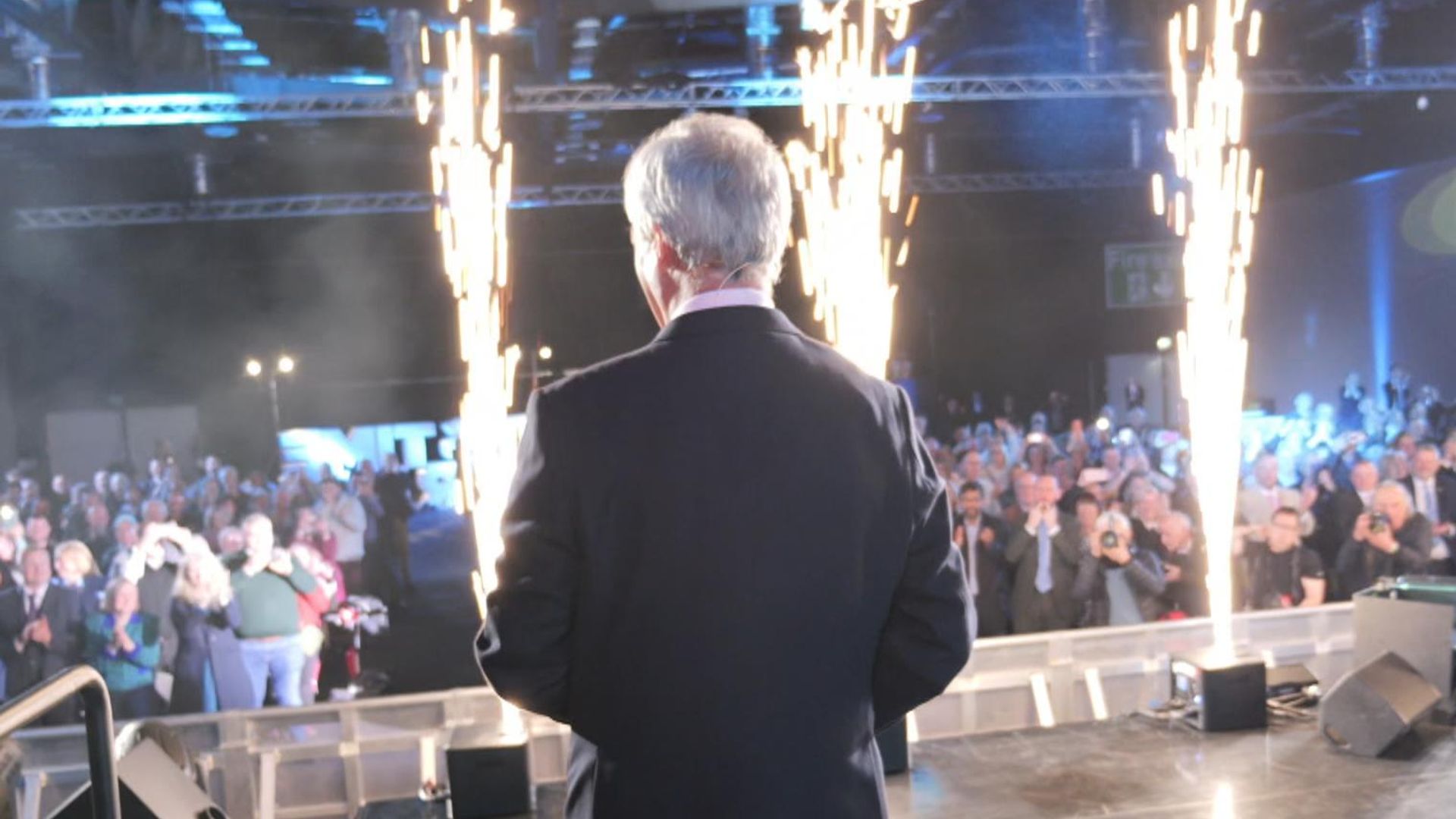
The air inside the community hall in Clacton-on-Sea smells of damp wool and high expectations. It is the kind of room where the linoleum floors have seen decades of bingo nights and parish meetings, but tonight, the atmosphere is electric with a specific, jagged kind of hope. Nigel Farage stands at the podium, a man who has made a career out of being the person you’d supposedly want to have a pint with, even if he’s usually the one holding the glass while you pay the tab.
He is irritated.
The irritation isn't just a flicker; it is a visible tightening of the jaw, a sharp recoil from the microphone. A journalist has just asked him about the math. Not the grand, sweeping "common sense" math that fits on a bus or a viral TikTok, but the gritty, inconvenient arithmetic of governance. They want to know why the bold pledges made by Reform UK—the tax cuts that look like gift-wrapped presents, the immigration stops that sound like a shutter clicking shut—haven't quite materialized into a coherent, costed reality.
"We’re not North Korea," Farage snaps back.
It is a curious defense. By invoking a hermit kingdom of total state control, he isn't just deflecting a question about policy; he is claiming the right to be disorganized. He is suggesting that the very act of being asked for a plan is an affront to the "contract" he has signed with the British people. But for the people in that room, and the millions watching through the digital keyhole of social media, the stakes aren't about North Korea. They are about the heating bill on the kitchen table and the feeling that the country is a ship taking on water while the officers argue about the color of the lifeboats.
The Anatomy of the Hook
Consider a hypothetical voter named Arthur. Arthur isn't a radical. He’s a retired engineer from a coastal town who worked forty years in a world that no longer exists. He sees the high street boarded up like a casualty of war. He hears politicians talk about "fiscal multipliers" and "headroom," and it sounds like a foreign language. Then comes Nigel.
Nigel speaks English. Nigel says it’s simple. Nigel says the reason Arthur’s grandson can’t find an affordable flat isn't a complex web of interest rates, planning laws, and global supply chains. No, it’s "them." It’s the "establishment." It’s the "bloated civil service."
This is the alchemy of the populist narrative: it turns systemic failure into a morality play. It provides a villain. When Farage bristles at being questioned on his manifesto—or "Contract," as he insists on calling it to avoid the stench of traditional politics—he is protecting that simplicity. To admit that the numbers don't add up is to admit that the world is complicated. And in the current climate, complexity is the enemy of the vote.
The "North Korea" comment was a reaction to a specific line of questioning regarding Reform's pledge to scrap the "Net Zero" transition and slash public spending. Economic experts have pointed out that the holes in these plans aren't just small gaps; they are craters. The Institute for Fiscal Studies (IFS) described the Reform UK tax and spending plans as "at best, a huge gamble." At worst? They are a fantasy that would require cuts to public services so deep they would make the last decade of austerity look like a spending spree.
The Friction of Reality
When Farage is pushed, he retreats into the persona of the insurgent. He isn't a leader yet; he is a disruptor. Disruptors don't need to explain how the plumbing works; they just need to point out that the sink is leaking.
But the leak is real.
The tension in British politics right now is the gap between the visceral anger of the electorate and the surgical reality of the Treasury. For years, the British public has been told that "taking back control" would lead to a sunlit upland. Instead, they found themselves in a thicket of bureaucracy and rising costs. Farage’s irritation is the sound of a man being asked to provide a map for a journey he only ever intended to narrate from the comfort of a television studio.
Imagine the "Contract" as a physical object. It’s glossy. It’s printed on heavy paper. It promises a £40,000 threshold before you pay a penny of income tax. To a worker earning £25,000, that sounds like a life-changing windfall. It’s the difference between a holiday and a staycation. It’s the difference between the "value" range and the brand names at the supermarket.
But when you pull the thread, the garment unravels. To fund that tax cut, you have to stop paying for something else. Farage’s answer to this is often to "bank levy" or "cut the waste," phrases that act as magical incantations in political rhetoric. In reality, "waste" is usually someone else's essential service. One man’s "bureaucrat" is another man’s oncology nurse or planning officer.
The Invisible Stakes
The real danger of the "not North Korea" defense is what it says about accountability. If a political movement claims that it is exempt from the standard scrutiny of "boring" economics because it represents "the people," it creates a dangerous vacuum.
We see this pattern globally. It starts with the rejection of the expert, moves to the irritation with the journalist, and ends with the dismissal of the fact itself. Farage is a master of this trajectory. By framing a request for a costed plan as a symptom of a "Stalinist" or "North Korean" desire for control, he flips the script. The person asking for the truth becomes the oppressor. The person dodging the truth becomes the freedom fighter.
This is a seductive flip. It appeals to a sense of rugged individualism. It suggests that we can common-sense our way out of a national debt that looks like a telephone number. But the invisible stakes are the people like Arthur. If the gamble fails—if the tax cuts lead to a run on the pound or a collapse in bond markets—Arthur isn't the one who suffers most. The people at the top of the Purple Tide have their exits planned. The people on the linoleum floors of the community halls do not.
The conversation around Reform's promises isn't just about politics; it's about the erosion of the shared reality required for a democracy to function. When we stop demanding that the math works, we start voting for ghosts. We start believing that there is a secret vault of money guarded by "elites" that can be unlocked if we just find a loud enough key.
The Mirror and the Mask
Farage is often described as a mirror. He reflects the frustrations of a forgotten class. But a mirror only shows you what is in front of it; it doesn't offer a way out of the room.
His irritation in the face of questioning is a mask slipping. It reveals that beneath the jovial, pint-clutching exterior is a man who finds the mechanics of truth-telling to be a nuisance. He wants the roar of the crowd, not the silence of the spreadsheet. He wants the "North Korea" quip to trend on X (formerly Twitter) because it’s punchy and defiant. It doesn't matter that it's nonsensical in the context of a budget inquiry. What matters is the vibe.
But vibes don't pave roads. Vibes don't fix the NHS waiting lists that have stretched into years.
There is a specific kind of exhaustion settling over the UK. It’s a fatigue born of being promised "straight talk" that turns out to be just another flavor of evasion. Whether it’s the "big beast" politicians of the old guard or the "insurgents" of the new, the pattern remains the same: the promise is a lion, the delivery is a mouse.
The journalist’s question remains hanging in the air, long after the cameras have cut away and the hall has emptied. It is a simple question: How? How do you lower the income of the state while increasing the demands on its services? How do you stop the tide of history with a slogan? How do you ensure that the "Contract" isn't just a piece of paper that will be discarded the moment the polls close?
Farage doesn't have the answer, or if he does, he finds the act of giving it to be beneath him. He would rather talk about dictatorships than decimals. He would rather fight a straw man than a statistician.
As the sun sets over the grey waters of the North Sea, the people of towns like Clacton are left with the same questions they had before the purple bus rolled into town. They are still waiting for a savior who knows how to do the laundry as well as they know how to start a fire. They are still waiting for a leader who understands that being "not North Korea" is the bare minimum requirement of the job—not a shield to hide behind when the math gets hard.
The man at the podium packs his bags and heads for the next town, the next hall, the next pint. The lights in the community center flicker and die. The linoleum remains, cold and indifferent, waiting for the next person to promise it the world while the roof continues to leak.


