Sarah stands in the hallway of an Edmonton elementary school, listening to a sound that haunts every parent in the neighborhood.
It is the sound of absolute silence.
She holds a white slip of paper in her hand. It is not a report card, a permission slip, or a drawing to stick on the fridge. It is a notification that her seven-year-old son, Leo, has been placed on a waitlist for the neighborhood school. He lost the lottery. To get to his new designated classroom across the city, he will have to board a yellow bus before the sun rises and spend nearly two hours a day commuting. He is in the second grade.
This is the reality of a province bursting at the seams. Over the past four years, roughly 90,000 new students have flooded into the Alberta school system. Imagine trying to fit the entire population of a major city into a network of classrooms that was already packed to the brim. In Calgary, the Board of Education reports that 160 schools are currently full or over-capacity, with high schools operating at a staggering average of 107 percent capacity.
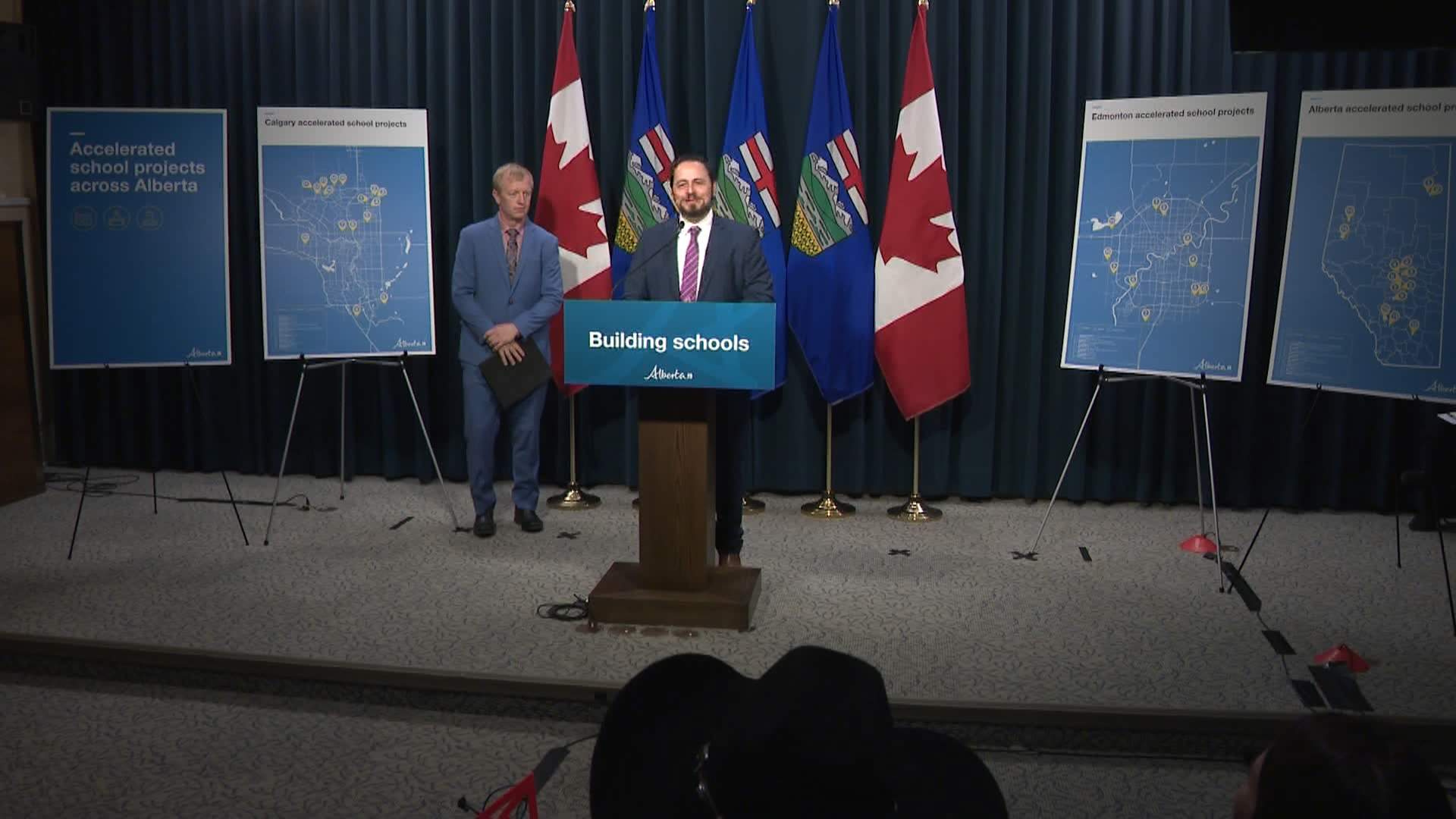
On a Thursday morning, the provincial government offered a grand gesture of relief. Education Minister Demetrios Nicolaides announced that 41 school projects across the province are being fast-tracked under the "Schools Now" program. This acceleration, the government claims, will shave anywhere from six weeks to nine months off construction timelines, eventually bringing 39,000 new or upgraded student spaces to communities that are desperately suffocating for room.
On paper, it sounds like a triumph. In reality, it highlights a much deeper, more troubling friction.
The Illusion of Shovels and Stone
Step back and look at the math. The government's plan promises to push 16 projects ahead in Calgary and 11 in Edmonton. For families who have spent months watching their children learn in overcrowded staff rooms or converted libraries, the announcement feels like rain in a drought. But experienced hands in the education sector know that moving a line item on a government spreadsheet is not the same as pouring concrete.
"Fast-tracking schools from the planning to the design stage isn't like putting shovels in the ground," warns Wing Li, a spokesperson for the advocacy group Support Our Students.
Of the 41 accelerated projects, only 19 are actually approved to begin construction. The rest are merely transitioning from abstract concepts to blueprint designs. For a parent like Sarah, a blueprint does not solve tomorrow morning's commute. It does not stop a lottery system from deciding if a child gets to go to school with the kids on their block.
This is where the frustration turns cynical. Critics argue that the timing of these announcements carries a distinct scent of political preservation. When a government faces intense pressure over public services, the easiest antidote is a press conference featuring glossy renderings of future buildings. It creates a visible monument of progress.
But a building is just an empty shell.
The Ghost Classrooms
Consider a hypothetical scenario that plays out in every newly constructed building. The ribbon is cut. The glass shines. The hallways smell of fresh paint and drywall. The doors open, and hundreds of children rush inside, ready to learn.
They sit at their desks. They look at the front of the room.
The chalkboard is blank. The teacher's chair is empty.
This is the invisible crisis that no construction accelerator program can fix. A school is not defined by its bricks and mortar; it is defined by the human beings who bring those spaces to life. Right now, Alberta is facing a crippling shortage of qualified educators. The province isn't just short on desks; it is short on human souls willing to stand in front of them.
"We know that there aren't enough professionals in this province entering that teaching profession or staying in the teaching profession," Li points out. "So having four walls and windows is great, but who is going to be teaching face-to-face in these classrooms?"
The relationship between the provincial government and its teaching workforce has been deeply fractured. The wounds are fresh. Just months ago, in October 2025, the province invoked the notwithstanding clause to legally override teachers' constitutionally protected right to strike, forcing an end to a bitter province-wide labor dispute.
You cannot aggressively force an exhausted workforce back to the blackboard and then wonder why young professionals are refusing to enter the field. Morale cannot be engineered with an infrastructure budget. When educators feel undervalued, policed by new restrictive classroom legislation, and stripped of bargaining power, they leave. The teachers who remain are left to manage classrooms that are not only overcrowded but increasingly complex.
The Stakes Beyond the Ballot Box
It is easy to view this entire saga through the cold lens of partisan politics. One side announces a multi-million dollar infrastructure push to court growing suburban voting blocs. The other side correctly identifies the gaps in human resources and calls it a stunt. The media reports the back-and-forth, and the public shrugs, accustomed to the predictable rhythm of political theater.
But the real problem lies elsewhere.
The true cost of this friction is borne by the children who are quietly absorbing the ambient stress of a system under siege. It is found in the teacher who stays up until midnight adjusting lesson plans for 35 different kids, knowing they cannot possibly give each one the individual attention they deserve. It is found in the parents who feel like they are gambling with their children's foundational years every time a new school year approaches.
Alberta will build these schools. The economic momentum of the province demands it. The concrete will be poured, the glass will be set, and the politicians will return to stand behind podiums, smiling for the cameras as they claim credit for the modern architecture.
But as the crowds clear and the echoes of the press conferences fade, the success of these institutions will not be measured by the speed of their construction timelines. It will be measured by whether a tired, disillusioned province can somehow find enough teachers to walk through those new doors, look at the waiting children, and choose to stay.