The dust in the Taklamakan Desert does not look like it could hold a secret. For centuries, it has stayed exactly the same: a blinding, baked expanse of ochre and ash where the air smells of parched clay and iron.
Zhang Wei has spent twelve years watching this horizon. As a senior maintenance engineer for the high-speed rail lines threading through China’s far-western Xinjiang region, his job has always been to fight the sun. He knows how steel rails behave when the mercury touches 45°C. He understands the rhythmic shifting of sand fences designed to keep dunes from swallowing the concrete ties.
But three months ago, standing on an embankment outside Korla, Zhang felt something that did not belong in the desert.
Moisture.
It was a thick, heavy dampness that clung to the skin, followed by an sky that turned the color of bruised slate. Then came the downpour. Not the fleeting, stuttering sprinkle the locals call a rain, but a violent, drumming sheet of water that turned the baked clay beneath his boots into an unreadable, slick paste.
Within hours, a dry gully nearby became a brown torrent. It roared toward the ballast, biting at the edges of an engineering marvel built to endure everything except this.
Something is shifting beneath the grandest infrastructure project on earth. Xinjiang, a region synonymous with ancient aridity and the dust-choked tracks of the Silk Road, is getting wet.
The Weight of an Arid Past
To understand why a few inches of water can threaten billions of dollars of modern engineering, you have to look at how the desert was conquered.
When planners drew up the blueprints for Xinjiang’s massive expansion—the deep-cutting highways, the high-voltage grids, the soaring viaducts of the multi-billion-dollar rail network—they built for the world they knew. It was a world governed by an absolute lack of water.
In engineering, this is called designing to the baseline. If an area historically receives 50 millimeters of rain a year, your drainage systems, culverts, and foundation formulas are optimized for exactly that. You build thick, heavy embankments out of local, silt-heavy soils because they are highly stable under intense heat and dry conditions. You don't spend limited budgets on massive storm drains or wide-bore culverts because the water to fill them simply doesn't exist.
But nature has ripped up the baseline.
Data from atmospheric monitoring centers across the region reveals a troubling reality. Over the past few decades, and accelerating sharply in recent seasons, a massive climatic pivot has taken hold. A combination of rising global temperatures and shifting atmospheric vectors is funneling intense pockets of moisture deep into central Asia. The air is warmer. Warmer air holds more water vapor. When that moisture hits the high, freezing peaks of the Tianshan and Altai mountain ranges, it does not dissipate.
It drops. All at once.
Consider what happens next: a single convective storm in Northern Xinjiang can now dump an entire year’s worth of historical average rainfall in less than ninety minutes. In 2018, a town near Hami was hit by 110 millimeters of rain in an hour—more than double its usual annual quota. The trend has only intensified since.
The results are catastrophic, not because the volume of water would flood a city like Shanghai, but because the desert has nowhere to put it.
When Solid Earth Liquefies
The real problem lies in the chemistry of the desert floor itself.
Much of Xinjiang's infrastructure rests on what engineers call collapsible loess and saline soils. When dry, these soils are incredibly strong, bound together by crystalline salts and baked hard by centuries of intense sun. They can support the immense weight of concrete pylons and heavy freight trains without flinching.
Water changes everything.
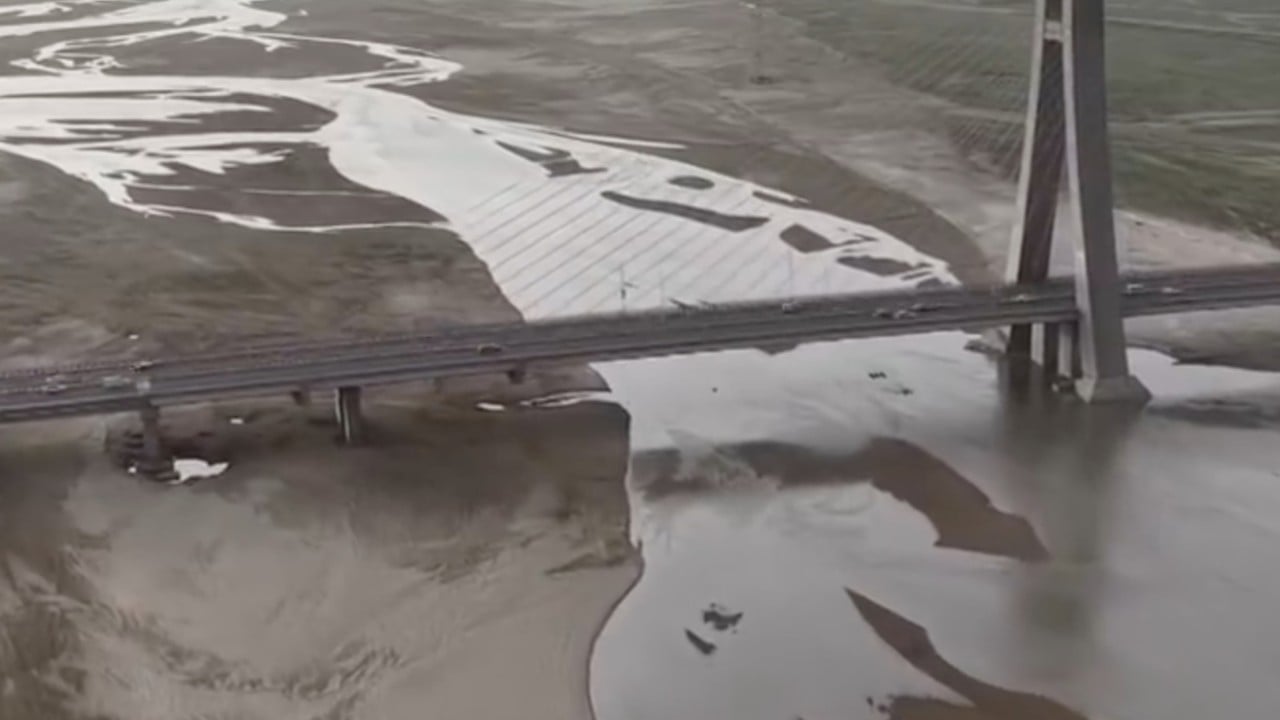
When a flash flood hits these saline foundations, the water dissolves the binding salts instantly. The soil structural matrix collapses. A solid embankment transforms into a heavy, moving soup in a process known to geologists as piping.
Imagine a hypothetical bridge carrying fiber-optic cables and a four-lane highway across a dry valley. The concrete pillars are anchored deep into the sediment. When an unprecedented surge of mountain runoff fills the valley, it doesn't just pool around the pillars; it aggressively eats the ground holding them up. The soil liquefies, the foundation shifts by just a few centimeters, and the entire structure cracks.
This is not a distant, theoretical worry for the future. It is happening now along the edges of the Tarim Basin.
Maintenance crews who once spent their days clearing windblown sand from the tracks are now being retrained as flood response units. They carry sandbags instead of dust brushes. They watch radar screens with a nervous intensity once reserved for coastal rail operators in the path of typhoons.
The invisible stakes extend far beyond local travel. Xinjiang is the literal gateway of the Belt and Road Initiative, the physical corridor connecting East Asian factories to European markets. Every high-speed train, every container of electronics, and every barrel of oil moving overland must pass through these mountain passes and desert depressions.
If a key bridge settles, or a chunk of ballast washes out, the supply chain doesn't just slow down. It breaks.
The Dilemma of Concrete and Sky
There is a profound irony in this drowning landscape. For decades, the primary challenge of engineering in the west was finding enough water to mix concrete and sustain human life. Now, the challenge is surviving its abundance.
Can an entire empire of concrete be retrofitted for a climate it wasn't built to face?
It is a terrifyingly expensive question. To fix the problem, engineers cannot just slap on a coat of waterproof sealant. They have to rethink the entire geography of drainage.
- Every small culvert running beneath thousands of miles of asphalt must be dug out and replaced with wider, reinforced concrete channels.
- Embankments must be chemically stabilized with polymers to prevent the internal salts from dissolving during sudden deluges.
- Slope-protection networks, currently consisting of simple stone lattices, must be anchored deep into bedrock to stop mudslides from burying vital rail arteries.
It is a race against an erratic clock. The weather is changing faster than the procurement cycles of local governments.
Back on the line outside Korla, Zhang Wei stands near a newly dug drainage trench. It is three times wider than the one it replaced, a jagged scar of fresh concrete cutting through the ancient yellow earth. It looks absurdly oversized for a place where the sun is currently baking the air to a shimmer.
But Zhang keeps his eyes on the white peaks of the distant mountains, where the clouds are beginning to gather once again. He knows the truth that the architects of the past missed.
The desert is no longer dry, and the concrete must learn how to swim.