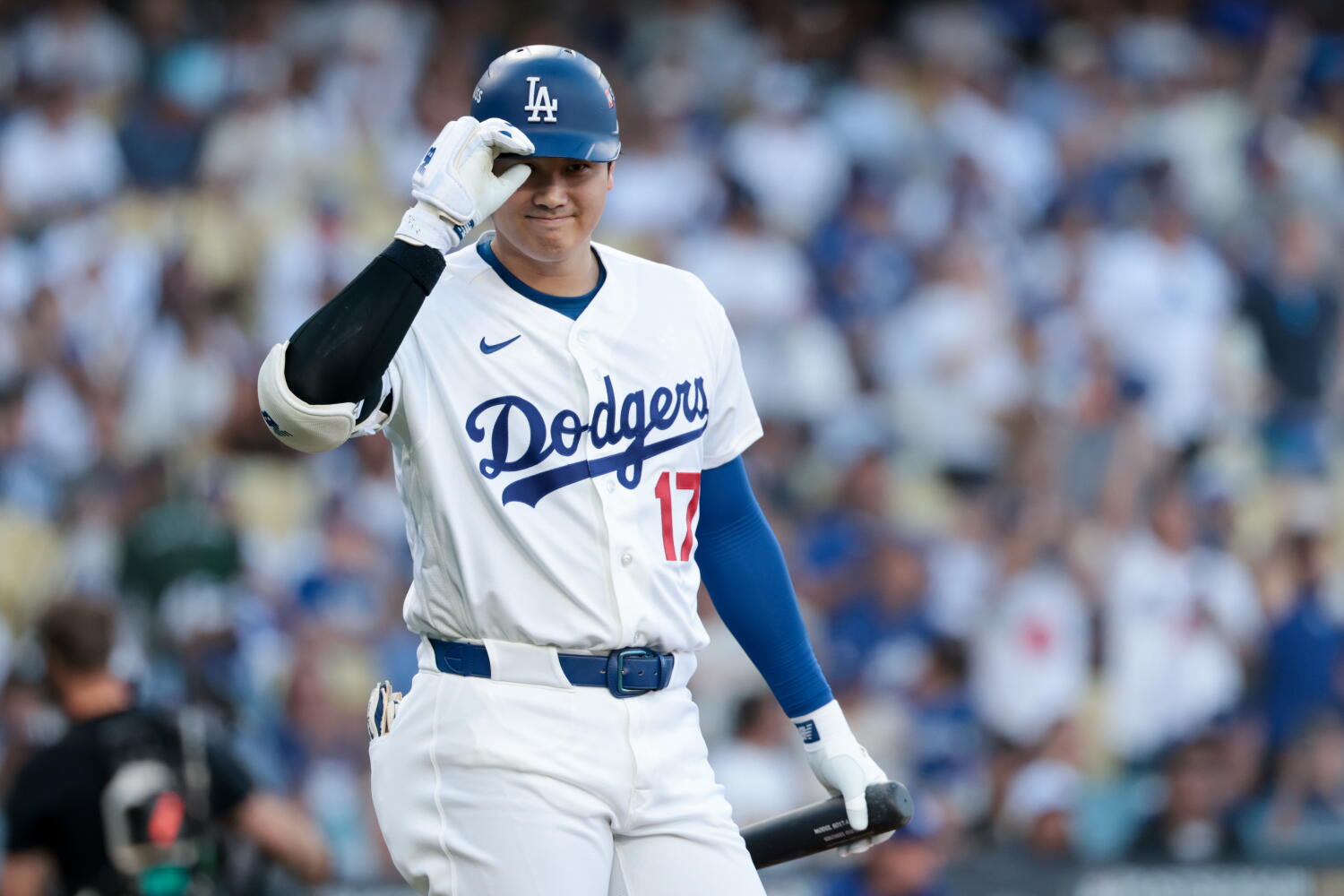
The sound is what stays with you.
If you have ever stood behind the batting cage during a quiet afternoon workout at Dodger Stadium, you know the distinct, hollow thwack of a wooden bat meeting a leather sphere at one hundred and fifteen miles per hour. It is a sharp, violent crack that echoes off the empty yellow seats in the upper deck. Then, thirty minutes later, you walk down the concrete tunnel toward the bullpen, and you hear a completely different acoustic signature. It is the heavy, wet slap of a four-seam fastball exploding into a catcher’s mitt at ninety-nine miles per hour, followed by the soft, rhythmic grunt of a six-foot-four human frame violently decelerating from a full sprint to a dead stop on a dirt mound.
For most of baseball history, those two sounds belonged to entirely different species of athletes.
They lived in separate ecosystems, followed incompatible sleep schedules, and subjected their bodies to mutually exclusive forms of trauma. Until Shohei Ohtani arrived from Iwate Prefecture and decided that the evolutionary boundaries of modern sport were merely suggestions.
Now, as the sports pages fill up with heated letters from fans, front-office executives, and orthopedic surgeons debating his two-way workload, we are witnessing something far deeper than a simple scheduling dispute. We are watching a tug-of-war over the soul of athletic ambition. Every time Ohtani steps onto the field, a silent question hangs in the humid stadium air. Should we protect the miracle by locking it in a glass case, or let it burn bright until the fuel runs out?
The Myth of the Indestructible Man
To understand why the debate over Ohtani’s workload makes grown men argue in barbershops and boardrooms, you have to understand what the human arm actually is.
As an analogy, think of a Major League pitcher’s ulnar collateral ligament—the famous UCL—not as a sturdy steel cable, but as a single strand of braided silk stretched over a jagged stone. Every time a pitcher throws a splitter or a sweeping slider, that silk thread absorbs enough torque to snap a broomstick. When you pitch once every five days, your body spends the four intervening nights in a frantic, microscopic construction project, rushing blood and proteins to patch the tiny tears in the muscle fibers before you have to do it all over again.
Now, imagine telling that same construction crew that on their days off, they also have to build a skyscraper.
That is the reality of Ohtani’s daily existence. While other starting pitchers spend their non-throwing days sitting in cold tubs, getting soft-tissue massages, and watching game film in air-conditioned lounges, Ohtani is in the cages taking fifty full-effort swings, sprinting ninety feet down the first-base line, and sliding headfirst into second base with a heavy protective oven mitt strapped to his hand.
In September 2023, the bill finally came due. Ohtani tore his UCL for the second time in his career, forcing him to undergo a major elbow revision surgery that kept him off the mound for the entire 2024 season. Yet, in a twist that defied every medical textbook in North America, he spent that recovery year becoming the first player in baseball history to hit fifty home runs and steal fifty bases in a single season. He won his third unanimous Most Valuable Player award without throwing a single pitch in a live game.
And that is precisely where the fracture line in the baseball world began to widen.
Two Voices in the Bleachers
Consider a hypothetical scenario playing out in living rooms from Los Angeles to Tokyo right now.
On one side of the couch sits Arthur, a seventy-two-year-old retired civil engineer who has kept scorecards with a sharpened number-two pencil since the days of Sandy Koufax. Arthur looks at Ohtani’s seventy-million-dollar annual contract and sees a simple math problem. When Ohtani only hits, he is the most dangerous offensive force on the planet, a perennial MVP candidate who never has to leave the lineup because his elbow is barking. When he pitches, he introduces a catastrophic variable. To Arthur, asking a fifty-home-run hitter to throw one hundred pitches every sixth day is like taking a priceless Stradivarius violin out into a thunderstorm just to prove it can still hold a tune. Why risk a generational dynasty for a novelty act?
On the other side of the couch sits Maya, a twenty-eight-year-old high school softball coach who grew up watching highlight reels on her phone. To Maya, Arthur’s logic misses the entire point of why we watch sports in the first place. Sports are not an accounting exercise designed to maximize return on investment over a ten-year amortization schedule. They are a theater of the impossible. If you strip away Ohtani’s pitching, you turn a mythological figure—the modern Babe Ruth, the singular unicorn of professional athletics—into a mere mortal, albeit a terrifyingly strong one. Maya argues that Ohtani did not sign with the Dodgers to be bubble-wrapped; he came to push the boundaries of human capability until the walls caved in.
Both Arthur and Maya are right. And that is what makes this debate so agonizing.
I remember sitting in the press box during the 2023 World Baseball Classic final in Miami, watching Ohtani jog out from the bullpen in the ninth inning to face his own Angels teammate, Mike Trout, with a championship on the line. The stadium was shaking so violently that my coffee cup vibrated across the wooden desk. Nobody in that building was thinking about pitch counts, thoracic outlet syndrome, or long-term asset management. We were holding our breath because we knew we were watching a moment that would be talked about a hundred years from now. When Ohtani struck Trout out on a vicious, eighty-seven-mile-per-hour slider that bent away from the barrel like a mirage, the roar was primal.
You do not get that roar from a designated hitter. You only get it when the guy who just hit a double in the seventh inning walks to the hill in the ninth to finish the job himself.
The Invisible Toll of the Double Shift
Still, romanticism has a habit of ignoring the ice packs.
When front offices and fans debate Ohtani’s two-way workload, they often focus entirely on his right elbow, treating the rest of his body like an afterthought. That is a profound misunderstanding of kinetic chains. Everything in baseball starts from the ground up. When Ohtani swings a bat from the left side, he violently rotates his hips counter-clockwise, generating immense shearing forces across his lower back and obliques. When he pitches with his right arm, he rotates his torso in the exact same direction, over and over, twisting his spine like a wet towel being wrung dry.
There is no symmetry in his athleticism. There is no counterbalance.
Let us look at the cold, hard numbers of what happens when a two-way star enters his thirties. Historically, power hitters who rely on explosive bat speed begin to see a slight decline in their exit velocity around age thirty-one or thirty-two. Starting pitchers, meanwhile, see their average fastball velocity dip by roughly half a mile per hour every season after age thirty, forcing them to rely more heavily on deception, command, and secondary breaking pitches that put even greater stress on the forearm flexors.
Ohtani is navigating both aging curves simultaneously.
By 2026, having crossed the thirty-year threshold with two major elbow surgeries already etched into his medical chart, every bullpen session is a negotiation between desire and biology. Critics who write angry letters demanding that he either become a full-time outfielder or a closer are not necessarily haters who want to ruin the fun. Many of them are scarred by history. They remember Bo Jackson’s hip popping out of its socket on a routine tackle. They remember Ken Griffey Jr.’s hamstrings tearing apart on the AstroTurf in Cincinnati. They have seen how quickly brilliance turns into a bittersweet "what if," and they are terrified of watching Ohtani’s career end on a Tuesday night in July with him grabbing his forearm and walking slowly toward the dugout with a trainer at his side.
The Psychology of Refusal
Yet, if you try to tell Ohtani to stop pitching, you run headfirst into a wall that no analytical model can account for: his own identity.
Athletes at the absolute summit of human performance are rarely rational actors. Rational actors do not spend their teenage years writing down rigid life matrices in notebooks, mapping out the exact month they will win the Cy Young Award and the exact year they will hit a home run in the World Series. Rational actors do not move across an ocean at twenty-three years old, turning down hundreds of millions of dollars under international bonus rules just to get to Major League Baseball two years earlier, solely because a team promised they would let him hit and pitch.
For Ohtani, the workload is not a burden imposed by greedy owners or demanding fans. It is the oxygen he breathes.
Consider what happens next if you force him to choose one path. If you make him a full-time designated hitter, you take away his competitive outlet on the four days a week when he only gets four plate appearances—roughly fifteen minutes of actual physical action over a three-hour game. Anyone who has spent time around elite competitors knows that idle time is poison. Pitching keeps Ohtani locked into the rhythm of the game in a way that sitting on the bench waiting for his turn in the batting order never could. Conversely, if you make him a full-time pitcher, you silence the loudest bat in baseball, depriving the sport of the electric anticipation that sweeps through a stadium every time he steps into the batter's box with runners on base.
The compromise that baseball executives are quietly crafting—and the one that makes the most sense for the years ahead—is not an all-or-nothing ultimatum. It is a radical reimagining of how a baseball season is paced.
We are already seeing the blueprint take shape: a six-man pitching rotation that gives Ohtani an extra day of rest between starts, scheduled days off from hitting the afternoon after he throws ninety pitches, and a strict cap on his regular-season innings so that his arm still has bullets left in the chamber when October arrives. It is a delicate, high-wire balancing act that requires constant communication between a fiercely proud superstar and a medical staff armed with wearable biometric sensors that track everything from his sleep quality to his forearm fatigue.
The Verdict in the Dirt
At the end of the day, the debate over Shohei Ohtani’s workload is really a mirror reflecting our own attitudes toward risk and greatness.
We live in an era obsessed with optimization. We track our steps, monitor our heart rates, diversify our portfolios, and sand down every sharp edge in life to minimize the chance of failure or injury. Baseball itself has become a game of probabilities, launch angles, and spin rates, managed by spreadsheets that calculate the exact percentage point gained by pulling a pitcher one batter early.
Ohtani is an offense against that sterile worldview. He is messy, inefficient, dangerous, and gloriously human.
Maybe his elbow holds together for another five years of thirty-home-run, fifteen-win seasons, cementing a legacy that no player in the next century will ever dare to touch. Or maybe, one humid evening under the bright stadium lights, his arm finally whispers enough, and he spends the final chapter of his career smashing baseballs into the upper deck as the greatest designated hitter who ever lived.
Either way, the price of admission has already been paid in full.
Late on a quiet night at the ballpark, long after the fans have filed out to their cars and the grounds crew has finished raking the infield dirt, the stadium lights flick off one bank at a time. Down on the mound, the white pitching rubber sits empty, bearing the deep, jagged cleats marks of a man who refused to pick just one dream when he knew he was strong enough to carry two.