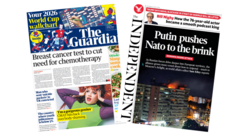
We wake up, grab a coffee, and glance at the front pages. One morning, the papers hit you with a bizarre, whiplash-inducing combination. Side by side, editors scream about Vladimir Putin pushing NATO to the absolute brink of conflict, while simultaneously celebrating a groundbreaking breast cancer test that could save thousands of lives.
It’s classic British journalism. Total geopolitical dread mixed with domestic scientific triumph.
But when you strip away the sensationalist ink, what are these stories actually telling us? The way the UK press packages major global escalations alongside monumental medical breakthroughs reveals a massive systemic issue. We’re being fed panic and hope in equal, superficial measures, leaving most readers entirely unequipped to understand what’s actually happening behind the scenes.
Let's look at what the mainstream press glossed over, what they got wrong, and what you actually need to know about these shifting global realities.
The Threat Inflation Behind the NATO Headlines
When the papers claim Putin is pushing the West to the brink, they want you to picture immediate, full-scale mobilization. It sells copies. It drives clicks. But the reality of modern geopolitical friction is far more calculated and less cinematic.
The press loves to treat every Russian airspace violation or aggressive military exercise as an unprecedented step toward global conflict. In truth, this brinkmanship is a highly choreographed gray-zone strategy. Russia isn't looking to trigger Article 5 tomorrow morning. Instead, the Kremlin specializes in sub-threshold aggression. This means cyberattacks on critical infrastructure, GPS jamming over the Baltic Sea, and intense disinformation campaigns designed to fracture Western political alignment.
By framing the situation purely through the lens of traditional warfare, the mainstream media misses the real danger. The threat isn't just tanks rolling across borders; it's the steady, quiet erosion of institutional trust and security. When everything is labeled a crisis, nothing feels like one anymore. Fatigue sets in, and that's exactly what adversarial intelligence networks count on.
The Real Science of the New Breast Cancer Screenings
On the flip side of the front page, we usually get the medical miracle narrative. The phrase "groundbreaking breast cancer test" gets tossed around by health editors almost every quarter. It sounds incredible, but the hype frequently outpaces the actual clinical implementation.
The media paints a picture of a magic bullet, a simple blood test or AI tool that will wipe out late-stage diagnoses by Friday. Here's what they leave out. Validating a new diagnostic tool takes years of rigorous, multi-phase clinical trials. Take the recent advancements in liquid biopsies and AI-integrated mammography, like the Transpara systems tested in Europe. They show immense promise. Some trials demonstrate a 29% increase in early cancer detection when pairing a single radiologist with AI compared to two human eyes alone.
But you can't just deploy this to every local hospital overnight.
The logistical reality is incredibly messy. Integrating advanced diagnostic software requires massive capital investment, widespread staff retraining, and a total overhaul of existing patient pathways. Furthermore, there’s the persistent challenge of false positives and over-diagnosis. Identifying micro-lumplike structures that might never actually progress can lead to unnecessary, invasive treatments and profound patient anxiety. The papers rarely find space on the front page to discuss diagnostic specificity or the economic strain on healthcare systems.
How the Media Distorts Our Perception of Risk
This jarring juxtaposition of war and wellness highlights a deeper problem with how we consume information. Our brains aren't wired to process an existential nuclear threat and a localized medical breakthrough at the same exact time over breakfast.
[Geopolitical Dread: Putin vs. NATO] <---> [Domestic Hope: Cancer Breakthrough]
                                    \     /
                                     \   /
                              [Risk Distortion]
The press creates an environment of permanent cognitive overload. By presenting these stories with the same level of urgency, editors distort our actual perception of risk. People end up terrified of a sudden global conflict that is structurally unlikely, yet they remain largely unaware of how to navigate or access the actual cutting-edge healthcare developments happening in their own backyards.
We see the headlines, internalize the anxiety, and completely miss the actionable context. It's a lucrative business model for media conglomerates, but it's a terrible way to build an informed public.
What You Should Do Next
Stop relying entirely on front-page aggregates to form your worldview. They are curated for emotional impact, not structural depth.
If you want to understand the actual state of European security, look to deep-dive policy analyses from institutions like the Royal United Services Institute (RUSI) or the International Institute for Strategic Studies (IISS). They strip away the panicked rhetoric and focus on troop movements, logistics, and supply chains.
When it comes to medical news, don't wait for a sensational headline to take charge of your health. Talk directly to your GP about your specific risk factors, understand your family history, and ask about the availability of newer digital breast tomosynthesis or AI-assisted screenings at your local health trust. True awareness doesn't come from a dramatic morning headline. It comes from looking past the hype and focusing on the underlying facts.