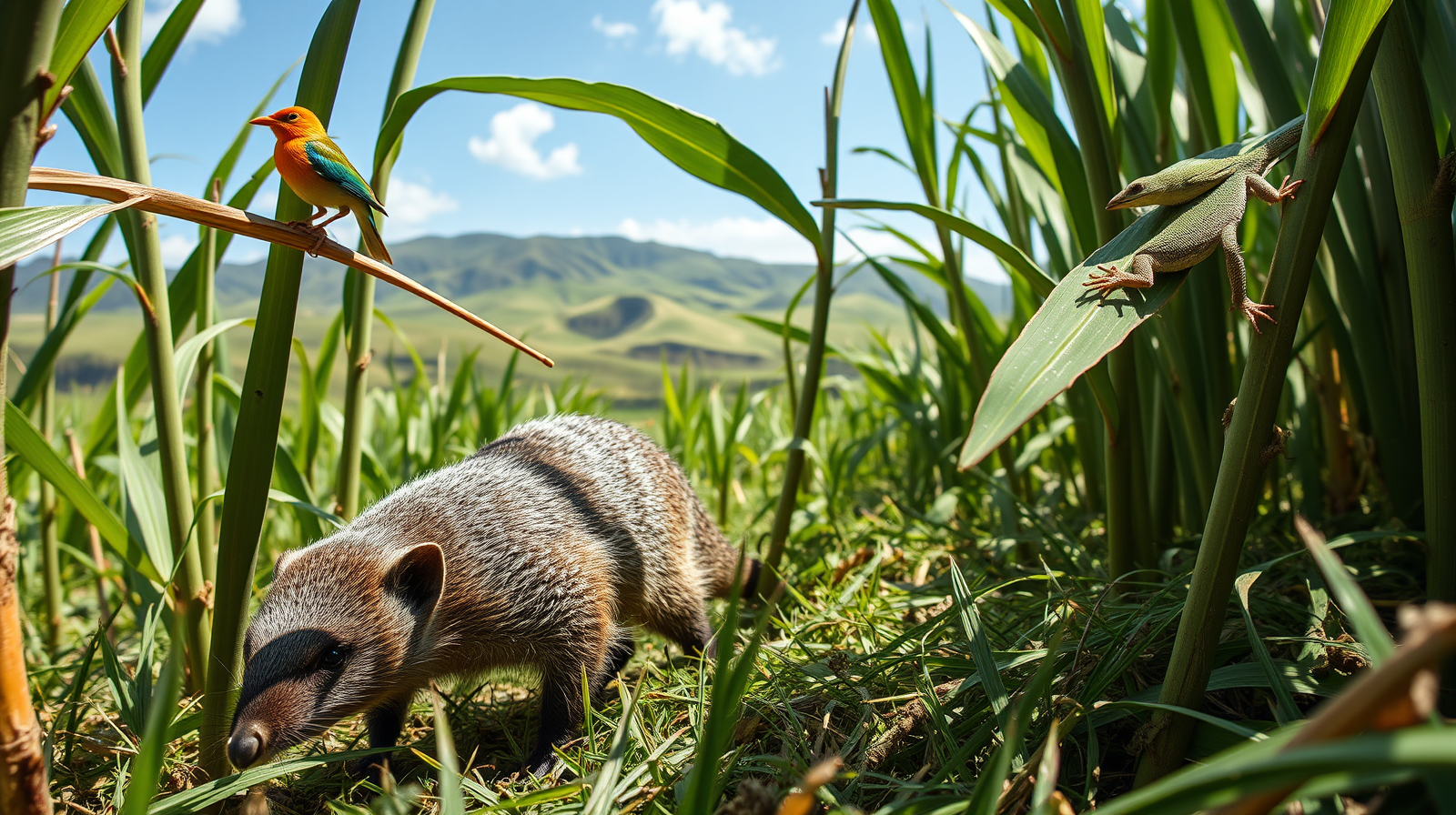
Ecology loves a simple villain. For decades, the story of Urva auropunctata—the small Indian mongoose—in Hawaii has been served up as the ultimate cautionary tale of biological control gone wrong. The narrative is comforting in its simplicity: foolish sugar barons in 1883 imported a nocturnal predator to fight diurnal rats, the two species completely missed each other, and the mongoose turned its attention entirely to decimating pristine native bird populations.
It is a neat, tidy story. It is also fundamentally flawed.
The conventional wisdom surrounding the Hawaiian mongoose relies on historical lazy consensus rather than rigorous population dynamics. By fixation on a single visible scapegoat, conservation narratives routinely ignore the systemic habitat destruction, avian malaria, and existing apex rodents that actually drove Hawaii’s avian crisis. The mongoose did not ruin Hawaii’s ecosystem; it merely moved into an ecosystem that was already broken.
The Temporal Mismatch Myth
Let’s dismantle the foundational lie of the mongoose critique: the idea that mongooses and rats completely missed each other because one sleeps while the other wakes.
This argument assumes animals operate like factory shifts. In reality, the black rat (Rattus rattus) and the Polynesian rat (Rattus exulans) exhibit significant crepuscular and daytime activity when population densities are high or when sugarcane fields provide dense, continuous cover. Field dissections from researchers as far back as the mid-20th century confirmed that mongooses were, in fact, consuming massive quantities of rats.
The introduction of the mongoose did exactly what the Planters' Labor and Supply Company wanted: it suppressed rodent biomass in the agricultural lowlands. The failure wasn't that the mongoose ignored the rats. The failure was the naive economic assumption that biological suppression equals total eradication. When you introduce a generalist predator into a disrupted landscape, it adapts. To blame the predator for adapting to a highly altered, artificially created monoculture is an exercise in intellectual laziness.
The Real Drivers of Avian Extinction
The dominant narrative implies that Hawaii was an avian paradise until the mongoose stepped off the boat in 1883. This ignores a century of ecological devastation that preceded it.
| Threat Factor | Timeline of Impact | Primary Ecological Consequence |
|---|---|---|
| Feral Pigs & Cattle | Late 18th Century | Widespread destruction of understory vegetation; creation of breeding pools for mosquitoes. |
| Avian Malaria (Plasmodium relictum) | Early 19th Century | Near-total elimination of native honeycreepers below 4,000 feet elevation. |
| Black Rats (Rattus rattus) | Mid-19th Century | Intensive canopy predation of eggs, nestlings, and roosting adult birds. |
| Small Indian Mongoose | Late 19th Century | Ground-level predation largely restricted to disturbed, low-elevation areas. |
Long before 1883, the lowlands of Oahu, Maui, and Kauai had already been stripped of native forests to make way for cattle ranching and sugar plantations. Native birds like the honeycreepers were already functionally extinct in these zones due to habitat loss and the introduction of the southern house mosquito (Culex quinquefasciatus), which carried avian malaria.
The mongoose is a terrestrial, low-altitude predator. It does not climb trees with the agility of the black rat. It does not fly into the high-altitude forest refugia where the remaining endangered native birds live. The species most heavily impacted by the mongoose—such as the Nene (Hawaiian goose) and the Hawaiian petrel—were already suffering catastrophic declines due to feral dogs, feral cats, and massive human hunting pressures.
To claim the mongoose is the primary driver of Hawaii's wildlife crisis is to look at a house that has been burned down, flooded, and struck by lightning, and blame the termites in the porch steps for the structural failure.
The Conservation Industry Bias
Why does this specific myth persist so aggressively? Because individual invasive species present an easy target for funding, trapping initiatives, and public relations campaigns. It is incredibly easy to mobilize public sentiment against a visible, scurrying mammal. It is much harder, and far more expensive, to address the structural realities of landscape-scale habitat degradation and microclimate shifts that favor disease vectors.
I have looked at conservation budgets that dump millions into localized trapping grids while ignoring the adjacent cattle ranches that are actively preventing forest regeneration. Trapping a thousand mongooses feels like progress. It generates metrics. It produces data points for annual reports. But unless you are addressing the canopy degradation that allows black rats to thrive out of the mongoose's reach, you are merely running on an ecological treadmill.
Consider the data from islands where mongooses were never introduced, such as Kauai. If the mongoose were the singular engine of destruction modern folklore claims it to be, Kauai’s native bird populations should be flourishing by comparison. They aren't. Kauai’s lowland avifauna collapsed just as spectacularly as the populations on Maui and Oahu, driven by the exact same combination of habitat loss, feral cats, and introduced disease. The absence of the mongoose did not save Kauai; it just left a different set of predators to take the blame.
Redefining the Management Metric
The obsession with eradication ignores the reality of novel ecosystems. Hawaii will never return to its pre-contact state. The goal of modern environmental management should not be an expensive, unwinnable war to return the islands to an arbitrary baseline year.
If we want to protect what remains of Hawaii’s unique biodiversity, the focus must shift entirely from visible mammalian suppression in the lowlands to aggressive high-altitude habitat exclusion.
- Construct Ungulate-Proof Fencing: Stop feral pigs and goats from destroying the upper-elevation native forests. This removes the standing water pockets where disease-carrying mosquitoes breed.
- Prioritize Canopy Predators: Focus rodent control resources on tree-climbing black rats in the high-altitude refugia, rather than wasting capital trapping mongooses in agricultural fields and beach parks where native birds haven't nested in two centuries.
- Accept Lowland Shifts: Acknowledge that the lowland ecosystems are permanently altered novel habitats where exotic species like the mongoose, the introduced game birds, and naturalized flora have formed stable, self-sustaining webs that cannot be unpicked without causing further trophic collapses.
Stop fixating on the 1883 sugarcane managers as historical caricatures of incompetence. They operated on the best agricultural knowledge of their era. The real incompetence belongs to modern commentators who continue to repeat century-old talking points instead of looking at the stark, uncomfortable data of modern landscape ecology. The mongoose is a symptom of a disrupted island ecosystem, not the cause. Address the systemic disruption, or keep wasting money chasing a shadow in the sugarcane.


