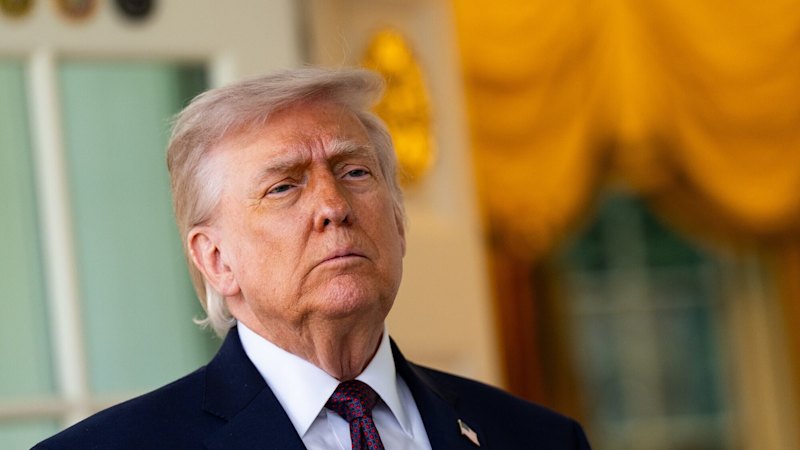
The room in the West Wing smells of old paper, floor wax, and the metallic tang of high-stakes anxiety. For the men and women who have spent decades navigating the corridors of power, silence used to be a tool. It was a pause for reflection. A moment to gather the threads of a complex geopolitical strategy. But lately, the silence has been replaced by something else. A noise that doesn't come from the hallway, but from the podium. It is a jagged, unpredictable frequency that leaves even the most seasoned staffers looking at their shoes, wondering if the man behind the microphone is still reading from the same map as the rest of the world.
To understand the current tremors shaking the American political landscape, you have to look past the partisan firewalls. Forget the blue and red jerseys for a moment. Instead, imagine a pilot at the controls of a wide-body jet. For years, the passengers have grown used to a certain level of turbulence—it is part of the journey, after all. But then, the pilot begins to bank sharply for no reason. He starts talking to the air traffic controllers about a flight path that doesn't exist on any chart. He repeats stories about a storm that passed three hours ago as if it’s currently hitting the windshield.
The passengers aren't just annoyed anymore. They are gripped by a primal, quiet terror.
This is the atmosphere surrounding Donald Trump as the 2024 campaign cycle grinds into its most volatile phase. The "erratic behavior" described in headlines isn't just a series of spicy soundbites for the evening news. It is a clinical and psychological puzzle that has moved from the fringes of internet speculation into the very center of the national conversation. When a former president and current frontrunner begins to weave together disparate, unconnected rants about electric boats, sharks, and Hannibal Lecter in a single breath, the question shifts from "What did he say?" to "What is happening inside?"
The Fracturing of the Narrative Thread
Think of a person's cognitive health as a high-definition tapestry. In a healthy mind, the threads of memory, logic, and impulse control are tightly woven. You can pull on one thread—a memory of a 1980s real estate deal—and it stays connected to the present reality of a campaign rally in 2024. But as that tapestry begins to fray, the threads snap.
Observers have noted a marked shift in the way Trump navigates a sentence. It isn't just the "weaving" technique he claims to use to tie themes together. It is the sudden, jarring derailment. One moment, he is discussing trade policy; the next, he is lost in a linguistic cul-de-sac about a person who has been dead for years or a grievance that has no bearing on the current moment.
Consider the "phonemic paraphasia"—a technical term for when a speaker starts a word but loses the trail, resulting in a nonsensical slurry of sounds. We’ve all tripped over our tongues. We’ve all forgotten a name at a grocery store. But in the context of the most powerful office on earth, these slips aren't just "senior moments." They are data points. For those watching closely, the frequency of these lapses suggests a cognitive engine that is misfiring, struggling to maintain the RPMs required for the grueling marathon of a presidential run.
The Invisible Stakes of the Inner Circle
Behind the scenes, the story isn't about the outbursts themselves, but the reaction to them. There is a specific kind of "gallows humor" that develops in political circles when things go sideways. It’s a defense mechanism. But lately, that humor has turned brittle.
Staffers who once took pride in "letting Trump be Trump" are now tasked with a different kind of labor: the constant, exhausting work of translation. They find themselves explaining to donors that a twenty-minute tangent about the beauty of a fictional serial killer was actually a sophisticated metaphor for immigration. They are the ones holding the frayed ends of the tapestry, trying desperately to knot them back together before the public sees the holes.
The human element here is the exhaustion. Not just the physical fatigue of a seventy-eight-year-old man on the trail, but the mental exhaustion of a man who seems to be fighting a war on two fronts. One front is against his political opponents. The other is against his own fading grasp on the linear progression of a story.
When he stands on a stage in the sweltering heat of a Pennsylvania summer and begins to repeat the same phrase five, six, seven times, he isn't just emphasizing a point. He is searching for the next one. He is a man in a dark room, feeling along the walls for a light switch that used to be exactly where he left it.
A Mirror of Our Own Fears
Why does this trigger such a visceral reaction in the electorate? Because it mirrors the most intimate fears we have for ourselves and our families. Almost everyone has watched a parent or a grandparent begin to slip. We know the signs. The sudden flashes of unprovoked anger. The obsession with "the good old days" that gradually replaces any interest in the future. The way the eyes seem to glaze over when a conversation becomes too complex.
By bringing these outbursts into the political arena, Trump has turned a private medical concern into a public stress test for democracy. We aren't just debating tax brackets or foreign policy anymore. We are debating the limits of the human brain under pressure.
Medical professionals, constrained by the "Goldwater Rule" which prevents them from diagnosing public figures from afar, are nonetheless sounding the alarm. They point to the "tangentiality" of his speech—a tendency to wander so far from the original question that the speaker eventually forgets what the question was. In a casual setting, it’s a quirk. In a situation where a leader might need to process nuanced intelligence about a nuclear threat or an economic collapse, it is a vulnerability that cannot be ignored.
The Loudness of the Silence
The irony of the "head-spinning outbursts" is that they are often used to mask a growing void. When the logic fails, the volume increases. The anger becomes a placeholder for the argument. If you cannot explain the intricacies of a policy, you can always shout about the "unfairness" of the world. It is a classic psychological pivot: when the internal world becomes confusing, the external world must be painted as hostile.
This creates a feedback loop. The more erratic the behavior, the more the media covers it. The more the media covers it, the more the subject feels persecuted. The more persecuted he feels, the more the cognitive guardrails fall away, replaced by a raw, unedited stream of consciousness that serves as a window into a mind that is increasingly untethered from the collective reality of the room.
Imagine a conductor leading a world-class symphony. For years, he has been known for his unorthodox style, his flair, his willingness to break the rules. The audience loves the spectacle. But slowly, the tempo starts to drift. He begins signaling the brass section when the strings should be playing. He stops looking at the score entirely. The musicians, terrified of a public mistake, try to follow his lead, but the music becomes a cacophony.
The audience is still there. Some are cheering because they love the conductor more than the music. But others—the ones who understand the composition—are looking at the exit signs.
There is a specific, haunting quality to a person who is losing their place in time. We see it in the way Trump speaks about figures from the 1990s as if they are still central players on the world stage. We see it in the confusion of names—mixing up world leaders, or even his own family members. It is a reminder that time is the one opponent that no amount of branding, wealth, or political power can defeat.
The stakes are not just about who sits in the Oval Office. They are about the nature of the reality that office represents. If the person at the center of the storm can no longer distinguish the clouds from the clear sky, the entire structure is at risk of being swept away.
We are watching a man grapple with the gravity of his own history, even as the present slips through his fingers like dry sand. The outbursts aren't just noise. They are the sound of a struggle that is as old as humanity itself—the desperate, loud attempt to stay visible as the light begins to dim.


