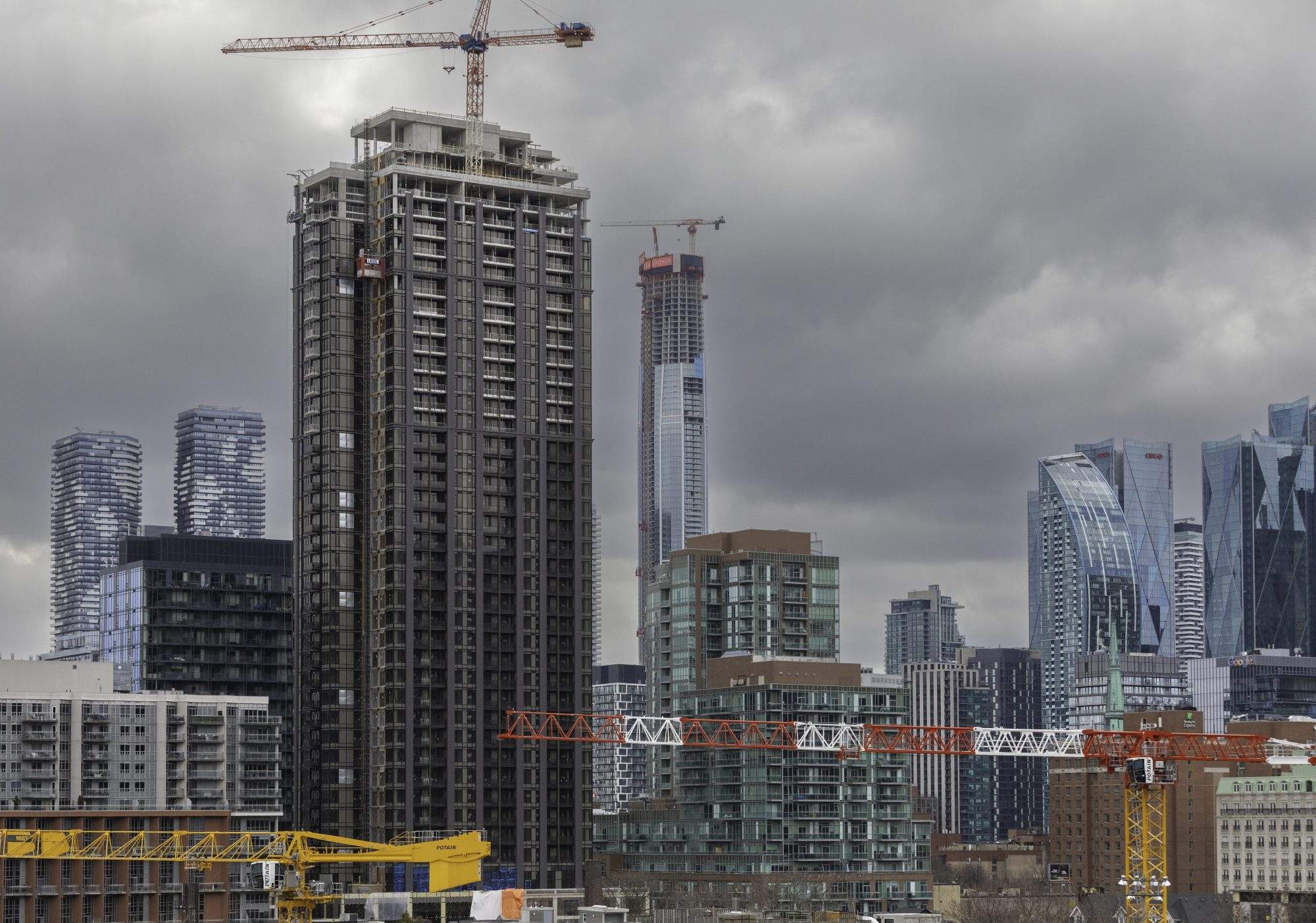
The smell of overturned earth in Ontario during early spring is usually a promise. It is the scent of progress, a sharp, damp aroma that fills the air when excavators bite into frozen soil to lay the foundations of tomorrow. By April, that smell usually blankets the edges of cities like Kitchener, Barrie, and the sprawling rims of the Greater Toronto Area. It means concrete is pouring. It means cranes are moving.
It means people are finally getting a roof.
But by May, the excavators started growing quiet.
If you look at the raw spreadsheets rolling out of the Canada Mortgage and Housing Corporation, the story looks like a minor blip on a corporate radar. The headlines call it a "dip." They note that after a surprisingly strong surge in the first quarter of 2026, housing starts across Ontario slowed down. The numbers flattened. It sounds clinical. It sounds like a natural, breathing market exhaling after a deep intake of breath.
Statistics have a clever way of hiding the sweat. They mask the anxiety of a young couple sitting in a parked car outside a fenced-off gravel lot, staring at a blueprint that suddenly feels less like a future home and more like a lottery ticket. When a housing start drops, it is not just a data point on a graph. A housing start is a moment of permission. When it vanishes, a family stays trapped in a cramped basement apartment for another year, watching their savings erode against the relentless tide of inflation.
To understand why the dirt stopped moving this May, you have to look past the bank press releases. You have to look at the people holding the shovels, the people signing the checks, and the quiet standoff happening on the gravel plains of Ontario’s unfinished subdivisions.
The Mirage of April
Consider a hypothetical builder named Marcus. He is a second-generation contractor based out of Hamilton, the kind of guy who measures his life in square footage and the cost of drywall.
In January and February, Marcus was optimistic. The provincial government had been pushing aggressive targets. Interest rates, while still a heavy weight around the neck of every developer in the province, seemed to be stabilizing. The early spring numbers reflected that brief flash of confidence. Across Ontario, developers rushed to break ground on projects that had been backlogged for months. The provincial numbers spiked, triggering a wave of self-congratulatory press releases about how Ontario was finally building its way out of a generational supply crisis.
It was an illusion.
"We broke ground because we had to clear the books on permits we bought two years ago," Marcus says, wiping grease from his hands on a faded rag. "But breaking ground is the easy part. Keeping the machines running when the math doesn't make sense? That’s where the wheels come off."
By May, the reality of the Canadian financial climate caught up with the optimism. Building a subdivision is not like manufacturing cars; you cannot simply turn off the assembly line when demand softens. You are dealing with a complex web of municipal approvals, fluctuating material costs, and a labor pool that is shrinking as older tradespeople retire without a new generation to take their place.
When Ontario’s housing starts dipped in May, it was the sound of reality crashing into political ambition. The backlog of old projects had been cleared, and when builders looked down the pipeline for what was coming next, they saw a wall of financial risk.
The Math Behind the Mud
Why did the momentum evaporate so quickly? The answer lies in an economic formula that has become incredibly hostile to the people who build our communities.
To build a standard multi-family condo building or a townhouse complex in Ontario, a developer must borrow millions before a single brick is laid. When interest rates hovered near zero, that borrowing cost was a negligible line item. Today, those interest payments are a monster lurking in the corner of every balance sheet.
Let us break down the anatomy of a slowdown.
Imagine a piece of land purchased for $10 million. Under current municipal frameworks, it can take anywhere from two to five years just to get the zoning permits approved to build. During every single month of that delay, the builder is paying interest on that $10 million loan. No revenue is coming in. The grass grows tall on the empty lot. The property taxes tick upward.
By the time the provincial authorities grant permission to dig, the builder has already spent millions just for the privilege of waiting.
Then comes the development charges. In many Ontario municipalities, the fees levied on new homes to pay for infrastructure—roads, sewers, water mains—have skyrocketed. In some areas, these fees add over $100,000 to the cost of a single-detached home before construction even begins.
Now, look at the other side of the equation: the buyer. The average family in Ontario can no longer qualify for the massive mortgages required to purchase these homes at their current cost of production.
The market has reached a bizarre, paralyzing paradox.
Builders cannot afford to construct homes for less money without going bankrupt. Buyers cannot afford to purchase those same homes for more money without financial ruin.
So, everyone waits.
The developer sits in their trailer, looking at the May numbers, deciding it is safer to leave the money in the bank than to risk it in the dirt. The buyer stays in their rental, watching the real estate apps with a mixture of hope and resentment. The excavators sit silent in the yard, their yellow paint gathering dust under the late spring sun.
The Human Cost of a Statistical Fluctuation
It is easy to get lost in the macroeconomics of it all, to treat the housing crisis like a massive, impersonal puzzle that can be solved with policy tweaks and interest rate adjustments. But the true weight of the May slowdown is felt in the quiet spaces of everyday life.
It is felt by people like Sarah and Dave, a hypothetical but deeply representative couple in their early thirties living in Mississauga. They have done everything right. They went to university, secured stable corporate jobs, lived frugally, and saved a down payment that would have bought a small mansion twenty years ago.
For the past year, they have been watching a specific townhome development on the edge of the city. They had their eyes on a specific unit—a two-bedroom space with enough room for a small home office and perhaps, eventually, a nursery. They attended the pre-construction sales events. They spoke with the agents.
Then came May. The sales center quietly closed its doors on weekdays. The developer pushed back the estimated occupancy date by another eighteen months, citing "market conditions" and supply chain recalibrations.
For Sarah and Dave, that eighteen-month delay is not a statistic. It is eighteen more months of putting their lives on hold. It is eighteen more months of rent paid into someone else’s equity. It is the slow, agonizing realization that the goalposts are moving faster than they can run.
"You feel like you're chasing a ghost," Dave says, his voice carrying the exhaustion shared by hundreds of thousands of Ontarians. "You save another ten thousand dollars, and the cost of entry goes up by twenty. You see the news saying the market is slowing down, and you think, 'Great, maybe prices will drop.' But then you realize the reason it's slowing down is because they've stopped building the houses you were hoping to buy."
This is the psychological toll of the housing dip. It breeds a quiet cynicism, a feeling that the foundational promise of Canadian life—that hard work guarantees a place of your own—is being dismantled piece by piece.
The Infrastructure Trap
There is another layer to this slowdown that rarely makes the evening news, a structural hurdle that cannot be solved by simply lowering interest rates or cutting red tape. It is the invisible grid beneath our feet.
You cannot build a house without a pipe to carry the water away. You cannot build a high-rise without an electrical grid capable of handling thousands of new stoves, refrigerators, and heat pumps.
Across Ontario, many municipalities are running out of literal, physical capacity. The water treatment plants are running at their limits. The sewage systems are maxed out. In some communities, builders are being told that even if they get their zoning approved, even if they find the money to build, they cannot connect to the town's water supply for another three years because the infrastructure simply does not exist.
We spent decades expanding our suburban footprints without investing in the heavy, expensive, unglamorous concrete infrastructure needed to support them. Now, the bill has come due.
The provincial government can mandate all the housing targets it wants. It can demand that cities build millions of homes by the end of the decade. But a politician's signature cannot instantly double the capacity of a wastewater treatment facility. That takes time. It takes billions of dollars. And it takes a coordinated plan that extends far beyond the next election cycle.
When the housing starts dipped in May, it was a warning light flashing on the dashboard of the province. It was a sign that the quick fixes have been exhausted. The low-hanging fruit has been picked. The remaining path forward requires a deep, painful, and costly restructuring of how we fund and build our cities.
The View from the Concrete
Walk onto a job site that is actually running, and you can feel the tension. The pace is different now. A few years ago, during the height of the post-pandemic housing boom, these sites were frantic. Material delivery trucks lined the roads. Subcontractors yelled over the roar of engines. There was a desperate, gold-rush energy to every square inch of the property.
Now, the energy is cautious. Deliberate. Almost tense.
The workers know the numbers. They see the empty lots next door that were supposed to be broken into this month but remain covered in weeds. They know that their livelihoods are tied directly to the confidence of developers who are currently looking at their spreadsheets with narrowing eyes.
A construction worker named Jeff stands near the edge of a foundation wall, watching a cement truck pour its grey cargo into a wooden form. He has spent twenty years building homes in southwestern Ontario. He has seen the booms and he has seen the busts.
"In the nineties, you knew where you stood," Jeff says, leaning on his shovel. "You built a house, someone bought it, you moved to the next one. Now, nobody knows anything. The guy buying the house is stressed. The guy building it is stressed. The guys pouring the concrete are wondering if they’ll have a job in the fall. It feels like we're all standing on a frozen lake, waiting to hear the ice crack."
That uncertainty is the true definition of a market dip. It is a collective holding of breath. It is an entire industry stopping to see who will blink first—the banks, the government, or the buyers.
Beyond the Horizon
We will see more numbers next month. June will bring a fresh batch of data from the CMHC. The pundits will analyze it. They will tell us if May was an anomaly or the start of a prolonged summer freeze. The politicians will find a way to spin the numbers to support whatever narrative they are selling this week.
But the dirt remembers the truth.
Every foundation that wasn't dug this month represents a missing piece of our social fabric. It represents a child who won't have a backyard to play in next summer. It represents a young professional who will decide to leave the province entirely, taking their talents to parts of the country where the dream of ownership isn't a luxury item.
The solutions are not secret. They involve massive, sustained public investment in infrastructure. They require a radical simplification of the approval process that treats housing like a necessity rather than a bureaucratic obstacle course. They demand a frank, honest conversation about how tax structures at every level of government inflate the cost of the very thing we claim we want to make affordable.
Until those structural shifts happen, the numbers will continue to fluctuate. A good month will follow a bad month. A strong quarter will mask a weak spring.
Meanwhile, the gravel lots on the edges of our towns will remain exactly as they are. The yellow excavators will wait under the wide Ontario sky, their buckets resting on the cold, unmoving earth, waiting for someone to give them a reason to dig.