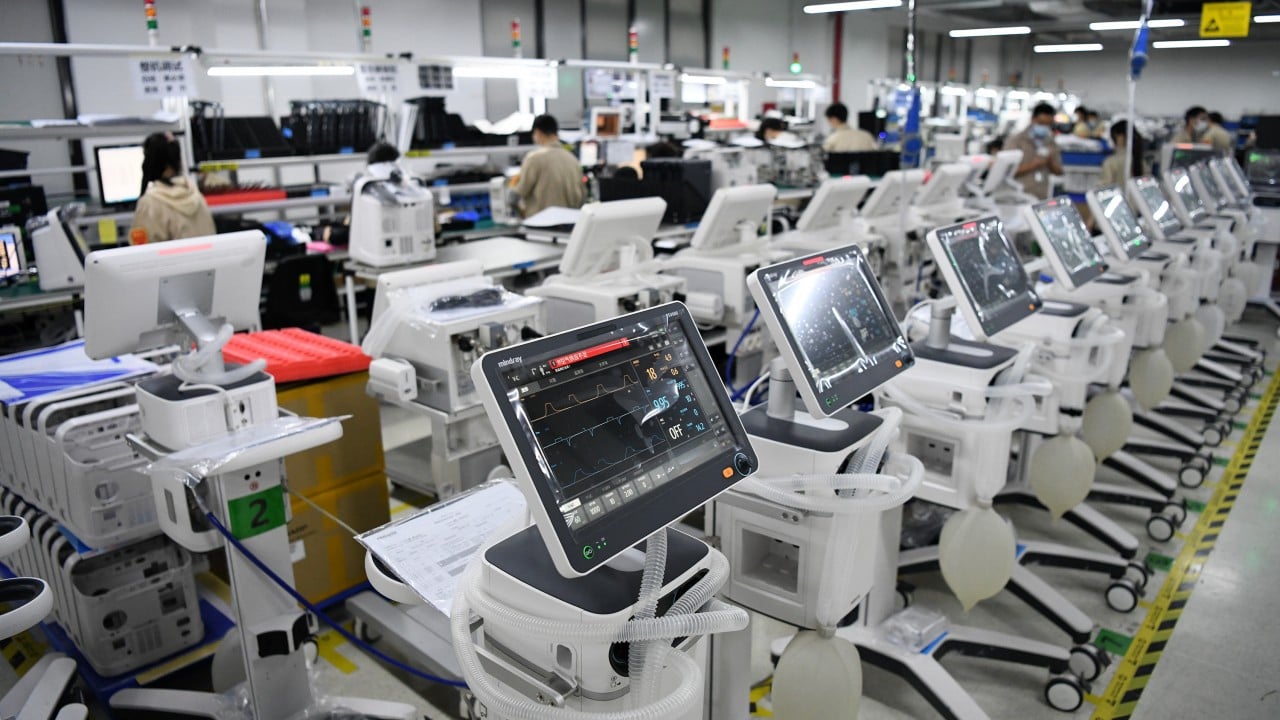
The fluorescent lights of the manufacturing plant in Shenzhen do not buzz, but the silence feels heavy. For nearly a decade, the routine was as predictable as the tides. A medical device company would design a high-end ultrasound machine or a new stent, secure local approvals, and then the real work began. That work did not happen in laboratories. It happened in private dining rooms, over expensive bottles of Baijiu, where hospital administrators and sales executives shook hands on procurement contracts that kept the wheels turning.
Then, the music stopped.
Beijing launched a sweeping, unprecedented anti-corruption campaign targeting the healthcare sector. Overnight, the long dinners vanished. Hospital presidents were detained. Doctors stopped meeting with sales representatives entirely, terrified that an innocent conversation might look like a bribe. The domestic market for medical equipment, once a goldmine of fast deals and soaring profit margins, froze solid.
Consider the position of a sales director trapped in this sudden ice age. Let us call him Chen. For years, Chen relied on relationships. Suddenly, his phone is a liability. His local revenue streams are evaporating. He has hundreds of sophisticated imaging machines sitting in warehouses, and a factory floor that cannot simply be turned off.
Chen looks at a map. His eyes land on Europe.
This is not a story about abstract corporate strategy. It is a story about survival, displacement, and the quiet reshaping of global healthcare. When a massive economic ecosystem faces an existential threat at home, it does not die. It migrates.
The Cold Clear Water of European Compliance
Exporting medical technology to Europe is not a casual endeavor. For decades, Western European hospitals relied almost exclusively on a trusted oligopoly of American and European conglomerates. These legacy giants commanded premium prices because they offered familiarity and deep institutional trust.
When Chinese manufacturers began showing up at trade shows in Düsseldorf and Paris, they were met with deep skepticism. European procurement officers did not just want to see a machine that worked; they demanded mountains of clinical data, rigorous adherence to European Union regulations, and proof of a reliable supply chain.
The contrast between the two worlds is stark. In the old domestic system, success often hinged on knowing the right person. In the new European system, success depends on surviving a bureaucratic marathon.
To bridge this gap, Chinese firms are forced to shed their old skins. They are hiring European executives who speak the language of compliance. They are building local distribution hubs in Germany and the Netherlands. They are learning to play a game where the rules are written down, rigidly enforced, and entirely indifferent to personal connections.
But the real pressure lies elsewhere. It rests on the sheer economics of the European hospital system.
The Budget Crisis Meets the Supply Shock
Walk into any public hospital in southern Europe right now. The walls are peeling, the staff is exhausted, and the budgets are stretched to the absolute breaking point. Health systems are facing a quiet crisis of sustainability. They need to upgrade their diagnostic capabilities, but the traditional suppliers are charging premium prices that public coffers can no longer support.
This is where the calculation changes.
Imagine a European hospital administrator looking at two bids for a fleet of new CT scanners. On one side is a traditional Western brand, dependable but extraordinarily expensive. On the other side is a rapidly rising Chinese manufacturer. The Chinese machine offers comparable image resolution and processing speed, but at a fraction of the cost.
The skepticism is real. Can we get spare parts in forty-eight hours if a machine breaks down? Will our technicians understand the software interface? These are the questions that keep hospital boards up at night.
Yet, the financial reality is an aggressive persuader. Slowly, the resistance is crumbling. What started as an experiment in smaller, private clinics is bleeding into major public tenders. The anti-corruption squeeze in Shanghai is directly subsidizing the modernization of healthcare clinics in rural Italy and suburban France.
The Irony of Forced Evolution
There is a profound irony in how this played out. The regulatory crackdown in China was designed to clean up domestic healthcare, lower costs for Chinese citizens, and weed out inefficient practices. It succeeded in upending the status quo, but it also acted as a powerful evolutionary pressure.
Biologists know that when an environment becomes hostile, species either adapt or perish. The weakest medical device makers in China collapsed under the weight of the anti-corruption campaign. But the strongest ones—the companies with genuine engineering talent and deep pockets—were forced to evolve at terrifying speed.
They could no longer rely on the easy crutch of domestic relationship-based selling. They had to make their products so technically sound and so financially attractive that a skeptical European doctor could not find a reason to say no.
This forced evolution is creating a new class of global competitors. These companies are no longer just copying Western designs; they are innovating on cost structure and manufacturing efficiency. They are turning the clinical data requirements of Europe into a shield, using their newly acquired certifications to prove their legitimacy on the global stage.
The Friction of the New Frontier
The transition is far from smooth. Cultural friction is an invisible tax on every deal. European medical societies are notoriously conservative, often viewing outside technology with an institutional bias that takes years to dissolve.
There are also growing political headwinds. European policymakers are increasingly wary of becoming overly reliant on foreign technology for critical infrastructure, and healthcare is the ultimate critical infrastructure. Discussions about economic security and supply chain sovereignty are growing louder in Brussels.
But out on the hospital floor, where a patient is waiting for a scan and a department head is staring at a deficit, those geopolitical arguments feel incredibly distant. The immediate concern is practical. Does the machine work? Can we afford it?
The answers to those questions are driving a quiet, steady realignment of the medical trade. The old boundaries are blurring. The machines that were once intended for hospitals along the Yangtze River are now hummed to life in the medical centers of the Danube.
The shift is structural, permanent, and accelerating. The crackdown at home did not stop the ambition of these manufacturers; it merely changed their destination.
The New Baseline
Step back and look at the broader picture. We are witnessing the birth of a more aggressive, multi-polar market in medical technology. The era of comfortable Western dominance in hospital procurement is drawing to a close, replaced by a hyper-competitive reality born out of domestic political necessity thousands of miles away.
The factories in Shenzhen continue to run through the night. The trucks still roll out toward the ports. The destination labels on the crates have simply been swapped from domestic provinces to European capitals. For the patients lying on the examination tables, the internal politics of the supply chain matter very little. They only care about the diagnosis.
The machine clicks. The scan begins. The code running the software was written in a tech hub that had to pivot or die, and the results are now rendering on a screen in a room half a world away.