Cold.
It does not announce itself with a dramatic crash; it arrives as a slow, creeping theft that begins at the tips of your fingers while you wait for a delayed morning train, steals into the soles of your boots on a salted sidewalk, and eventually settles deep into your sternum until every breath tastes faintly of pennies and frozen iron. Also making news recently: What Seventeen Years of Footsteps Along a Wooden Pier Actually Cost.
I learned this the hard way during a brutal February in Chicago three years ago, standing on an exposed elevated platform with three hundred dollars' worth of trendy, chunky-knit acrylic gear wrapped around my neck and head. On paper, I looked prepared for an Arctic expedition. In reality, my teeth were chattering so violently I bit the inside of my cheek, my ears burned with that sickening, prickly numbness that precedes frostbite, and my sweat-dampened socks had turned into two blocks of ice inside leather boots that had zero room left for circulation. I had fallen for the great modern winter lie—the idea that staying warm is simply a matter of piling on bulk, buying whatever looks cozy in a catalog, and hoping thickness equals heat.
We treat winter accessories like afterthoughts, grabbing whatever discount beanie sits near the checkout register or inheriting an oversized scarf that looks dashing in a coffee shop mirror while doing almost nothing against a twenty-knot wind. Yet physiological research and centuries of cold-weather survival tell a completely different story. Your body is not a furnace that generates infinite heat; it is a tightly regulated survival machine that ruthlessly sacrifices your extremities the moment your core temperature drops by even a single degree. When you get your winter accessories wrong, you are not just mildly uncomfortable—you are triggering a cascade of vascular constriction that ruins your mood, drains your cognitive energy, and turns four months of the year into an endurance test you simply wait out indoors. Additional details regarding the matter are explored by Cosmopolitan.
The Myth of the Heavy Coat and the Naked Extremities
Consider a hypothetical commuter—let us call her Maya—who spends two thousand dollars on a knee-length down parka rated for sub-zero temperatures, then walks out the door wearing thin cotton ankle socks, fashion touchscreen gloves made of synthetic polyester, and no hat at all because she just styled her hair.
Maya feels invincible for exactly four minutes.
By minute five, the winter air finds every unguarded border of her body. Because her head and neck are exposed, warm blood rushing toward her brain cools rapidly as it passes near the surface of her skin, returning to her heart chilled. Her brain registers this drop immediately and hits the panic button, initiating peripheral vasoconstriction—a biological emergency protocol where blood vessels in the hands, feet, ears, and nose narrow dramatically to keep warm blood pooled around vital organs. Suddenly, her two-thousand-dollar parka feels strangely ineffective, not because the coat failed, but because she left the doors and windows of her circulatory system wide open.
Think of your body's heat retention like insulating a house during a blizzard. You can install triple-pane glass and four feet of fiberglass in the attic, but if you leave the mail slot propped open and a basement window cracked, the furnace will run nonstop while the floorboards remain freezing. Winter accessories are not decorative trim; they are the weatherstripping of human anatomy.
Historically, cultures that thrived in extreme latitudes—from the Inuit of the Arctic to Scandinavian fishermen working the North Sea—understood that survival depended on protecting high-vascular zones where blood flows closest to the skin: the wrists, the neck, the ankles, and the crown of the head. Somewhere along the way, fast fashion replaced functional fiber science with cheap petroleum-based synthetics that mimic the appearance of wool while failing at every thermodynamic job wool actually performs.
Why Your Favorite Knit Hat Is Actually Making You Colder
To understand why most store-bought winter accessories fail, you have to look at what happens at a microscopic level when you walk briskly to catch a bus or shovel snow off your driveway.
Even in freezing temperatures, human skin continuously releases moisture through insensible perspiration—tiny amounts of vapor evaporating off your body before you ever feel sweaty. When you wear an acrylic beanie or a cheap fleece scarf, that warm vapor rises, hits the cold outer layer of synthetic plastic fibers, and condenses directly into liquid water. Because acrylic and standard polyester cannot absorb moisture inside their fibers, that water sits trapped directly against your skin and hair. Water conducts heat away from the human body roughly twenty-five times faster than air. Within twenty minutes of mild exertion, your cozy winter hat becomes a wet compress actively pulling warmth out of your skull.
I spent years assuming I simply had "bad circulation" because my hands always froze ten minutes into a winter walk. I blamed my genetics, bought chemical hand warmers by the box, and resigned myself to miserable winters. The turning point came when a mountaineering guide in Vermont looked at my mittens, laughed gently, and told me I was suffocating my own fingers. I had been jamming thick cotton liner gloves inside tight leather shells, compressing the air pockets that actually trap heat while trapping sweat against my skin.
True warmth never comes from the fabric itself; fabric generates zero heat on its own. Warmth comes entirely from dead air—millions of microscopic pockets of still air trapped near your skin that your body heats up and keeps from escaping.
This is where natural protein fibers rewrite the rules of winter comfort. Merino wool, cashmere, and alpaca fibers have a complex, crimped scale structure that creates thousands of tiny air chambers while simultaneously pulling moisture vapor into the core of the fiber itself. Merino wool can absorb up to thirty percent of its own weight in moisture without feeling damp to the touch, and even more remarkably, it undergoes a subtle exothermic reaction—releasing a tiny amount of actual heat as water molecules bond with the amino acids inside the wool.
The Anatomy of a Truly Warm Winter Kit
Building a collection of winter accessories that genuinely keeps you warm all season does not require looking like you are scaling K2, nor does it require emptying your savings account on luxury labels. It requires strategic layering across four specific zones, matching the right material to the mechanical job each piece has to perform.
The Head and Ears Where Wind Steals Everything
Walk through any windy city in January and watch people clutching their hoods shut with bare hands. A standard loose-knit beanie lets thirty-mile-per-hour gusts blow straight through the yarn gaps like a screen door.
The smartest cold-weather upgrade you can make is switching to a double-layered merino wool beanie or a watch cap lined with a wind-resistant fleece or tightly woven wool band over the ears. Pay attention to the cuff. A folded cuff over the forehead and ears creates four layers of trapped air precisely where cartilage—which has almost no blood supply of its own—is most vulnerable to frostbite. If you wear glasses or hate hat hair, a fleece-lined merino headband paired with an insulated, structured hood gives you ear protection without flattening your crown.
The Neck The Forgotten Radiator
Your carotid arteries and jugular veins run remarkably close to the surface on either side of your neck, carrying huge volumes of warm blood between your heart and your brain every minute. Leaving a V-shaped gap at the collar of your coat acts like an open chimney, pumping warm air out from inside your jacket every time you take a step.
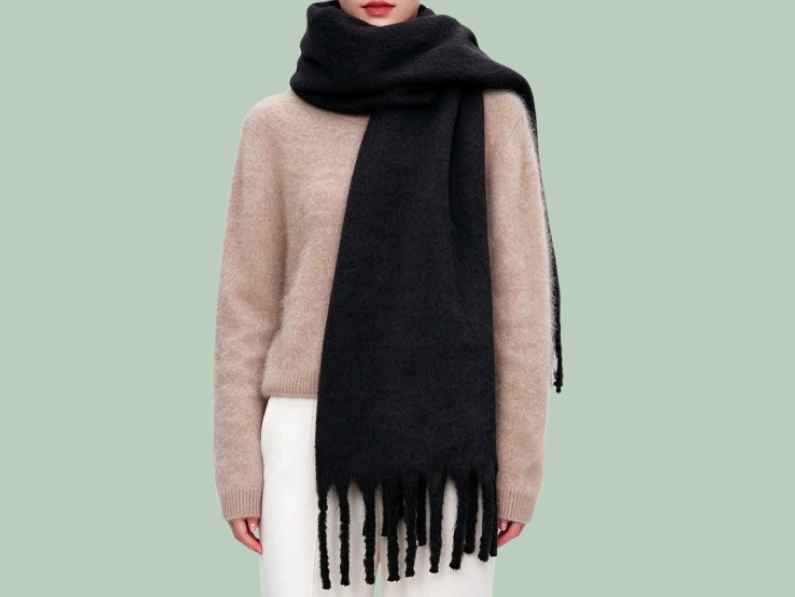
Long, draping scarves look romantic in cinema, yet in real life they constantly unravel, drag through slush, and leave air gaps at the throat. A merino wool neck gaiter or a cashmere snood seals that collar gap completely without bulk. For days when you want the versatility of a traditional scarf, look for a densely woven lambswool or brushed alpaca weave long enough to wrap twice around your neck and tuck flat inside your coat lapels, creating an airtight gasket between your chest and the outside air.
Hands The Great Mitten Versus Glove Debate
Here is an uncomfortable truth that almost nobody wants to hear when they are trying to unlock their smartphone at a crosswalk: gloves are terrible at keeping hands warm.
Every finger wrapped in its own individual fabric tube dramatically increases the surface area exposed to cold air while isolating each digit from the radiant warmth of its neighbors. It is the difference between four people sleeping in separate single-person tents during a blizzard versus sharing one insulated cabin.
Mittens win every single time when temperatures drop below freezing. By housing your four fingers together in a single shared chamber, your hand creates its own microclimate. If you need dexterity for keys, transit cards, or cameras, the modern solution is a modular system: a thin, snug merino wool or silk liner glove worn underneath a windproof, fleece-lined leather or waxed-canvas mitten—or convertible flip-top mittens with magnetic holds that let you free your fingertips for ten seconds without exposing your entire hand to the wind. Never buy gloves or mittens so tight that your fingertips press firmly against the end seam; if you compress the insulation at the tips, you eliminate the dead-air pocket right where your fingers need it most.
Feet The Foundation That Ruins Everything Else
Ask any winter rescue worker what ends an outdoor excursion first, and the answer is almost always cold feet. Yet most people make two fatal mistakes every morning when they lace up their boots.
First, they wear cotton socks. Cotton is wonderful in July and catastrophic in January; it holds sweat like a sponge, flattens completely under body weight, and loses every ounce of insulating value the second it gets damp. Swap every pair of winter cotton socks for mid-weight merino wool blends with cushioned terry loops underfoot.
Second, people try to double up on thick socks inside regular sneakers or snug dress boots. Cramming two thick socks into a boot squeezes the tiny capillaries in the top of your foot, choking off warm blood flow before you even reach the front door. Your toes need wiggle room. If you cannot freely splay your toes inside your winter footwear, your boots are too tight to keep you warm, regardless of how thick your socks are. Pair medium-cushion wool socks with boots that have a removable thermal insole—felt or shearling inserts block the brutal conductive cold rising up from frozen concrete sidewalks, which drains heat far faster than the air around your ankles ever will.
The Quiet Relief of Getting It Right
Consider what happens next when you finally replace guesswork with physics.
Picture that same hypothetical commuter, Maya, stepping out onto a windswept platform in mid-January after making four quiet changes to her morning routine. Her boots have half an inch of breathing room over merino-blend socks and a thin wool-felt insole. A ribbed cashmere neck gaiter sits tucked cleanly beneath her coat collar, sealing off the draft at her collarbone. A tightly knit merino watch cap covers her ears without itching, and inside her coat pockets sit supple goatskin mittens lined with shearling over thin liner gloves.
The wind is still blowing at twenty knots. The thermometer still reads nineteen degrees. Nothing about the weather has softened or become kinder.
Yet her shoulders drop two inches away from her ears. Her breathing slows into an easy, unhurried rhythm. Instead of staring grimly at the tracks while clenching her jaw and counting the seconds until a heated train car arrives, she notices the way low winter sunlight catches the frost along the iron railings, pulls a hand effortlessly out of a mitten to answer a text without her fingers stiffening into claws, and walks into her office feeling energized rather than depleted.
Winter stops feeling like an adversary you have to survive and becomes what it was always meant to be—just another season with its own crisp, quiet beauty, waiting outside the door for anyone dressed properly enough to meet it.