The brain is a glutton for oxygen. It consumes 20 percent of your body’s supply while weighing just three pounds. When a stroke hits, that gluttony becomes a death sentence. Every sixty seconds, 1.9 million neurons wither. They don’t just sleep. They vanish.
Consider a man named Arthur. He isn't real, but his circumstances are mirrored in thousands of emergency rooms every day. Arthur is sixty-four. He is sitting at breakfast when the spoon feels like it weighs fifty pounds. His wife watches his face slide, a slow-motion avalanche of muscle and skin. She calls for help immediately. But "immediately" is a relative term.
The ambulance must navigate traffic. The paramedics must stabilize him. The hospital must perform a CT scan to ensure his brain isn't bleeding before they can even think about administering clot-busting drugs. By the time the needle hits his vein, two hours have passed. Arthur has lost the ability to name his grandchildren. He has lost the strength to walk his dog. He was fast, but biology was faster.
For decades, the medical community has obsessed over the "Golden Hour." It is the window where intervention can mean the difference between a full recovery and a lifetime of assisted living. Yet, for most of the world, that hour is a ghost. It's a theoretical ideal crushed by the reality of geography, sirens, and hospital bureaucracy.
The Blood-Brain Barrier Problem
The biggest obstacle isn't the distance to the hospital. It’s a gatekeeper inside your own head. The blood-brain barrier is a fortress. It is a semi-permeable border of cells that protects the brain from toxins while letting in nutrients. It is incredibly good at its job. Unfortunately, it is also incredibly good at keeping out medicine.
To get a drug into the brain, doctors usually have to flood the entire bloodstream with it. It’s like trying to water a single houseplant by flooding the entire neighborhood. This high-dose approach carries risks, specifically the danger of causing a massive hemorrhage. You want to dissolve a clot, but you might end up causing a leak.
Researchers at the University of Hong Kong looked at this fortress and decided to stop trying to kick down the front door. They looked at the nose instead.
There is a direct, secret passage from the nasal cavity to the brain. It’s called the olfactory pathway. It’s how the scent of rain or woodsmoke reaches your consciousness so quickly. By bypassing the bloodstream and the blood-brain barrier entirely, medicine can travel straight to the gray matter. But there was a catch. Most drugs don't survive the trip in high enough concentrations to actually stop the damage of a stroke.
The Tiny Couriers of Hong Kong
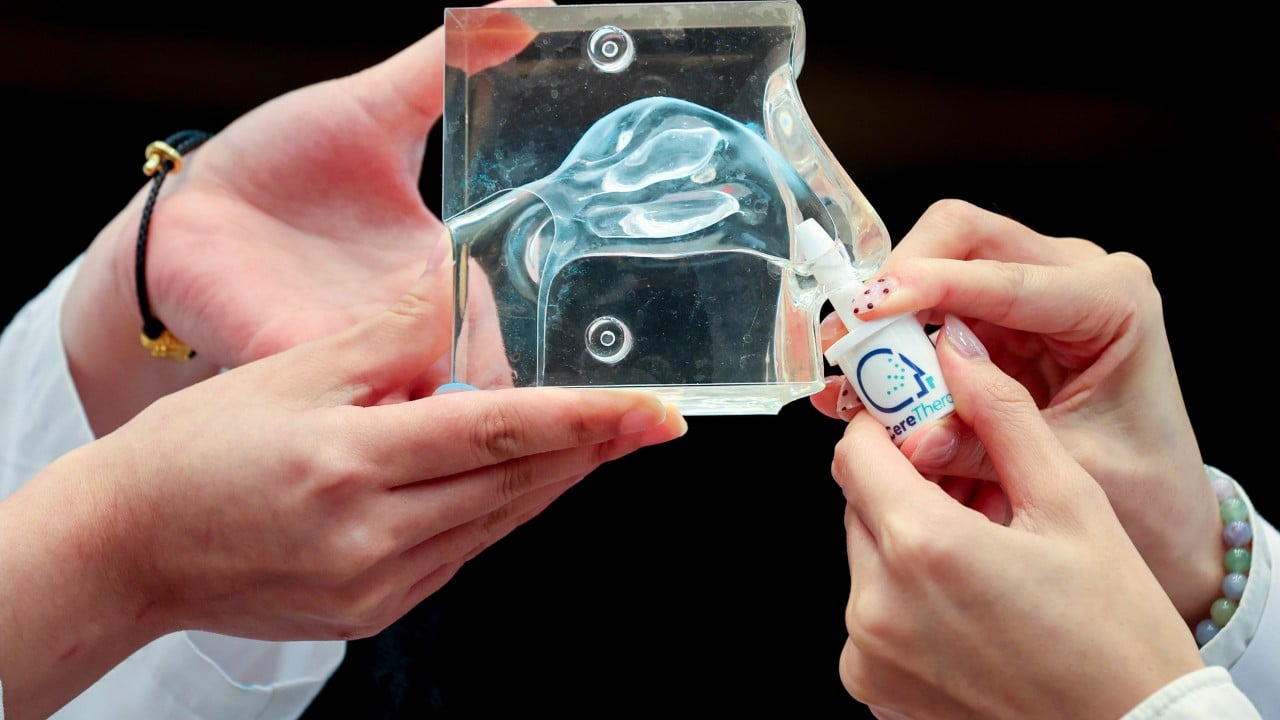
The team in Hong Kong didn't just find a new drug. They built a new vehicle. They developed a "world-first" nasal spray that uses nanoparticles as couriers.
Think of these nanoparticles as specialized delivery drones. They are tiny enough to slip through the nasal mucosa and navigate the neural pathways directly to the site of the ischemic crisis. Inside these drones is a cargo of neuroprotective agents. Their mission is simple: buy time.
In their studies, the researchers found that these particles could reach the brain in minutes. Not hours. Minutes. When tested against traditional methods, the results were startling. The spray didn't just deliver the medicine; it delivered it with a precision that reduced brain tissue death by a significant margin.
This isn't just a win for chemistry. It’s a win for the human clock.
If Arthur’s wife had this spray in her medicine cabinet, or if the first responder at the door could have administered it before the ambulance even moved, the 1.9 million neurons Arthur lost every minute might have been placed in a state of suspended animation. The spray doesn't necessarily dissolve the clot—that still requires a hospital—but it shields the brain cells from the toxic aftermath of the blockage. It keeps them alive until the heavy machinery arrives.
The Invisible Stakes of the Waiting Room
We often think of medical breakthroughs in terms of "cures." We want the pill that makes the cancer go away or the surgery that fixes the heart. But stroke treatment is a game of mitigation. It’s a war of attrition where the goal is to save as much of the person as possible.
The stakes are invisible because we don't see the memories that disappear. We don't see the lost conversations or the missed walks. We only see the deficit that remains.
The Hong Kong spray shifts the battlefield. By moving the point of intervention from the sterile hospital suite to the living room floor, it acknowledges that the most important part of healthcare isn't the doctor’s expertise—it's the speed of the first ten minutes.
It's a terrifying reality to admit that our current system is built on a race we almost always lose. Admitting that the "Golden Hour" is often a myth requires a level of vulnerability from the medical establishment. It requires admitting that the ambulance, for all its lights and sirens, is often too slow.
A Shift in the Nervous System
The science here is complex. It involves micellar delivery systems and specific protein interactions that sound like a foreign language to anyone without a PhD. But the logic is as old as humanity. When a fire breaks out, you don't wait for the fire truck to arrive from three towns over if you have a fire extinguisher in your hand.
This nasal spray is that extinguisher.
It targets the secondary damage of a stroke—the "oxidative stress" and inflammation that ripple out from the initial blockage like a shockwave. When the blood stops flowing, the brain releases a cocktail of chemicals that actually poisons the surrounding healthy cells. It's a chain reaction of self-destruction. The Hong Kong researchers' nanoparticles act as a dampening field, neutralizing those toxins before they can spread.
The beauty of this delivery method lies in its simplicity. A spray requires no specialized training. It requires no IV line. It requires no sterile field. It is a piece of high-tech molecular engineering disguised as a common household item.
The Weight of a Small Bottle
We are moving toward a future where the geography of where you live matters less than the contents of your first-aid kit. For a daughter living in a rural area two hours from the nearest trauma center, this bottle represents the difference between a father who recognizes her and a stranger in a bed.
The researchers are now moving toward clinical trials, the long and arduous process of proving to the world that what works in a lab will work in a human being. There will be skeptics. There will be regulatory hurdles. There will be the inevitable delays of a world that moves slower than a neuron dies.
But the prototype exists. The pathway has been proven.
The silence of a stroke is its most terrifying quality. It doesn't scream. It doesn't bleed. It just quietly erases the person you love while you stand there, helpless, waiting for the sound of a siren that is still miles away.
Soon, that silence might finally be met with an answer. Not a miracle, but a bridge. A tiny, misted bridge through the nose, carrying a cargo of hope to a brain that is starving for just a few more minutes of life.
The spoon drops. The face sags. But this time, the clock doesn't start at zero.
The spray is in the cabinet. The neurons stay. The man remains.