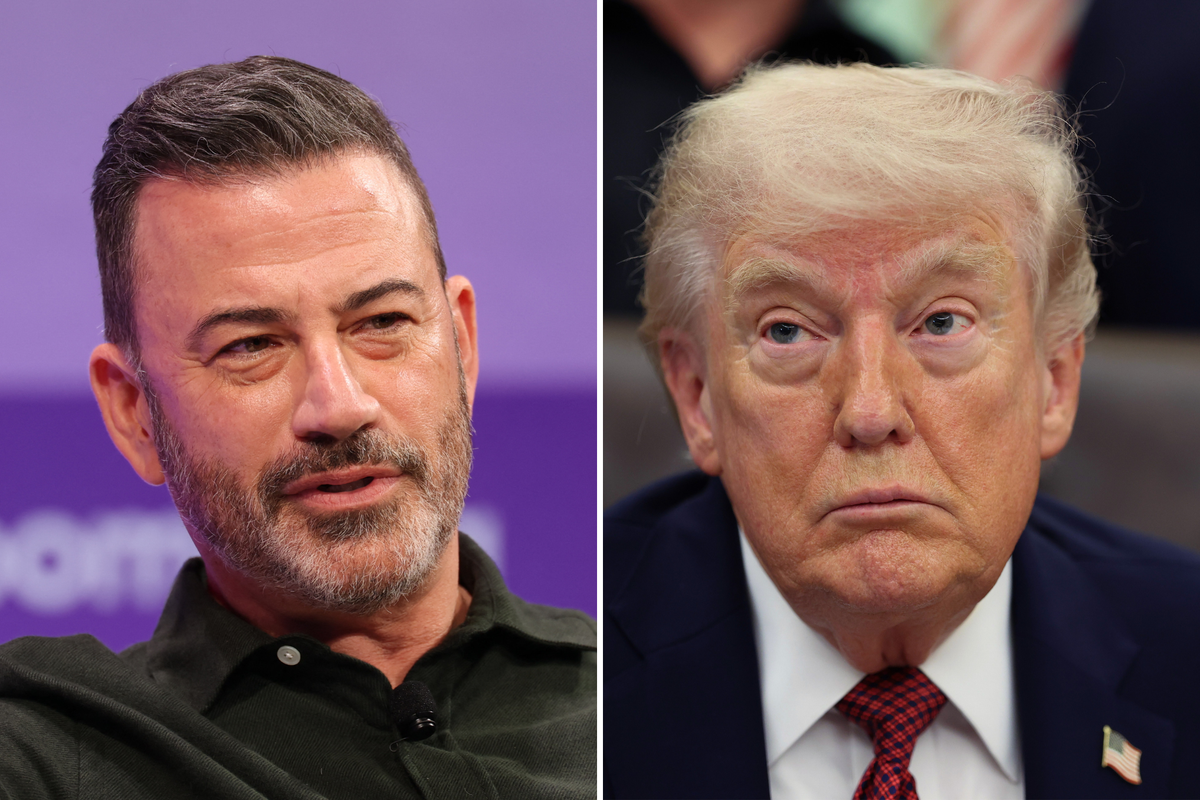
The glow of a late-night television screen is a strange kind of campfire. Millions of people sit in the dark, watching a man in a sharp suit try to make sense of a world that increasingly feels like a fever dream. When Jimmy Kimmel stepped onto his stage recently, he wasn't just there to deliver jokes. He was there to perform a sort of public exorcism on a claim so detached from reality that it bordered on the surreal.
Donald Trump had taken to social media to declare that we are currently living in a "Golden Age of Athletics."
It is a phrase that drips with nostalgia. It evokes images of Grecian statues, of Jesse Owens defying tyranny in Berlin, or perhaps the sheer, unadulterated dominance of the 1992 Dream Team. But when you look at the actual state of the world—the aging rosters, the controversies, and the simple fact that time moves forward regardless of what a politician posts on Truth Social—the "Golden Age" starts to look more like a coat of cheap spray paint.
Kimmel didn't let the moment slide. He leaned into the absurdity. He highlighted the jarring disconnect between the former president's rhetoric and the lived experience of anyone who has actually watched a game in the last four years.
Consider the hypothetical fan, let’s call him Arthur. Arthur is seventy-two. He remembers when the "Golden Age" meant something tangible. It meant the rise of the Super Bowl as a national holiday. It meant watching Muhammad Ali transform from a lightning rod into a saint. For Arthur, sports were the one place where the scoreboard didn't lie. You either ran the fastest, or you didn't. You either caught the ball, or it hit the grass.
Now, Arthur sits in his recliner and listens to a former world leader tell him that today—right now—is the pinnacle of human physical achievement, simply because that leader says it is. It creates a peculiar kind of vertigo.
The facts, however, are far less shimmering.
The "Golden Age" claim arrived just as the sports world was grappling with some of its most profound identity crises. We are seeing the twilight of the gods. Roger Federer has hung up the racket. Serena Williams has moved on. The giants who defined the last twenty years are exiting the stage, leaving a vacuum that hasn't quite been filled by the next generation of icons.
Kimmel’s monologue pierced the bubble of this revisionist history. He mocked the idea that Trump was somehow the architect of this supposed athletic renaissance. It is a recurring theme in the Trumpian playbook: find something successful, or even just functional, and claim ownership of its soul.
But the soul of athletics doesn't belong to the White House or Mar-a-Lago. It belongs to the dirt, the sweat, and the brutal honesty of the clock.
To suggest we are in a peak era requires ignoring the messy, complicated reality of modern sports. We are currently seeing a massive shift in how athletes are compensated, with the NIL (Name, Image, and Likeness) deals fundamentally changing the collegiate landscape. We are watching the professionalization of youth sports reach a breaking point, where burnout is more common than a breakout season. These aren't signs of a golden age; they are signs of a system in the middle of a chaotic metamorphosis.
Kimmel pointed out that Trump's obsession with "gold" and "greatness" often serves as a distraction from the mundane truths of policy and governance. By framing the current moment as a peak, he attempts to bypass the hard work of addressing the valleys. It’s a classic rhetorical sleight of hand. If everything is already perfect, why change anything?
But the fans know.
They know that the "Golden Age" isn't something you can summon with a tweet. It’s a rare alignment of talent, culture, and timing. When Kimmel deconstructed the claim, he was defending the integrity of that definition. He was reminding his audience that words have weight, and when you apply "golden" to everything, the metal starts to look remarkably like lead.
There is a certain irony in a man who famously prefers golf carts to walking claiming to be the herald of a new era of physical prowess. Kimmel didn't miss this. He played on the contrast between the image Trump projects—the strongman, the winner, the ultimate judge of talent—and the reality of a person who views sports primarily through the lens of ratings and loyalty.
The invisible stakes here are higher than just a late-night punchline. When the line between objective reality and political branding disappears, we lose the ability to celebrate actual achievement. If every era is the "Greatest Ever" because a leader says so, then the legendary seasons of the past are cheapened, and the struggles of current athletes are ignored.
Think about the young gymnast training in an unheated gym in Ohio, or the kid playing soccer on a cracked asphalt lot in Queens. Their "age" isn't golden. It’s grit. It’s struggle. It’s the hope that maybe, if they work hard enough, they can reach a level of excellence that speaks for itself. To have that effort co-opted for a political talking point is a quiet kind of theft.
Kimmel’s ridicule wasn't just about partisan bickering. It was an act of cultural maintenance. He was sweeping the stage, clearing away the confetti of false praise to show the floor beneath it.
The monologue served as a reminder that we are living in an era of hyperbole. We are told every movie is a masterpiece, every product is a revolution, and every four-year cycle is a golden age. We are drowning in superlatives.
As the laughter died down and the show moved to a commercial break, the image remained: a screen glowing with the blue light of a social media post, making a claim that no one truly believes, but everyone is forced to reckon with.
The scoreboard in the stadium doesn't care about the spin. It doesn't care about the brand. It only knows what happened on the field. And no matter how much gold leaf you apply to the present, the truth remains as cold and hard as a finish line.