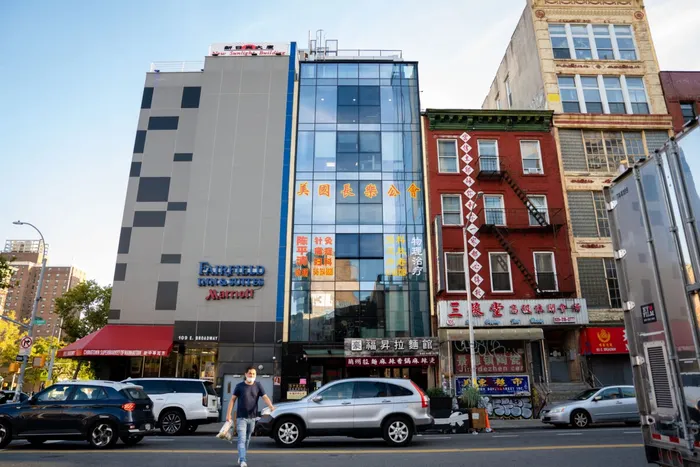
The neon sign for the America Changle Association hung above a nondescript brick building in Manhattan’s Chinatown, sandwiched between a noodle shop and a convenience store. To the thousands of commuters rushing past it toward the Manhattan Bridge, it was just another piece of the neighborhood's dense, chaotic urban scenery. A place where elderly immigrants gathered to play mahjong, speak their native Fuzhou dialect, and find a sense of home in a city that often felt overwhelming.
But a home can easily become a cage.
In the spring of 2026, a federal courtroom in Brooklyn began unravelling what lay beneath that ordinary facade. The trial of a New York City resident accused of operating an unauthorized, secret police station on behalf of the Chinese government entered the public record. It is a case that strips away the abstract concept of transnational repression and lays it bare on the pavement of New York. This is not a sleek spy thriller filled with high-tech gadgets and midnight drop-offs. It is a story about the weaponization of bureaucracy, the quiet erosion of safety, and the invisible borders that follow people across oceans.
Imagine a man. We will call him Chen. He fled a provincial town in Fujian province a decade ago, seeking the loud, messy freedom of America. He drives a taxi, pays his taxes, and sends money back to his aging parents. One afternoon, his phone rings. The voice on the other end is polite, familiar, and terrifying. The caller knows where Chen works. They know where his sister lives in Queens. They suggest he stop by a specific office on East Broadway to "update his documents" and handle some administrative tasks for the homeland.
Fear is a quiet weight. It doesn’t always scream; usually, it whispers. For Chen, and for thousands like him, that phone call instantly dissolved the thousands of miles of ocean between his past and his present. He was reminded that even in the heart of New York, he was never truly out of reach.
Federal prosecutors allege that this specific outpost was established under the direction of the Fuzhou branch of China’s Ministry of Public Security. On paper, its purpose was benign, almost helpful. It offered driver's license renewals and administrative assistance for immigrants who found it difficult to navigate foreign systems. But the state's apparatus rarely stops at administrative convenience.
According to court documents, the station was used to track down and pressure Chinese dissidents, critics of the regime, and ordinary citizens who had run afoul of Beijing's strict orthodoxy.
To understand how this happens, one must understand the psychology of the diaspora. When you leave an authoritarian country, you leave behind parts of yourself. Your childhood friends, your extended family, your ancestral home. These are not just memories; they are hostages to fortune. A secret police station does not need to deploy agents with handcuffs to arrest someone on American soil. They merely need to remind a target that their cousin back home could lose their job, or that their elderly mother’s pension could suddenly vanish.
The internet has turned the entire world into a panopticon, but a physical office in Manhattan adds a chilling layer of reality. It proves that the eye is not just watching from across the globe; it has rented a room down the street.
During the trial, prosecutors detailed how the operation functioned behind closed doors. The defendants allegedly used their standing within local community organizations to gather intelligence, monitor gatherings, and report back to handlers in China. It was a system built entirely on trust, twisted into a mechanism of control. The very associations created to protect and uplift immigrants were used to spy on them.
Consider the sheer vulnerability of this position. When an average American citizen feels threatened, they call the police. But when an immigrant is targeted by the government of their country of origin, who do they turn to? The local precinct might not understand the cultural nuances or the specific nature of the threat. The FBI feels distant, intimidating, and monolithic. Many victims choose silence. They shrink their lives, delete their social media accounts, and stop attending community events. They disappear into the background of the city, hoping to become invisible enough to be forgotten.
This silence is exactly what the architects of these stations rely upon.
The defense argued that the actions were merely community service, a benign attempt to help elderly residents who struggled with language barriers and technology. They painted a picture of a neighborhood hub that had been misunderstood and caught in the crossfire of escalating geopolitical tensions between Washington and Beijing. It is a defense that plays on the genuine confusion of globalized life, where the lines between civic duty and state intelligence can sometimes appear blurry to the untrained eye.
But federal investigators presented a different narrative, backed by encrypted messages, financial transactions, and direct directives from overseas security officials. The evidence suggests a coordinated effort to establish a footprint, to create an ecosystem where dissent could be choked out before it ever had the chance to breathe.
This trial is not an isolated incident. Human rights organizations have documented over a hundred similar undeclared stations operating in dozens of countries across Europe, Africa, and the Americas. They operate in plain sight, capitalizing on the openness of democratic societies to build networks of surveillance. It is a modern paradox: the very freedoms that allow these stations to open are the freedoms they are designed to destroy for the people who seek refuge within them.
The technology of control has evolved. It no longer requires iron bars. A smartphone, a database, and a quiet office above a Chinatown bakery are more than enough to build a prison without walls.
As the legal proceedings continue in Brooklyn, the true stakes become clear. This is not just a legal debate over registration acts or bureaucratic violations. It is a referendum on the meaning of asylum and the reality of American sovereignty. If a foreign power can police its former citizens on the streets of New York, then the promise of safety for those fleeing tyranny is an illusion.
The neon sign on East Broadway is gone now, taken down after federal agents raided the location. The brick building looks even more ordinary than it did before. But for the people who walk past it every day, the air carries a cold, lingering question. They look at the windows above the shops, at the community centers, at the familiar faces in the neighborhood, wondering how much of the old world they brought with them, and how much of it refuses to let them go.
The courtroom is warm, filled with the rustle of legal pads and the low murmur of lawyers. Outside, the city moves at its usual frantic pace. Trains rumble across the bridge, street vendors call out their prices, and the life of the diaspora continues, vibrant and resilient. But underneath the noise, a quiet battle is being fought for the right to live without looking over your shoulder.