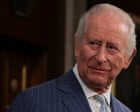
The chandeliers in the State Dining Room at Buckingham Palace do not merely light a room; they hum with the weight of centuries. They have witnessed the frantic whispers of ministers during the Blitz and the polite, icy silences of the Cold War. On this particular evening, the air carried a different kind of charge. It was the scent of expensive cologne, old floor wax, and the palpable, jagged tension of a world tilting on its axis.
At the center of the room stood two men who represent the most profound collision of modern power. One, King Charles III, is a man whose entire life has been a rehearsal for a role defined by restraint, continuity, and the quiet dignity of a constitutional anchor. The other, Donald Trump, is a whirlwind of disruption, a leader who treats international treaties like negotiable leases and global alliances like burdensome subscriptions.
Between them lay more than just a dinner table. Between them lay the ghost of a continent that has forgotten what it feels like to burn.
The Fragility of a Promise
Outside the palace gates, the world is loud. In the freezing trenches of eastern Ukraine, a twenty-year-old soldier—let’s call him Mykola—is not thinking about grand banquets. He is thinking about the mud in his boots and the fact that his ammunition is a finite resource. Mykola is the human face of a dry acronym: NATO. For him, the North Atlantic Treaty Organization is not a bureaucratic headache or a line item in a budget. It is the only reason he believes his younger sister might grow up in a country that still belongs to her.
When King Charles stood to speak, he wasn’t just performing a ceremonial duty. He was speaking to Mykola. He was speaking to the millions of people across Europe who feel the cold wind of Russian aggression rattling their windows. The King’s message was a masterclass in the "velvet glove" of diplomacy. He praised NATO as the "bedrock" of our collective security.
It sounds like standard political fare. It isn't. In the context of a visiting American president who has frequently questioned the value of the alliance and suggested that the United States might not come to the aid of "delinquent" members, the King’s words were a pointed, necessary defense of a world order that is currently being stress-tested to the breaking point.
A History Written in Blood
To understand why a King would choose a state banquet to talk about military alliances, you have to look at the portraits on the walls. The British Monarchy has a long memory. Charles is the grandson of King George VI, the man who stood in the rubble of London and refused to leave while the Luftwaffe rained fire from the sky. That generation learned a brutal, indelible lesson: peace is not the natural state of man. Peace is an expensive, fragile construction that requires constant maintenance.
The King knows that when we stop valuing our alliances, we start inviting our enemies to dinner.
History shows us that the moment a superpower hints at isolationism, the map of the world begins to change color. We saw it in the 1930s. We saw the high cost of "America First" sentiments that delayed entry into a conflict until the world was already half-consumed by shadow. Charles wasn't just reciting a speech written by the Foreign Office; he was channeling the institutional memory of a crown that has seen empires rise and fall based on the strength of their handshakes.
The tension in the room was almost visible. While the King spoke of the "unshakeable" bond between the UK and the US, the subtext was a plea for consistency. Foreign policy shouldn't be a pendulum that swings violently every four years. For the countries on the "front line"—Poland, the Baltics, the Czech Republic—that pendulum is a wrecking ball.
The Math of Human Suffering
We often talk about defense spending in terms of percentages. The 2% of GDP target is a common talking point, a dry statistic that causes eyes to glaze over. But let's look at what that 2% actually buys.
It buys the certainty that a school in Tallinn won't be hit by a cruise missile tomorrow. It buys the satellites that track troop movements so a surprise invasion becomes impossible. It buys the collective brainpower of thousands of intelligence officers who stop cyberattacks on hospital power grids before they happen.
When a leader suggests that this protection is transactional—a "pay-to-play" scheme—they ignore the moral gravity of the pact. NATO’s Article 5, the "one for all and all for one" clause, is the only thing standing between a sovereign Ukraine and a map that looks like it belongs in the nineteenth century.
The King’s urge to defend Ukraine was not a call for endless war. It was a recognition that the cheapest way to handle a fire is to prevent it from spreading. If the West tires of the burden of supporting Ukraine, the eventual cost—in blood, in treasure, and in global stability—will be exponentially higher. We are currently paying a premium for a security insurance policy. If we let the policy lapse, we shouldn't be surprised when the house burns down.
The Silent Conversation
State visits are a strange theater. There is the public show—the gold-trimmed menus, the toasts, the carefully choreographed walk through the gallery. Then there is the silent conversation happening in the margins.
Imagine the private moments between the King and the President. Charles, a man who has spent decades worrying about the environment and the long-term health of the planet, is talking to a man who focuses on the immediate, the tactile, and the profitable. They are two different types of time-travelers. One looks back at centuries of tradition to guide the future; the other looks at the 24-hour news cycle to dominate the present.
The King’s emphasis on Ukraine was a bridge between these two worlds. He was framing the conflict not as a distant border dispute, but as a fundamental test of the West's character. Can we keep our word? Do we still believe in the right of small nations to exist?
The reality is that Europe is terrified. They see the political volatility in Washington and wonder if the "Arsenal of Democracy" is closing its doors for a private sale. When the British monarch stands up and reaffirms the importance of the Atlantic alliance, he is acting as a diplomat of last resort. He is reminding the guest—and the world—that some things are supposed to be above the fray of partisan politics.
The Weight of the Crown and the Reach of the Pen
There is a profound irony in a King lecturing a President on the virtues of democratic alliances. But we live in ironic times. The King’s power is purely symbolic, yet symbols are the fuel of civilization. A flag is just a piece of cloth until someone dies for it. A treaty is just a piece of paper until it prevents a massacre.
The speech was a gamble. In the British system, the monarch is supposed to be "above" politics. But when the very existence of the international order is at stake, silence becomes a political act in itself. By choosing to be vocal about NATO and Ukraine, Charles signaled that the defense of the West is not a "political" issue—it is a survival issue.
Think back to Mykola in his trench. He doesn't care about the fine vintage of the wine served at the palace. But he cares deeply that the man sitting at that table, the one with the power to send him the drones and shells he needs, hears a consistent message from every ally. He needs to know that the world hasn't moved on to a newer, flashier story.
The stakes are invisible until they aren't. They are invisible until the power goes out in a capital city. They are invisible until the refugees start crossing the borders by the millions. They are invisible until the world realizes, too late, that the "dry facts" of military spending were actually the heartbeats of our children.
The banquet ended, the guests departed, and the chandeliers were dimmed. But the questions raised by the King's speech remain hanging in the air, unanswered. The world is watching to see if the rhetoric of "unshakeable bonds" can survive the cold reality of shifting political tides.
We are living through a moment where the past is trying to warn the future. The King gave voice to that warning. Now, we wait to see if anyone was actually listening, or if we are simply dressing up for a finale we refuse to acknowledge.
The ghost of 1938 is still in the room, and it doesn't care about the quality of the service. It only wants to know if we've finally learned how to stand our ground before the ground is taken from us.