Thirty thousand feet above the salt haze of the Persian Gulf, the world shrinks to two things. Blue glass. And the thin, insistent hum of a single Pratt & Whitney engine vibrating through the soles of your boots.
Sit inside that cockpit for a moment.
Let us call him Captain Miller—a hypothetical composite drawn from the thousands of American fighter pilots who have flown patrol loops over the Strait of Hormuz since the 1980s. Miller is twenty-nine years old. He smells stale oxygen, sweat trapped beneath Nomex flight gear, and the faint metallic tang of cockpit electronics warming under an Arabian sun. Below him, tankers move like slow gray beetles across dark green water. Somewhere to the north, across a line drawn on radar screens rather than waves, batteries of surface-to-air missiles sit camouflaged in coastal scrub and concrete bunkers.
Then a headline breaks four thousand miles away.
Iranian state-linked channels announce that an air defense missile struck an American F-16 Fighting Falcon over the Gulf, damaging the jet and forcing it to limp away. Hours later, from a podium in Washington or a press desk at Central Command, an American military spokesperson issues a flat, clipped denial. No aircraft was hit. No pilot was injured. All coalition planes returned safely to base.
Silence follows. The news cycle moves on to domestic politics, stock tickers, or celebrity trials.
Stop. Look closer at that tiny, sanitized press release.
Because what just happened between Tehran and Washington is not merely a squabble over sheet metal and radar tracks. It is a window into a terrifying modern reality: in the skies over the Persian Gulf, truth itself has become a weaponized projectile, and the human beings strapped into those cockpits are flying blind through a fog of competing realities where a single misread blip can set half the globe on fire.
The Anatomy of a Phantom Strike
To understand why a disputed missile launch over empty water matters to someone eating breakfast in Ohio or London, you first have to understand how easy it is for two nations to stare at the exact same patch of sky and swear they saw two completely different wars.
Think of radar not as a photograph, but as a flashlight beam swept across a dark warehouse.
When an Iranian air defense operator sits inside a cramped, humming radar van along the coast of Bushehr or Bandar Abbas, they are not watching high-definition video of an American F-16. They are watching glowing phosphor pips, clutter from sea spray, atmospheric inversions caused by blistering desert heat meeting cooler Gulf water, and electronic jamming designed specifically to make one aircraft look like five—or none at all.
Consider what happens next in that hypothetical radar room.
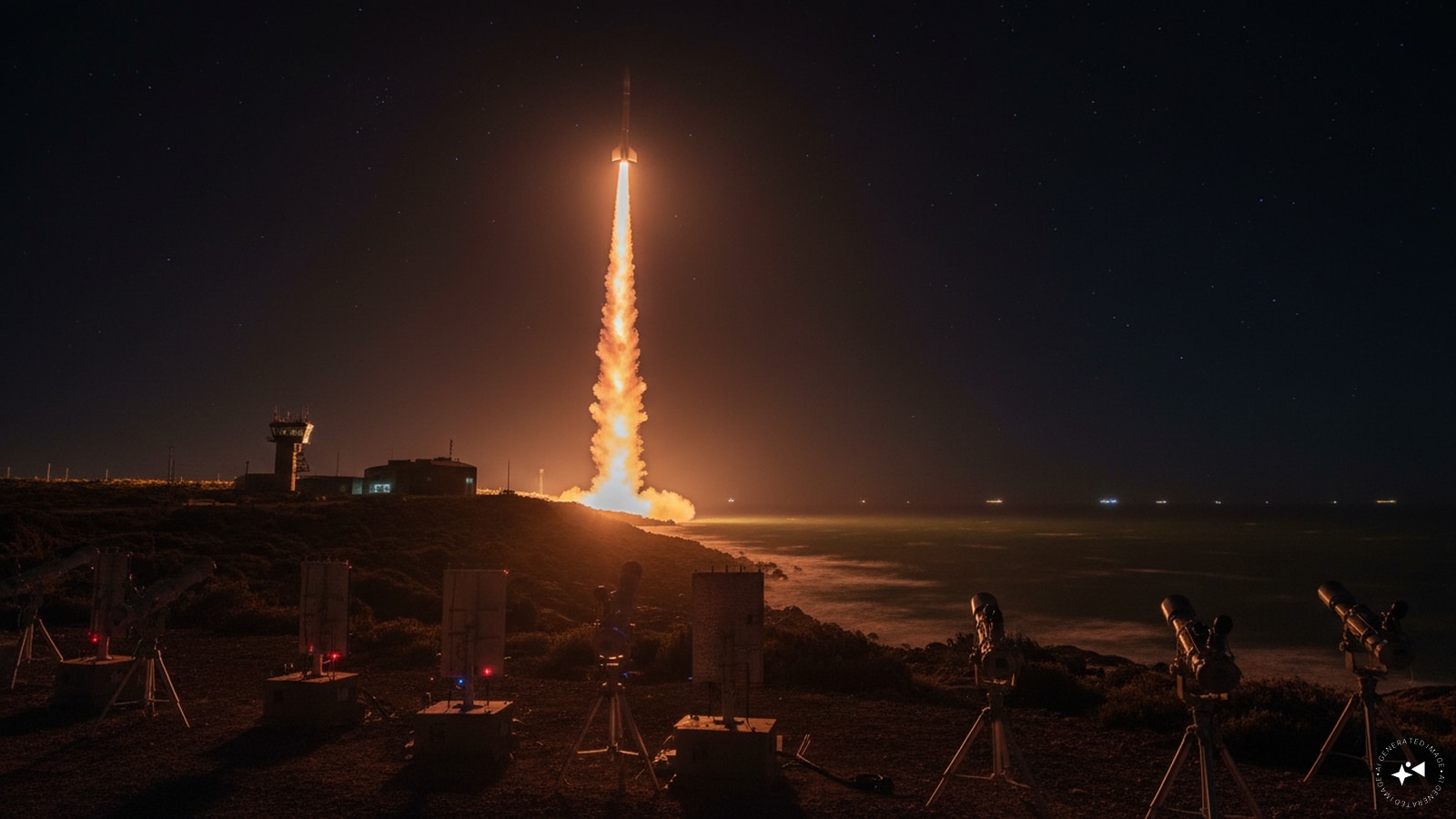
An operator spots a fast-moving return skirting the edge of claimed airspace. Tension in the room spikes. Orders crackle over headsets. A surface-to-air missile—perhaps a modified Sayyad or an older Hawk derivative—leaves its rail in a roar of white smoke and sulfur. The missile climbs toward an intercept point calculated by radar waves bouncing off superheated air. Near the target's predicted path, the warhead detonates, scattering thousands of steel fragments into the sky.
On the operator's screen, the target's steady electronic signature suddenly flickers, drops altitude rapidly to evade, and vanishes beneath the radar horizon.
To the crew in that coastal bunker, the math looks indisputable. Missile fired. Proximity fuse triggered. Target disappeared. In their logbooks, and soon on state television in Tehran, an American F-16 just took shrapnel over the Gulf.
Now rewind the tape and watch those exact same ninety seconds from inside Captain Miller's cockpit.
His radar warning receiver—an electronic ear listening for hostile radio waves—screams a shrill, rhythmic tone into his helmet. Spike. Missile launch. His heart slams against his ribs at a hundred and sixty beats a minute. Instinct and ten thousand hours of brutal muscle memory take over. He slams the side-stick left, rolls the jet onto its back, punches out bursts of magnesium flares and aluminum chaff to blind the incoming seeker, and dives hard toward the deck, pulling seven times the force of gravity until gray tunnels close around the edges of his vision.
The missile explodes harmlessly a mile behind him, its shockwave barely rocking his wings.
Down below the radar horizon, skimming two hundred feet above the whitecaps, Miller levels off, checks his fuel gauges, confirms his engine temperature is green, and flies home to Al Dhafra or Al Udeid. He lands, unstraps, walks into the debriefing room, and signs a maintenance log showing zero damage.
Both sides saw the flash. Both sides saw the dive. And both sides walked away convinced their version of history was carved in stone.
Why Denials Are Never Just About Hardware
Of course, radar confusion is only half the story. The other half is deliberate, calculated theater.
I have spent years reading military communiqués from the Middle East, watching how language gets hardened like armor plating before it ever reaches the public. When you read those dry wire reports—"US denies Iranian account that missile damaged F-16 over Gulf"—you are watching two vastly different political machines trying to speak to their own audiences at home while pretending to talk to each other.
In Tehran, military leadership lives under constant pressure to project deterrence. When sanctions bite, when regional proxies take losses, or when American carrier strike groups park twenty miles off the coast, domestic audiences want proof that the state is not helpless. Claiming a hit on an iconic American fighter jet—the nimble, battle-hardened F-16 that has symbolized U.S. air power since the Cold War—sends an immediate, intoxicating message across local news networks: They are not untouchable. We can reach them. Even if the claim cannot be independently verified, the headline does its work before a denial ever crosses the wire.
Washington faces the exact opposite pressure.
For the Pentagon, admitting that a hostile surface-to-air missile even grazed an American tactical fighter changes the political temperature in Congress overnight. A damaged jet is not just a repair bill running into millions of dollars; it is a casus belli waiting to happen. If an American F-16 takes shrapnel over international waters, hawks in Washington immediately demand retaliatory strikes on Iranian radar sites. Pundits fill cable news panels asking why American pilots are being left exposed.
So when Central Command issues a crisp denial, it does two things at once. First, if the jet truly is untouched, it punctures Tehran's propaganda balloon with cold, bureaucratic precision. Second, it buys diplomatic breathing room—keeping a tense standoff from boiling over into an automatic, escalatory tit-for-tat that neither capital actually wants on a Tuesday afternoon.
Wait. Pause and sit with that discomfort for a second.
Could a government ever shade the truth about minor damage to avoid starting a regional war? History says yes. During the Tanker War of the late 1980s, and throughout the long, shadowy maritime skirmishes of the 2010s and 2020s, both Washington and Tehran repeatedly downplayed close calls, misfires, and near-misses when admitting the full scope of an incident would have forced their hands politically. Conversely, state media in conflict zones routinely exaggerate strikes, recycling old footage or claiming kills that never happened.
We sit on the outside of these classified rooms, peering through frosted glass. That uncertainty is unsettling. It should be.
The Invisible Weight Inside a Single-Seat Jet
Numbers make war feel tidy. One F-16 Fighting Falcon costs roughly thirty to sixty million dollars depending on its avionics block. An Iranian air defense missile costs a fraction of that—maybe a few hundred thousand dollars. On a spreadsheet, the asymmetry looks almost absurd.
Human beings do not live on spreadsheets.
Talk to anyone who has flown single-seat fighters over contested water, and they will tell you that the hardest part of the mission isn't the G-forces or the heat. It is the isolation. In a transport plane or a bomber, you have a crew—someone beside you to crack a joke, double-check a switch, or share the terror when the warning lights flash red. In an F-16, the canopy curves down right beside your shoulders like a glass coffin lid. You are utterly alone with your breathing.
Every patrol over the Gulf carries an invisible psychological tax.
Pilots know the geography by heart. The Persian Gulf is barely thirty-four miles wide at its narrowest choke point in the Strait of Hormuz. At five hundred knots—roughly nine miles a minute—a tiny twitch of the wrist or a minor navigation drift puts an American jet within seconds of Iranian territorial limits. Meanwhile, Iranian fast-attack boats buzz coalition destroyers below, drones hum quietly at medium altitudes without transponders, and commercial airliners carrying families from Dubai to Frankfurt cruise overhead along the exact same corridors.
Remember July 3, 1988.
That date is etched into the institutional memory of every naval officer and air defense commander in the region. On that morning, in the middle of intense skirmishes with Iranian gunboats, the American cruiser USS Vincennes misidentified Iran Air Flight 655—a civilian Airbus A300 climbing normally out of Bandar Abbas—as an attacking Iranian F-14 fighter jet. Two missiles were fired. Two hundred and ninety innocent people, including sixty-six children, fell into the sea.
That tragedy happened because stressed human beings, staring at ambiguous electronic symbols inside a darkened room, filled in the blanks with their worst fears.
Every time a missile streaks upward over the Gulf today, and every time two capitals release contradictory statements about whether it hit its mark, the ghost of 1988 hangs over the water. Because the margin between a denied rumor and an irreversible catastrophe is measured in seconds.
How to Read the Fog Without Losing Your Mind
So when you see a terse headline about an unverified missile strike and an official military denial, how do you separate real danger from routine saber-rattling? You do not need a top-secret security clearance. You just need to watch what militaries do rather than what their press offices say.
First, watch the metal, not the microphones.
When an American aircraft actually takes battle damage in the Middle East, it is nearly impossible to hide for long in the age of commercial satellite imagery and open-source flight trackers. Damaged fighters divert to nearby friendly airfields with emergency trucks foaming the runways. Tanker orbits shift abruptly. Rescue helicopters launch. If flight-tracking transponders over Qatar, Bahrain, and the Emirates continue their boring, predictable figure-eight patterns the next morning, the jet almost certainly came home clean.
Second, look for photographic receipts.
In modern information warfare, proof is currency. If an air defense unit genuinely cripples an adversary's jet over coastal waters, radar telemetry logs, infrared targeting camera footage, or debris photos almost always leak onto Telegram channels within forty-eight hours. When an accusation stays purely verbal—relying on unnamed military sources and stock file photos of fighter jets taking off at sunset—skepticism is your sharpest tool.
Third, measure the silence that follows.
True escalation has an unmistakable acoustic signature. It sounds like emergency Pentagon briefings, carrier groups canceling port calls in Bahrain, and diplomatic evacuations of non-essential embassy staff. When a fiery claim is met with a two-sentence denial and then absolute radio silence from both sides, you are witnessing a controlled release valve at work. Both nations screamed into the wind, satisfied their domestic audiences, and quietly stepped back from the ledge.
The Salt Spray Still Settles
Sunset over the Persian Gulf turns the water the color of hammered copper.
Down on the flight line at a desert air base, ground crews in oil-stained coveralls roll wheel chocks under the tires of returning F-16s. The engines spool down with a long, falling whistle that fades into the hum of portable generators. A young crew chief climbs a yellow ladder, opens an access panel along the fuselage, and runs a flashlight over rivets, hydraulic lines, and exhaust nozzles, checking for hairline cracks, bird strikes, or scorch marks.
Nothing. Just salt crust dried white against gray stealth paint.
Four thousand miles away, screens refresh. Analysts file their reports. Citizens scroll past a tiny, disputed headline about a missile that may or may not have come close to a jet flying over water they will never visit.
Out over the Strait, however, night falls fast, the radar dishes keep turning in slow, tireless circles against the stars, and another pilot straps into a narrow seat—knowing that tomorrow, truth will once again depend entirely on who blinks first in the dark.