Mud remembers everything.
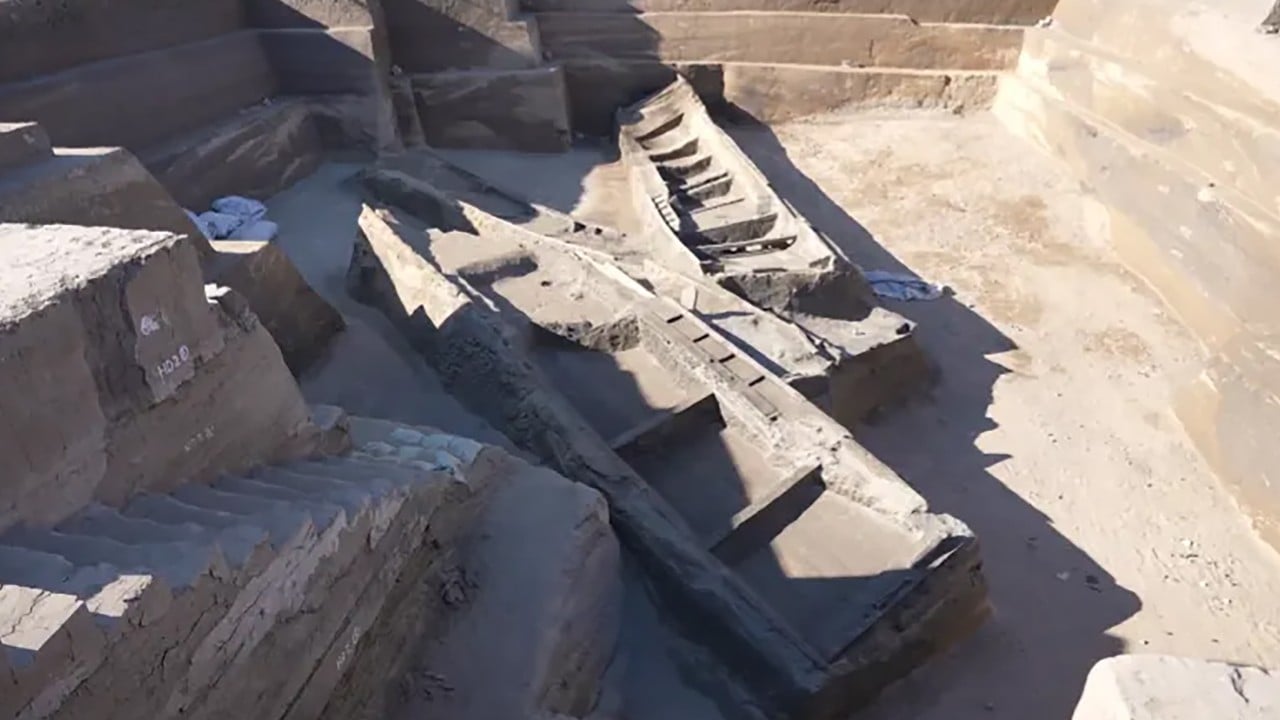
You can pave over a riverbed with concrete, erect glass skyscrapers that scrape the smog out of the northern sky, and reroute a million commuters through subterranean steel tubes, yet six meters down in the oxygen-starved clay of Tongzhou, the earth keeps its receipts. When archaeologists pressed their trowels into the waterlogged soil of Beijing’s eastern district, they were expecting pottery shards. Maybe a rusted coin. Perhaps the splintered remains of a local grain barge that sank while hauling millet toward the imperial capital. You might also find this similar coverage interesting: Pourquoi la rue indienne défie enfin l’impunité politique de Narendra Modi.
Instead, they uncovered a hull that didn’t belong there.
Imagine standing on the lip of a muddy excavation trench in modern Beijing, the hum of the Sixth Ring Road vibrating through the soles of your boots, looking down at dark, preserved timber that has sat untouched for eighteen centuries. Eighteen hundred years. That takes us back to the Eastern Han dynasty—or, depending on the exact carbon decay of the oak and cypress, the chaotic twilight of the Three Kingdoms period, around the second or third century AD. On the other side of the Eurasian landmass, Septimius Severus was tightening his grip on the Roman Empire, marble baths were steaming in Londinium, and legions were patrolling the stone walls of Britannia. As reported in recent articles by The New York Times, the implications are worth noting.
We like to draw thick, neat lines on our historical maps. Rome sits on the left page, draped in crimson and marble. China sits on the right page, inked in jade and silk. Between them stretches an empty white expanse labeled terra incognita, bridged only by a dotted line we call the Silk Road—a romantic shorthand that makes ancient global trade sound like a polite relay race of camels carrying bolts of fabric across the Taklamakan Desert.
That neatness is a lie. And the wooden ribs emerging from the Beijing silt just blew a hole right through it.
The Architecture of Impossible Journeys
To understand why a boat buried in northern China has historians pacing their offices late at night, you have to look at how the thing was nailed together.
Carpentry is like a fingerprint. A shipwright in Alexandria, a boatbuilder in Ostia, and a craftsman along the Yellow River each solved the terrifying problem of keeping water out of a wooden box in completely different ways. Traditional Chinese naval architecture of the Han era relied heavily on bulkheads—watertight compartments inspired by the segmented stalks of bamboo—and flat-bottomed hulls secured with iron nails and vegetable-fiber caulking. It was brilliant engineering, built for shallow rivers, shifting sandbars, and coastal hugging.
Mediterranean shipbuilders, by contrast, were obsessed with the shell. Greek and Roman craftsmen built their vessels from the outside in, locking planks edge-to-edge using intricate mortise-and-tenon joints pinned with wooden dowels before ever inserting the internal ribs. They curved their hulls deeply to slice through the choppy, unforgiving swells of the open sea.
Now picture a hypothetical shipwright—let’s call him Marcus, though his name might just as easily have been Greek, Syrian, or Nabataean—kneeling in a shipyard along the Red Sea port of Berenike around 180 AD. His knuckles are scarred from adze blades. His tunic smells of pine pitch and salt. He is shaping a keel using techniques passed down since the days of the Phoenicians, never once imagining that the blueprint inside his skull, or the very timber beneath his knees, would find an echo five thousand miles away in the heartland of northern China.
Wait. Let’s be brutally honest here, because mystery can easily curdle into myth if we let our imaginations sprint ahead of the dirt.
Did a Roman trireme actually sail up the Hai River and drop anchor in ancient Beijing? Almost certainly not. Even the most audacious Mediterranean merchant vessels would have struggled to survive the monsoon-whipped Indian Ocean, the treacherous pirate-infested straits of Malacca, and the cold currents of the Bohai Sea without catastrophic damage or total crew replacement.
What the Tongzhou discovery reveals is far more fascinating—and far more human—than a lost Roman legion washing up on Chinese shores. The hull exhibits structural anomalies, joinery techniques, and design proportions that mirror Mediterranean maritime traditions rather than purely indigenous northern Chinese boatbuilding. Whether this vessel was built by foreign craftsmen brought east through maritime trade networks, constructed using imported blueprints carried by Sogdian or Roman merchants, or salvaged and rebuilt along the southern coast before making its way north through China’s nascent canal systems, the conclusion remains inescapable.
Ideas were crossing the ocean long before we thought boats could make the trip.
The Invisible Highway Beneath the Waves
Stand on a windy dock anywhere in the world and watch a cargo container ship crawl across the horizon. We take global supply chains for granted until a vessel gets wedged sideways in the Suez Canal and suddenly your local hardware store runs out of garden hoses.
Two millennia ago, the stakes were infinitely higher, and the blind spots were absolute.
For generations, textbooks taught us that the overland Silk Road was the primary artery connecting East and West. You know the mental picture: ragged caravans trudging past the snow-capped Pamir Mountains, dodging bandits in oasis towns like Dunhuang and Kashgar, trading Roman glassware for Chinese lacquerware one saddlebag at a time. That overland route existed, of course, and it was brutal. A single camel could carry roughly four hundred pounds. Every mountain pass took a tax in blood, frostbite, and bribery.
The sea, however, was a freight train.
A single Roman-era merchantman—a corbita—could haul upwards of three hundred to four hundred tons of cargo in its belly. That is the equivalent of a thousand camels, moving continuously day and night whenever the wind cooperated, without needing to stop for water or grazing.
Let’s step into the boots of a third-century merchant—again, a composite figure drawn from historical records like the Periplus of the Erythraean Sea and the Chinese Book of Later Han—to see how this actually worked. Call him Lucius. Lucius doesn't wear a toga; he wears coarse linen stained with sweat and fish sauce. He boards a vessel in Egypt, rides the summer southwest monsoon across the Arabian Sea to the pepper ports of Muziris on India’s Malabar Coast, and unloads amphorae of Italian wine, red coral, and Roman gold coins minted with the profile of Marcus Aurelius.
He doesn’t stop there.
In the bustling, multilingual harbors of southern India and Sri Lanka, ships from the West met junks and outriggers coming down from the South China Sea. In 166 AD—a date explicitly recorded in the official annals of the Han dynasty—an embassy claiming to be sent by "Andun," the king of Da Qin (the Chinese name for the Roman Empire, almost certainly referring to Emperor Marcus Aurelius Antoninus), arrived by sea at the southern Chinese commandery of Rinan, in modern-day Vietnam. They presented ivory, rhinoceros horn, and tortoiseshell to Emperor Huan.
Think about what those gifts tell us. They didn't bring fine Italian marble or Roman bronzes. They brought tropical goods picked up along the Indian Ocean rim—proof that they had run out of homegrown merchandise months earlier and were trading their way across the monsoon belt to stay solvent.
When you trace that maritime web northward, from the Pearl River Delta up the coastline toward the Yellow River basin and the ancient garrison town that would one day become Beijing, the 1,800-year-old ship in Tongzhou stops looking like an aberration. It starts looking like a missing puzzle piece that finally locks two halves of the ancient world together.
Why We Keep Underestimating Our Ancestors
I have spent years walking through archaeological digs and dusty museum basements, and there is one recurring mistake modern people make whenever we look at ancient artifacts: we mistake a lack of technology for a lack of ambition.
Because they didn't have GPS, satellite weather forecasting, or steel hulls, we assume ancient sailors hugged the shoreline like terrified toddlers holding onto the edge of a swimming pool. We assume languages formed impenetrable walls. We assume that someone born in Antioch died within twenty miles of their mother’s kitchen, completely ignorant of what lay beyond the next mountain range.
Look closely at the timber pulled from the Tongzhou mud, and that smug modern assumption evaporates.
Wood does not lie about the hands that shaped it. When conservators carefully wash away eighteen centuries of anaerobic silt, every chisel mark, every mortise slot, every subtle curve of the strakes tells a story of human problem-solving. You can almost hear the arguments on the riverbank when that hull was laid down. Imagine a local northern Chinese master shipwright standing over the keel alongside a darker-skinned mariner who spoke a broken pidgin of Greek, Prakrit, and Middle Chinese—pointing at the ribs, drawing diagrams in the wet sand with a stick, debating how to brace a hull against the violent tidal bores of the northern coast.
No, not like that. If you mortise the planks here, the hull flexes with the wave instead of snapping.
That moment—two strangers from opposite ends of the earth figuring out how to build a better boat in the mud—is the real story here. Not kings. Not emperors. Not conquering armies planting flags in foreign soil. Just working people exchanging survival skills because the sea doesn't care what language you pray in when a squall hits at midnight.
Of course, archaeology rarely hands us a neat, signed confession. Let’s be candid about what we still don't know, because pretending otherwise insults the science.
Waterlogged ancient wood is notoriously fragile. The moment air touches timber that has been preserved in wet clay for 1,800 years, the cellular structure begins to collapse, warping like a dried leaf unless treated immediately with polyethylene glycol and painstakingly freeze-dried. Researchers studying the Beijing wreck still face years of dendrochronological testing—reading the tree rings to pinpoint the exact forest where the timber was felled—alongside isotopic analysis of the trace minerals trapped inside the wood fibers and any surviving resin or caulking.
Could the Mediterranean-style joinery turn out to be an independent convergent invention by Chinese shipwrights solving a similar engineering challenge? Possibly. Human beings are remarkably good at inventing the same wheel twice when faced with identical physics.
Yet the sheer density of corroborating evidence surrounding the Bohai Sea and northern China during the second and third centuries makes total isolation hard to defend. Roman glass beads have been unearthed in Han-era tombs from Guangzhou to Luoyang. Mediterranean-style gold granulation techniques appear on artifacts buried in northern steppes. Even the mythology of the era began absorbing distorted rumors of Da Qin—a mythical western paradise where the roofs were made of crystal and the people were tall, honest, and wore no crowns.
The Fragility of What Survives
There is a quiet tragedy built into every archaeological miracle. We only ever find the failures.
Think about that for a second. A ship that completes its voyage safely gets unloaded, repaired, sailed for thirty years until its planks rot, and eventually gets broken up for firewood to cook someone’s dinner. You never find successful ships in the archaeological record.
The only reason we get to touch this 1,800-year-old hull in Beijing today is because something went terribly wrong.
Perhaps an unseasonable autumn storm blew in off the Bohai Gulf, driving the vessel deep into a shallow tributary where its keel ground hard into a mudbank. Maybe the river shifted its course overnight—as the turbulent rivers of the North China Plain have done with catastrophic frequency for thousands of years—leaving the boat stranded in a shrinking lagoon until the silt swallowed it whole. Maybe a crewman stood on the bank watching the water recede, cursing his luck as the hull tilted sideways, never guessing that his ruined livelihood would become a time capsule for twenty-first-century scientists.
Loss is the preservative of history.
Walk through the sprawling urban landscape of Tongzhou today—now Beijing’s gleaming municipal administrative center, where cranes swing steel beams across the sky and high-speed trains whisper past at two hundred miles an hour—and pause to appreciate the sheer improbability of this survival. For eighteen centuries, empires rose and shattered directly above this buried hull. The Northern Wei marched through. The Tang poets drank wine nearby. Kublai Khan built his grand capital Dadu just to the west, digging the northern terminus of the Grand Canal almost directly over the forgotten riverbed. Ming emperors raised walls; Qing banners fluttered; modern bulldozers carved foundations for apartment towers.
A meter to the left, a concrete piling would have pulverized the ribs into splinters. A meter higher, fluctuating groundwater would have rotted the oak into black dust before the Song dynasty even began.
Instead, the mud held its breath until our trowels arrived.
What the Mud Is Trying to Tell Us
Why should anyone outside a university history department care about a waterlogged wooden hull dug out of a construction site in China?
Because we are living through an era obsessed with walls.
Every week brings fresh headlines about decoupling economies, severing supply chains, erecting digital borders, and retreating into tribal camps convinced that East and West are fundamentally incompatible civilizations locked in an eternal zero-sum collision. We talk as if globalization were a fragile modern software update invented in the nineteen-nineties—something we can simply uninstall if it gets too inconvenient.
The ghost ship beneath Beijing laughs at that arrogance.
Connection is not a modern invention; it is the default setting of human curiosity. Even when the journey required risking drowning in unmapped oceans, dying of dysentery in foreign ports, or navigating languages that shared not a single root word, people still built the boats. They still loaded the cargo. They still traded secrets of timber and iron across six thousand miles of water and sand.
When conservators finally finish stabilizing the Tongzhou vessel, and those dark, ancient ribs go on display beneath museum spotlights, resist the urge to look at it as a mere curiosity—a quirky footnote about Romans and Chinese crossing paths in antiquity. Look at the joints where the planks meet. Look at the curve of the hull. You are looking at proof that no ocean was ever wide enough, and no empire ever insular enough, to keep human beings from reaching across the dark to see who else was out there.
Down in the cold clay beneath Beijing, the timber waited eighteen hundred years to remind us that we have been neighbors far longer than we remember.