Dust. That is what history smells like when you pull a two-hundred-year-old plantation ledger off a climate-controlled shelf in London. It smells like dry paper, dried ink, and the quiet, suffocating weight of money that never died.
For decades, the debate over transatlantic slavery reparations has lived inside sterile conference rooms and shouting matches on cable television. One side waves spreadsheets; the other side waves hands, muttering about ancient history and the impossibility of untangling a knot tied in the eighteenth century. To most people watching from the sidelines, the whole argument feels like a ghost story—abstract, unsolvable, and safely locked in the past.
Until a former BBC journalist walked into a dusty archive, opened a box, and found a receipt for over a thousand human beings.
Laura Trevelyan did not set out to become the poster child for Caribbean reparations. She was a seasoned television anchor living a comfortable life in New York, far removed from the cane fields of Grenada. Yet when she and her relatives began tracing their family tree, they collided with an uncomfortable mathematical reality. In 1834, when Britain abolished slavery across its empire, the British government did not pay a single penny to the people who had endured generations of forced labor. Instead, London borrowed twenty million pounds—roughly forty percent of the national budget at the time, an astronomical sum that British taxpayers only finished paying off in 2015—to compensate the slave owners for their lost "property."
The Trevelyan family was on that payout list. They received roughly thirty-four thousand pounds, worth millions in today's currency, for the enslavement of more than one thousand Africans across six sugar plantations on the island of Grenada.
Pause. Let that number sit in the room for a second.
Generational wealth does not evaporate; it compounds. Think of inherited capital like a snowstorm on a mountain peak—what starts as a few flakes in 1834 becomes an avalanche of private school tuitions, seed money for businesses, prime real estate, and quiet financial safety nets two centuries later. Meanwhile, at the bottom of that same mountain, the descendants of the people who cut the cane inherited the mudslide: underfunded hospitals, fragile infrastructure, chronic poverty, and a health crisis rooted in generations of nutritional deprivation.
The Ledger and the Living
To understand why Caribbean campaigners have seized upon the Trevelyan story, you have to step off the mainland and stand on the red soil of Grenada.
Picture a hypothetical afternoon in St. George’s—a town where the pastel buildings cling to steep green hills overlooking a harbor that once processed human cargo alongside nutmeg and sugar. Imagine a local schoolteacher named Marcus, a composite of the dozens of educators and activists who walk these streets every day. Marcus teaches history in a classroom where the textbooks still occasionally frame British colonialism as a civilizing mission. His students are bright, ambitious, and acutely aware that the island's economy remains tethered to the whims of foreign tourism and volatile agricultural exports. When a hurricane hits, the recovery takes years because the national treasury lacks the deep reserves that older, wealthier nations take for granted.
For Marcus, reparations are not about a quick cash handout or a symbolic handshake. They are about the broken engine of an entire region.
When the Trevelyan family traveled to Grenada in early 2023 to issue a formal, public apology and establish a community fund—starting with a personal pledge of one hundred thousand pounds from Laura Trevelyan herself—something shifted in the air. The argument stopped being theoretical. A real family had looked at a real ledger, acknowledged a direct line of financial benefit, and said, We owe a debt, and we are starting to pay it.
But the real problem lies elsewhere. One family writing a check, however noble, is a thimble emptied into an ocean.
Across the fifteen member states of CARICOM, the Caribbean Community, leaders and activists have spent over a decade drafting a precise, ten-point blueprint for reparatory justice. If you have ever wondered what Caribbean nations actually want when they say "reparations," forget the caricature of politicians demanding suitcases of unmarked bills. The CARICOM plan reads less like a ransom note and more like a Marshall Plan for a wounded region.
It asks for full formal apologies—not expressions of "regret," which carry zero legal weight, but explicit admissions of culpability. It calls for debt cancellation, pointing out that many Caribbean nations were forced to borrow massive sums from Western banks immediately after independence just to build basic plumbing and roads that colonial powers never bothered to construct. It demands targeted investment in public health to combat the sky-high rates of hypertension and diabetes that researchers link directly to the trauma and dietary scarcity of plantation life. It asks for educational programs, technology transfers, and psychological rehabilitation.
The Architecture of Denial
Why, then, does the mere mention of the word reparations trigger such visceral panic in London, Washington, and Brussels?
I have spent years reporting on institutional accountability, and I can tell you that the resistance rarely comes from a lack of historical evidence. The paper trail of the transatlantic slave trade is arguably the most meticulously documented crime in human history. Insurance companies in London still sit in buildings financed by marine policies written on slave ships. British banks, universities, and aristocratic estates carry names directly tied to the sugar trade. The University College London database, which spent years digitizing the 1834 compensation records, laid the entire architecture bare for anyone with an internet connection to see.
No, the hesitation is rooted in fear—specifically, the terror of precedent.
Consider what happens next if the British Crown or the British government officially says, Yes, we owe reparations for slavery. In the eyes of government lawyers in Whitehall, an apology is an open door. Once you admit legal and moral liability for state-sanctioned exploitation in the Caribbean, what stops former colonies in Africa, South Asia, or elsewhere from stepping through that exact same door with their own ledgers in hand? The financial exposure becomes theoretically boundless.
So, politicians duck. Prime Ministers express "deep sorrow" while insisting that the present generation cannot be held responsible for the sins of the past. They argue that the money has been spent, the perpetrators are dead, and we should all focus on moving forward together.
It is a convenient philosophy, especially when you are sitting on the winning side of the compound interest curve.
Consider an analogy from everyday life. Imagine your grandfather stole the deed to his neighbor’s farm, worked the neighbor’s family for free for fifty years, and used the profits to buy a chain of successful hardware stores. When your grandfather dies, you inherit those stores. You didn't steal the deed. You are a decent, hardworking person who treats your employees fairly. One day, your neighbor’s grandchild knocks on your door, living in a leaking shack on the edge of the property, holding the original, stolen deed. You might not be personally guilty of theft, and nobody is suggesting you go to prison. Yet pretending that your prosperity has nothing to do with their poverty requires a willful, almost athletic blindness.
That blindness is what Caribbean campaigners are trying to cure.
The Fracture Inside the Movement
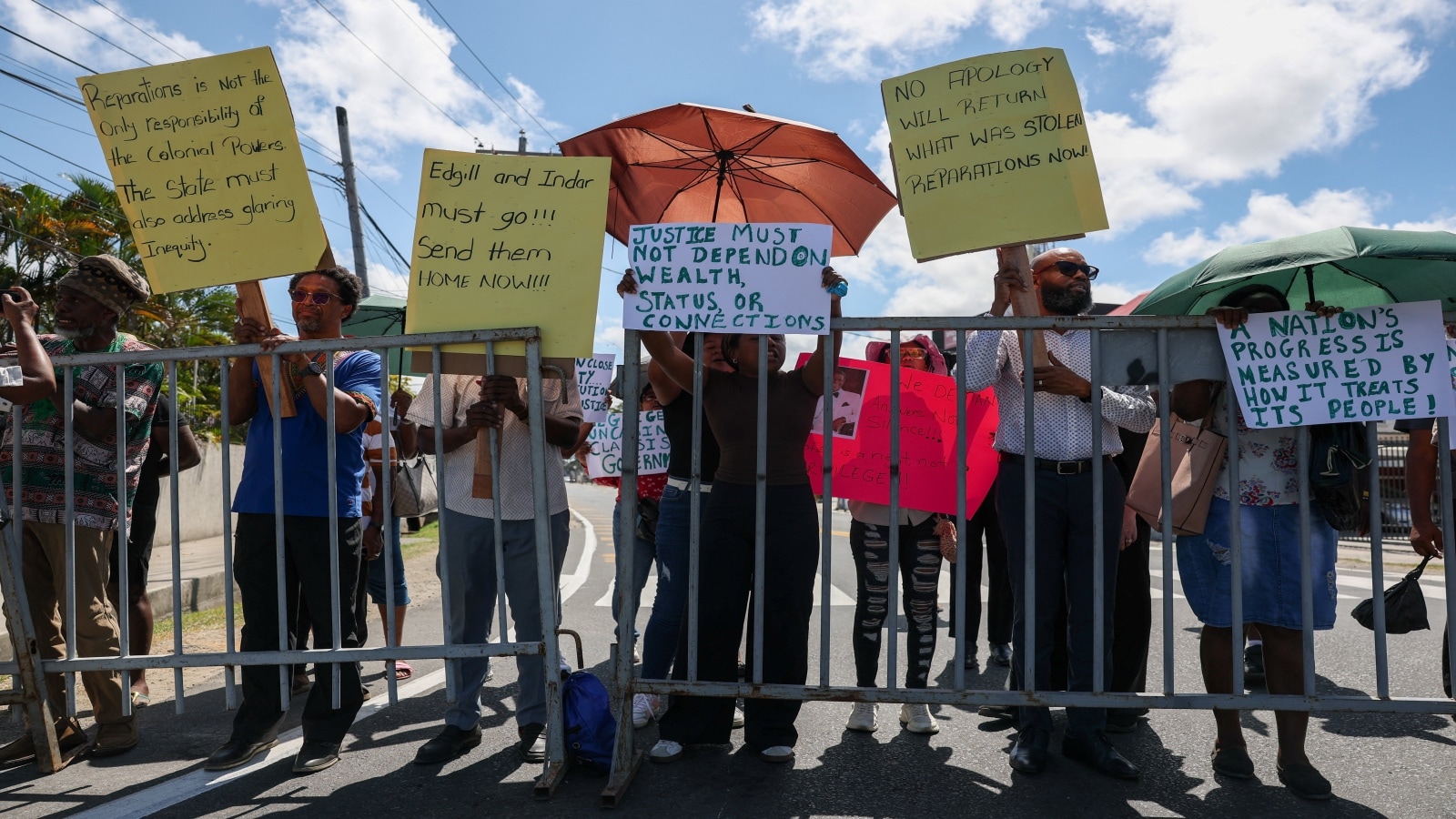
Yet even among those fighting for justice, the path forward is messy, contentious, and deeply uncertain. It would be dishonest to pretend that the Trevelyan gesture was met with universal applause across the Caribbean.
When Laura Trevelyan stood before cameras in Grenada and spoke of her family’s shame, many welcomed the courage it took to break ranks with the British establishment. Hilary Beckles, the vice-chancellor of the University of the West Indies and chair of the CARICOM Reparations Commission, praised the family for setting a moral benchmark that shamefully outpaced the British government.
At the same time, sharper voices within the grassroots movement raised an eyebrow. A hundred thousand pounds, spread across an island of over a hundred thousand people, amounts to less than a pound per citizen. Critics pointed out the danger of "reparations theater"—the risk that wealthy Western families or institutions might make modest, tax-deductible donations, collect glowing headlines in the international press, cleanse their family name, and leave the fundamental structural inequalities completely untouched.
There is also the thorny, unresolved question of distribution. If billions of dollars were somehow unlocked tomorrow, who gets the money? Should it go directly to individuals who can prove descent from enslaved people, a bureaucratic nightmare given how deliberately plantation owners erased family records? Or should it flow into national governments, where skeptical citizens worry it might vanish into political patronage or poorly managed state projects?
I do not have a neat answer to that question, and anyone who claims they do is selling you a fairy tale. Designing a mechanism to repair four centuries of systemic extraction is one of the hardest logistical, legal, and moral puzzles humanity has ever faced. The fear of getting it wrong is real. The complexity is staggering.
Why the Trevelyan Precedent Still Refuses to Die
Still, ask yourself why the story of one British family has refused to fade from the headlines, even as bigger, louder global crises dominate the news cycle.
It endures because it shatters the most common excuse used to shut down the conversation: It’s too complicated to trace.
The Trevelyans proved that it isn't. They proved that the records exist, the names are legible, and the descendants of both the profiteers and the victims are still breathing the same air. Following their public reckoning, a group called Heirs of Slavery formed in the United Kingdom—a coalition of affluent British citizens whose ancestors profited from the transatlantic trade, quietly stepping forward to lobby their own government to enter formal talks with Caribbean leaders.
Momentum has a strange way of building in the dark before it breaks the surface. For years, campaigners in Barbados, Jamaica, and Grenada felt like they were shouting into a hurricane. Now, the conversation is happening inside the halls of the Church of England, which pledged a hundred million pounds after discovering its own historical links to the slave trade, later raising its ambition after an independent oversight group argued the figure was far too low. It is happening inside British universities, newspapers, and insurance giants.
Look closely at what is actually changing. The debate is slowly shifting from whether a debt exists to how that debt should be settled.
In late 2024, when Commonwealth leaders gathered in Samoa, British officials desperately tried to keep reparations off the official agenda. They failed. Despite diplomatic pressure from London, the final communique signed by fifty-six nations included a specific agreement that the time had come for a "meaningful, truthful and respectful conversation" toward forging a common future based on equity. It was diplomatic language, cautious and hedged, yet it represented a crack in a dam that had held firm for generations.
The Weight of an Unpaid Bill
Let us return to that archive room in London, and to the red soil of Grenada.
History is not a museum exhibit behind velvet ropes. It is an active ingredient in the present, baked into the interest rates developing nations pay on international loans, the resilience of their coastlines against rising seas, and the opportunities available to a child born in St. George’s versus a child born in Kensington.
When Caribbean campaigners point to the Trevelyan family, they are not holding them up as saviors. They are holding them up as a mirror. They are saying to the British state, to global financial institutions, and to the quiet beneficiaries of an old, brutal economy: Look. It can be done. You can open the books. You can tell the truth without the sky falling in.
Whether governments choose to follow that lead remains an open question, tangled in politics, pride, and the sheer terror of the bill coming due. Yet the ledger has already been pulled off the shelf, the dust has been blown away, and the ink—dark, stubborn, and unmistakable—is still wet.


