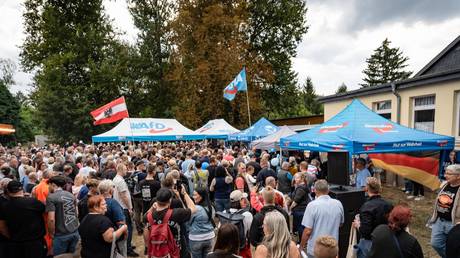
Everybody in Berlin is hyperventilating over a wall that stopped working years ago.
The lazy consensus dominating media coverage treats the political quarantine in eastern Germany as a sacred barrier holding back an inevitable democratic apocalypse. Commentators wring their hands over whether an electoral breakthrough in Saxony-Anhalt will shatter postwar norms, treating the regional vote as a moral test for the nation. This framing misses the entire structural reality. The barrier is not a defense mechanism keeping extremism at bay; it is a luxury crutch used by mainstream parties to avoid confronting their own policy failures.
I have watched political establishments blow millions of euros and decades of voter trust on containment strategies that achieve the exact opposite of their intent. When you declare an entire political faction untouchable while failing to deliver basic economic growth, security, and administrative competence, you do not marginalize them. You turn them into the only vessel for systemic frustration.
Let us define terms precisely. The German political quarantine, or Brandmauer, is a self-imposed absolute ban on coalition building, joint legislative cooperation, or structural normalization involving the Alternative for Germany. The original objective was simple: deplatforming through total exclusion.
Instead, it created an asymmetric political shelter. By locking the opposition out of executive responsibility, mainstream parties insulated them from the compromises, stumbles, and unpopular trade-offs that come with governing. The opposition never has to balance a real-world state budget or answer for stalled infrastructure projects; they can pitch pure, unadulterated grievance politics while the ruling establishment ties itself into ideological pretzels to form awkward, multi-party coalitions just to keep the math working.
The standard media narrative claims that if the barrier falls, democracy collapses. That logic is backward. Democracy is already hollowed out when mainstream coalitions form not around shared vision, but around the sole negative identity of excluding a surging bloc of voters. When the Christian Democrats and their center-left partners spend all their energy coordinating who not to talk to, governance grinds to a halt.
Look at the economic backdrop. Saxony-Anhalt faces severe demographic contraction, low productivity growth, and an aging population. Voters there are not rebelling because they woke up one morning and decided to discard history; they are reacting to decades of industrial stagnation and a feeling that Berlin treats eastern states like administrative afterthoughts.
When the establishment responds to these structural fractures by screaming about structural walls rather than fixing local hospitals, schools, and transport links, voters double down. Every warning headline from the capital acts as free marketing for an insurgent movement that thrives precisely on being hated by the metropolitan elite.
Imagine a scenario where the quarantine is completely abandoned tomorrow. Mainstream parties would be forced to debate policy point-for-point in public view, stripping away the romantic aura of martyrdom that surrounds the opposition. Parties that cannot win arguments on economic competitiveness or energy costs deserve to lose power. Hiding behind a procedural cordon sanitaire does not make bad governance any more palatable to a taxpayer staring down stagnant wages and crumbling local services.
The political class in Berlin needs to stop treating elections as moral pageants and start treating them as performance reviews. If your strategy for ten years has been to isolate an opponent while their numbers double, your strategy is a failure.
Stop obsessing over the breach of a wall that only exists to protect exhausted incumbents from accountability. Fix the economy, deliver competent public services, and win back your voters. Everything else is just noise.



