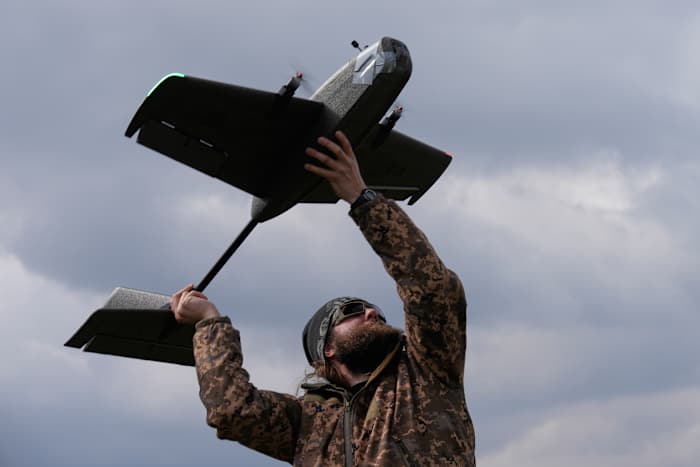
The recent dismissal of Ukrainian-produced First Person View (FPV) drones as "Lego" toys assembled by "housewives" by German Defense Minister Boris Pistorius represents a fundamental misunderstanding of the modern industrial-military complex. This rhetorical failure is not merely a diplomatic gaffe; it reveals a structural blindness within traditional Western procurement models toward the High-Frequency Iteration Loop (HFIL) that now dictates survival on the modern battlefield. When an official characterizes distributed, agile manufacturing as amateurism, they ignore the shift from capital-intensive, slow-cycle defense production to low-cost, high-attrition electronic warfare.
The Anatomy of the HFIL Model
Traditional defense procurement operates on a multi-decade horizon. A platform—whether a tank or a fighter jet—is designed, prototyped, tested, and fielded over fifteen to twenty years. This is the Static Defense Paradigm. In contrast, the Ukrainian drone ecosystem operates on a cycle measured in weeks.
The "Lego" analogy fails because it focuses on the outward appearance of the hardware rather than the sophistication of the internal systems. A modern FPV drone is a vehicle for three critical technical components:
- Frequency Agility: The ability to hop across radio spectrums to evade Russian Signal Intelligence (SIGINT) and Electronic Warfare (EW) jamming.
- Payload Integration: The mechanical and chemical engineering required to fuse a $500 quadcopter with a PG-7VL anti-tank grenade.
- Optical Guidance Algorithms: The software layer that allows a pilot to maintain a terminal lock despite signal degradation during the final descent.
Calling this "housewife" labor ignores the fact that these "kits" are being optimized by software engineers and electronic warfare specialists who have more combat-testing hours than any NATO procurement officer. The "housewives" are the labor force in a distributed manufacturing network that bypasses the primary bottleneck of modern war: the centralized factory target.
The Cost-Exchange Ratio Inversion
The primary metric for evaluating any weapon system in a war of attrition is the Cost-Exchange Ratio (CER).
$$CER = \frac{Cost\ of\ Neutralization}{Cost\ of\ Platform}$$
In traditional 20th-century doctrine, a $5 million Leopard 2 tank is expected to destroy several $2 million T-72 tanks, maintaining a favorable CER. However, the introduction of the mass-produced FPV drone has inverted this equation. When a $600 drone, assembled in a basement in Kyiv, disables a $5 million armored vehicle, the CER is approximately 1:8,333.
By belittling the "low-tech" nature of these drones, Western defense officials are clinging to a model where "quality" is defined by industrial polish rather than economic efficiency. The "Lego" drone is not a toy; it is a precision-guided munition that costs less than a single 155mm artillery shell ($3,000–$8,000) and offers significantly higher accuracy.
Distributed Manufacturing vs. The Single Point of Failure
The German defense industry is built on the concept of Vertical Integration. Companies like Rheinmetall or Krauss-Maffei Wegmann manage massive, centralized facilities. While these produce world-class hardware, they are vulnerable to two factors in a high-intensity conflict:
- Logistical Fragility: One strike on a specialized component factory can halt an entire production line.
- Scale Scarcity: These facilities cannot 10x production in a month. They are bound by specialized tooling and labor shortages.
Ukraine’s "amateur" drone industry utilizes Horizontal Distributed Manufacturing. By utilizing off-the-shelf components—flight controllers, brushless motors, and carbon fiber frames—thousands of small-scale workshops contribute to a national output that exceeds 100,000 units per month. This is not a lack of sophistication; it is a tactical evolution. It creates a "Hydra" effect where the manufacturing base has no single point of failure.
The Software-Defined Battlefield
The most significant error in the "Lego" critique is the failure to recognize that the value of the drone has shifted from the airframe to the silicon. The physical drone is a disposable delivery mechanism. The real intellectual property resides in the Frequency-Hopping Spread Spectrum (FHSS) logic and the AI-driven target acquisition software being patched into these drones daily.
While a German defense firm might take two years to certify a software update for a Puma IFV, a Ukrainian drone unit can push a code update to 500 pilots via Telegram to counter a new Russian jamming frequency discovered that morning. This is Software-Defined Warfare. The hardware's "toy-like" appearance is a byproduct of prioritizing speed and cost over aesthetics.
The Failure of Traditional Military-Industrial Logic
The friction between Ukrainian drone advocates and German defense officials stems from a clash of two different economic theories:
- The Gold-Plating Theory: The belief that a weapon system must be ruggedized, multi-functional, and built to last thirty years. This leads to the "Lego" insult because the drones look flimsy.
- The Disposable Attrition Theory: The belief that in a high-EW environment, a drone has a life expectancy of three flights. Therefore, any money spent on "ruggedization" or "aesthetic finish" is wasted capital.
The Ukrainian model recognizes that the "sensor-to-shooter" link is the only thing that matters. If a drone works once and kills a tank, it has achieved 100% of its design objective. To a traditionalist, a weapon that breaks after one use is a failure. To a modern strategist, a weapon that is too expensive to lose is a liability.
Strategic Divergence in NATO Doctrine
The "housewife" comment reflects a deeper cultural rift in NATO. Many Western militaries are still optimized for "expeditionary" warfare—fighting insurgencies where they have total air and electronic superiority. In that environment, you can afford expensive, slow-to-build toys.
In a peer-to-peer conflict against a nation with advanced EW capabilities, the "exquisite" platforms fail. They are too few in number to absorb losses and too complex to repair in the field. The Ukrainian drone program is currently the only entity in the world conducting mass-scale research and development on Electronic Counter-Countermeasures (ECCM) in a live environment.
The Risk of Institutional Arrogance
By dismissing these efforts, Western defense leaders risk falling behind in the next generation of arms development. If Germany continues to focus on protecting the prestige of its legacy heavy industry at the expense of integrating low-cost, high-tech autonomous systems, it will find its military-industrial complex obsolete.
The "Lego" drone is the precursor to the autonomous swarm. The software being written by those "housewives" and volunteer coders today will form the backbone of autonomous combat logic for the next decade.
The strategic imperative for European defense is not to mock the decentralization of Ukrainian production, but to figure out how to replicate its speed. This requires a transition from a hardware-first mindset to a software-first mindset.
The following variables must be integrated into Western procurement immediately to avoid terminal obsolescence:
- Modular Open Systems Architecture (MOSA): Ensuring that drone components can be swapped as easily as "Lego" blocks to stay ahead of EW.
- Rapid Prototyping Funding: Moving away from five-year contracts toward three-month "sprints."
- Acceptance of Failure Rates: Shifting the KPI from "mean time between failures" to "target neutralized per dollar spent."
The dismissal of Ukrainian innovation as amateurism is a defense mechanism for an industry that knows it cannot compete with the price point or the iteration speed of the "Lego" model. The future of the European continent may well depend on whether its leaders can learn to build "toys" as effectively as their Ukrainian counterparts.
Invest in the software layer of the attrition cycle. Stop evaluating weapon systems by their durability and start evaluating them by their ability to evolve within a single combat deployment. The side that iterates faster wins; the side that builds the most "polished" museum pieces loses.