The water off the coast of Nova Scotia does not gently lap at the shore; it presses. It is a heavy, slate-gray expanse that carries the memory of winter even in the heart of July. On a Tuesday morning that felt entirely ordinary, the Atlantic decided to show its hand.
Sarah MacLeod was cleaning the salt crust off her kitchen window when the harbor chatter began. It was not the sharp, urgent crackle of a marine emergency, but something stranger—a low murmur that ripple-effected down the wooden docks of Cape Breton. People were leaving their coffee cups half-drunk, pulling on thick wool sweaters, and walking toward the edge of the stone wharf.
She followed them. Everyone follows a mystery when the sea is involved.
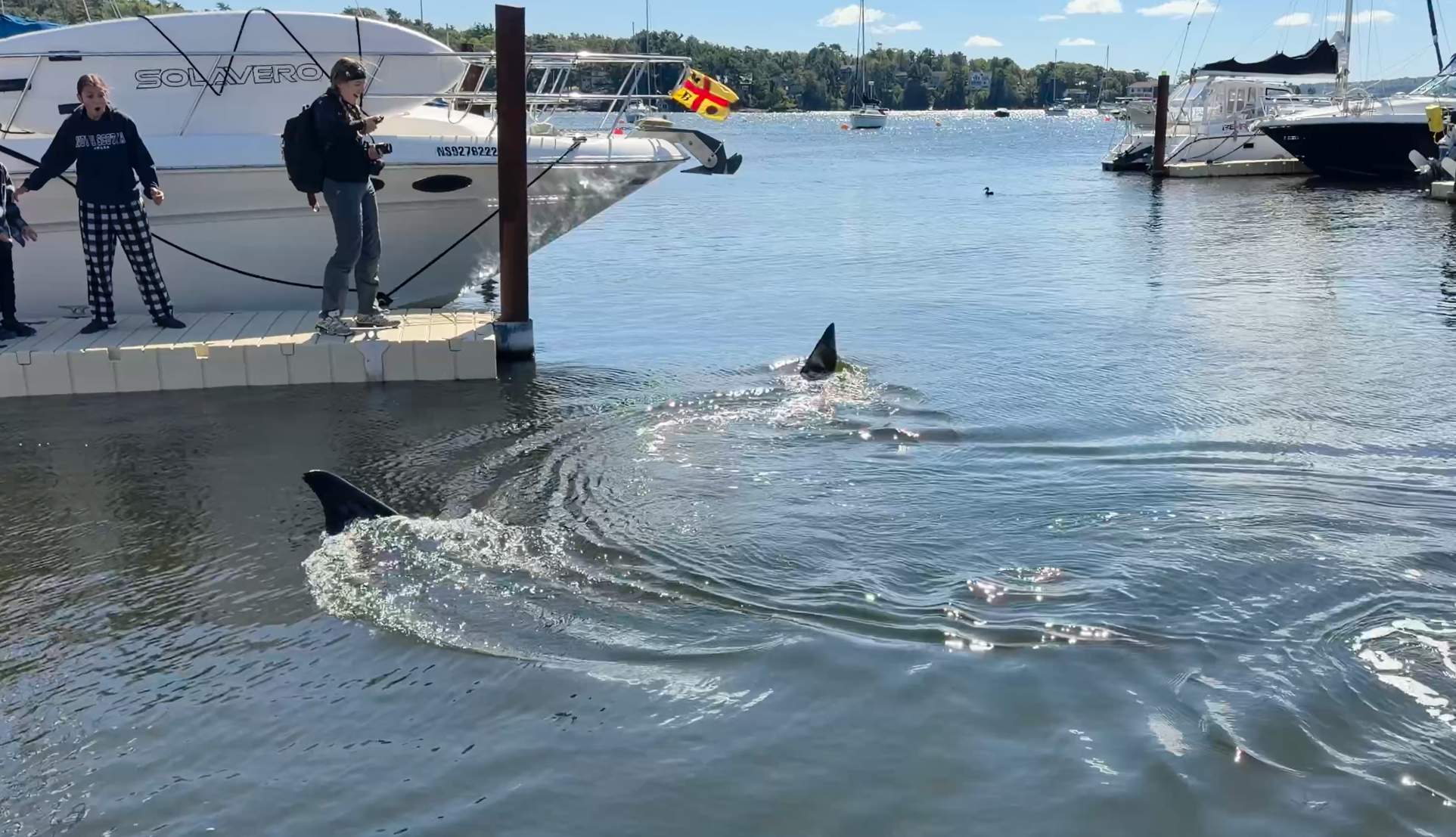
There it was.
Floating just beneath the surface, moving with a terrifying, hypnotic slowness, was an animal that belonged to a different epoch. It was a massive basking shark, stretching nearly thirty feet from its blunt, conical snout to the scythe-like sweep of its tail. To call it a fish feels like an insult to its scale. It was a submarine of muscle and cartilage, a living mountain drifting through the kelp beds.
Most people recoil from the word shark. They smell blood in the syllable. They picture serrated teeth and black, unblinking eyes. But as Sarah stood on the barnacled pilings, watching the giant glide within arm's reach of the wooden pylons, she felt none of that.
The creature’s mouth was wide open. It was a gaping cavern, pale white and impossibly vast, scooping up billions of microscopic copepods and plankton with the unhurried dignity of a machine. It looked less like a hunter and more like an open furnace, drawing in the life of the sea to keep a quiet engine burning. It was peaceful. It was ancient. And, for a few breathtaking moments, it was sharing the harbor with us.
The Anatomy of a Gentle Giant
We have spent centuries painting the ocean's largest inhabitants as monsters, mostly because we are terrified of things we cannot control. Yet the basking shark—Cetorhinus maximus, if you prefer the Latin weight of it—poses zero threat to human beings.
Picture standing next to a public transit bus, then imagining that bus is made of velvet muscle and lives underwater. That is what a thirty-foot elasmobranch looks like up close. Weighing up to five tons, they are the second-largest fish in the modern sea, trailing only behind the whale shark. Yet their diet consists almost entirely of organisms smaller than a grain of rice.
They do not bite. They do not stalk. They simply filter.
To watch one feed is to witness an exercise in absolute efficiency. As they cruise at a sluggish two knots—about as fast as a casual human stroll—water rushes through their immense gill slits. These gill arches are lined with bristle-like structures called gill rakers, which trap every drifting morsel of zooplankton while letting the seawater stream harmlessly out the sides.
For the fishermen of Nova Scotia, seeing a basking shark used to be as common as watching gulls wheeling overhead. Generations ago, older salts would mutter about "sun-fish" lazily lolling at the surface on hot summer afternoons, warming their massive dorsal fins in the top layer of the water column. They looked like floating logs. Sometimes, unsuspecting sailors nearly collided with them, mistaking the slate-colored ridge of a fin for a jagged reef that had no business being in the middle of the bay.
When the Ghosts Vanish
Then, they stopped.
Not all at once, which is the tragedy of ecological decline. It happens in whispers. A season passes without a sighting. Then a decade. By the late twentieth century, the basking sharks of the North Atlantic had largely vanished from the surface waters, hunted relentlessly for their valuable liver oil, fins, and meat. Their slow reproductive cycle—females carry pups for over a year, perhaps up to three—made them uniquely vulnerable to human harvesting. You cannot overfish a ghost without killing the species twice over.
Which is why when one appears now, near the docks, it is more than just a local curiosity. It is an ecological census report delivered in person.
Marine biologists call their return a hopeful anomaly, though caution is always the anchor of marine science. Are these waters cooling just enough? Are the copepod blooms thicker this year because of shifting nutrient currents? Or did we simply give the ocean enough breathing room for a few survivors to reclaim their ancestral migration routes?
Standing on the wharf, Sarah didn't care about the academic jargon. She watched the giant’s massive tail sweep once—a slow, rhythmic crescent that displaced tons of water without a single splash. It was an economy of motion that humans lost the ability to practice centuries ago.
The shark turned its blind, tiny eye toward the shadow of the pier. For a fraction of a second, the ancient lineage of the deep met the hurried architecture of the land.
What We Owe the Deep
We are a species obsessed with leaving our mark. We carve highways through mountains, lay fiber-optic cables across oceanic trenches, and fill the sky with aluminum and exhaust. We demand that nature bend to our timelines, our economies, our news cycles.
The basking shark does not care about our timelines. It was swimming through these very waters before the first human carved a canoe from a birch tree, and it will be filtering the dark abyssal currents long after our concrete docks have crumbled back into sand.
As the great fish finally tilted its massive head downward, dissolving slowly into the green-gray depths until only a pale shadow remained, the harbor grew quiet again. The spell broke. People picked up their coffee cups. Boats sputtered back to life.
But the water looked different. It looked heavier. It looked deep.
Beneath the choppy surface of our daily lives, there are still giants moving in the dark, reminding us that we share this planet with things far older, far larger, and far more patient than we will ever be.