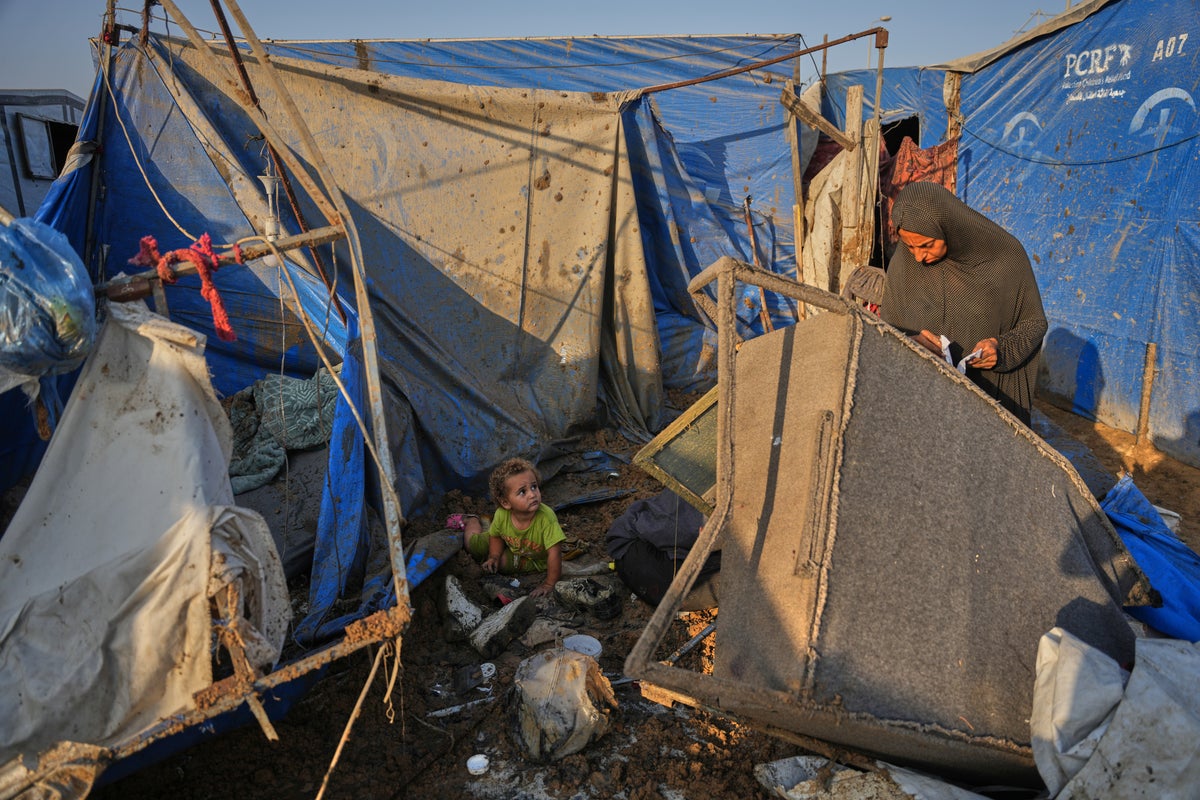
Desperation smells like woodsmoke and open sewage in the tent camps stretching across southern Gaza. When Washington announced a breakthrough deal requiring Hamas to hand over its weapons, millions of displaced civilians felt a brief surge of adrenaline. Maybe the relentless pounding would finally stop. Maybe they could walk back to the concrete piles where their kitchens used to be.
That fragile hope collided with reality within minutes. Israeli airstrikes kept blasting central and southern neighborhoods, proving that high-level diplomatic handshakes mean very little to artillery crews on the ground. People trapped in the enclave are caught in a brutal psychological trap. They want an end to militant rule that brought total destruction, but they are terrified that if Hamas drops its arms, the Israeli military will simply stay forever.
The Trap of Sequencing and Suspicion
The roadmap pushed by the U.S.-led Board of Peace sounds tidy on paper. It maps out a phased transition where Hamas decommissions heavy weapons, tunnels, and manufacturing sites, an international stabilization force deploys as a buffer, and Israeli troops execute a gradual withdrawal.
Real life doesn't follow a neat timeline. Residents know this intimately. Since a tentative ceasefire went into effect back in October, more than 1,200 Palestinians have been killed by ongoing military fire, and the footprint of occupied territory has actually expanded.
When a government or an army promises a phased pullback, ordinary citizens look at the bulldozers clearing buffer zones and the concrete separation lines like the Yellow Line. They don't see a temporary security measure. They see permanent annexation.
"They will make us suffer," says Ammar Kaskeen, a 30-year-old resident staring out at the rubble of southern Gaza. He speaks for a weary public that has heard every promise in the book. Trust is entirely gone. Hamas is viewed by many exhausted civilians as having traded their futures for a war they couldn't win, while Israel's ultimate objective is widely feared to be the permanent depopulation of the strip.
Who Actually Controls the Ground
Diplomats in Washington and Cairo love talking about technocratic governance and international police forces. But right now, daily survival rules everything. Water is scarce. Infectious diseases spread easily through crowded encampments. Children sleep on dirt under torn plastic sheets.
Abdel Moneim Aboul-Roos drives a tuk-tuk in Deir al-Balah. He lost a leg in an airstrike. His perspective strips away all the diplomatic jargon. "I don't care about any of it as long as there is no food or medicine," he says.
That is the baseline metric for success in Gaza. If a disarmament deal doesn't immediately translate to calories, clean water, and an absolute halt to bombs dropping from the sky, it is just more noise.
Militant factions remain fractured on the terms, too. While representatives for Hamas indicated acceptance of a framework, other groups like the Palestinian Islamic Jihad publicly dismissed the announcements as inaccurate. Meanwhile, Israeli leadership has maintained strategic ambiguity, refusing to lock themselves into a firm departure schedule.
What Happens When the Cameras Turn Off
The friction point of this entire arrangement comes down to simultaneity. Nickolay Mladenov, a high representative for the peace board, noted that verification has to be real and that withdrawal must move in lockstep with decommissioning.
That sounds great in a press release. But armies do not easily give up tactical high ground once captured, and underground militant networks do not surrender their primary leverage without absolute safety guarantees.
If Israel stays entrenched behind security barriers while international forces try to sort out a brand-new civilian administration, the enclave risks splintering into permanent cantons of control. Palestinians aren't just worried about a temporary occupation phase. They are bracing for a fractured reality where their homeland is permanently sliced apart, leaving them as permanent refugees in their own towns.
The desire to turn the page on armed conflict is real. So is the terror that the people paying the ultimate price will be left with neither peace nor a home.