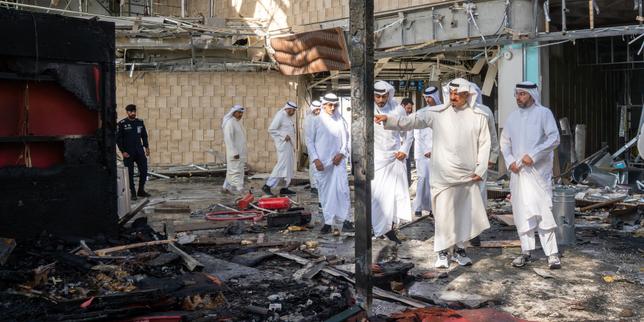
The transition from high-intensity conflict to an unstable diplomatic truce rarely yields total peace. Instead, it frequently establishes a high-friction equilibrium: a persistent state of low-intensity attrition where adversarial states substitute large-scale conventional maneuvers with targeted, deniable, and cost-asymmetric disruptions. The breakdown of the April 8 ceasefire between the United States and Iran—demonstrated by the June 2026 missile and drone salvos targeting Kuwait International Airport and Bahrain, followed by immediate American kinetic responses on Qeshm Island—illustrates this mechanism.
Western observers routinely mischaracterize these spikes in violence as irrational breakdowns in communication or erratic geopolitical behavior. In reality, they represent a calculated calibration of kinetic leverage within a defined, ongoing negotiations framework. By mapping the strategic logic driving this attritional state, we can understand how the regional architecture enforces a protracted conflict ecosystem despite formal cessation agreements. Building on this topic, you can also read: Why the Ohio Chase That Killed a Pregnant Teen is Igniting a Massive Immigration Debate.
The Tri-Calculus of Post-Ceasefire Attrition
The stabilization of a low-intensity conflict zone relies on three core operational pillars. Adversaries utilize these structural mechanics to alter the political status quo without crossing the threshold that triggers total conventional mobilization.
+-----------------------------------------------------------------+
|               POST-CEASEFIRE ATTRITION FRAMEWORK                |
+-----------------------------------------------------------------+
|                                                                 |
|  1. ASYMMETRIC COST FUNCTIONS                                    |
|     Low-cost manufacturing (Zubal, Shahed) forces deployment    |
|     of high-cost interception assets (Patriot, NASAMS).         |
|                                                                 |
|  2. PROXY-HOST DISRUPTION                                       |
|     Targeting non-combatant hosts (Kuwait, Bahrain) to exploit  |
|     political leverage points via U.S. forward bases.           |
|                                                                 |
|  3. SIGNALING UNDER POLICY AMBIGUITY                            |
|     Kinetic actions test redlines amidst volatile, shifting     |
|     presidential rhetoric and policy transitions.               |
|                                                                 |
+-----------------------------------------------------------------+
Asymmetric Cost Functions in Chokepoint Warfare
The fundamental economic vulnerability of Western defense architectures in the Persian Gulf lies in the radical cost imbalance between offensive denial systems and defensive interception systems. Tehran leverages this discrepancy through the mass deployment of loitering munitions and short-range ballistic missiles across the Strait of Hormuz. Experts at BBC News have provided expertise on this situation.
A standard long-range offensive drone requires an estimated manufacturing cost of $20,000 to $50,000. In contrast, the surface-to-air defense infrastructure deployed by the United States and its Gulf Cooperation Council (GCC) partners—such as MIM-104 Patriot or NASAMS interceptors—incurs an operational cost ranging from $1 million to $4 million per launch.
This creates a structural bottleneck. By maintaining a continuous, low-volume stream of sporadic drone strikes against regional infrastructure, an adversary can exhaust defensive inventories and impose high financial stress on host nations without utilizing its primary conventional arsenal. The objective is not absolute destruction, but the enforcement of a continuous economic tax on Western military presence.
Proxy-Host Disruption and Hostage Geography
The geography of international defense agreements creates structural vulnerabilities for smaller Gulf states like Kuwait and Bahrain. These nations do not possess independent offensive postures capable of deterring large regional powers; instead, they exchange territorial access for Western security umbrellas. This creates an exploitation vector for adversaries.
When an adversary targets Kuwait International Airport with a mixed package of 13 ballistic missiles and 17 drones, the strategic objective is not to initiate a war with Kuwait. The true target is the operational continuity of the forward-deployed United States military infrastructure hosted within that territory.
By executing kinetic actions against non-combatant economic infrastructure, the attacking power introduces friction into the host nation's domestic politics. The civilian population experiences immediate economic shockwaves—demonstrated by the halting of commercial aviation and localized casualties—which pressures the host government to renegotiate the operational constraints of foreign bases on its soil.
Kinetic Signaling Under Policy Ambiguity
Ceasefires routinely degrade when political signaling replaces structured diplomacy. In a political environment defined by shifting executive mandates, conventional diplomatic assurances lose their credibility. Kinetic escalation fills this vacuum as a primary communications channel.
Adversaries interpret public policy reversals, fluctuating tariff threats, and contradictory executive statements from Washington as strategic instability. To decode the actual defensive thresholds of a changing administration, the opposing power deploys calculated, sub-critical military strikes.
The launch of missiles toward Bahrain and the subsequent American counter-strikes on communication nodes on Qeshm Island serve as an interactive boundary-testing mechanism. Each side uses precise, limited violence to map out the opponent's current rules of engagement and verify which verbal threats are backed by an actual willingness to escalate conventionally.
The Strait of Hormuz Bottleneck
The structural persistence of this low-intensity conflict is structurally linked to the physical realities of global energy transit. The Strait of Hormuz functions as a geographic choke point that translates localized military frictions directly into global macroeconomic shocks.
Unlike land-based geopolitical theaters, maritime chokepoints possess binary operational states: they are either secure, or they are highly volatile. When kinetic activity occurs within striking distance of the Strait, international energy markets instantly price in maritime insurance premiums and systemic transit risks. The sudden return of oil prices toward the $100-per-barrel threshold following the June 2026 strikes confirms that the global economy remains tethered to this single maritime passage.
This reality alters the bargaining positions of the involved parties. For an energy-exporting nation insulated by structural sanctions, global economic volatility functions as a vital piece of leverage. By demonstrating an explicit capability to close or severely disrupt the Strait through low-intensity drone warfare, an adversary can project systemic economic risks directly into Western financial markets, using global inflation as a tool to force diplomatic concessions.
Strategic Limitations of the Maritime Umbrella
The current Western security framework in the Persian Gulf operates under major structural limitations that prevent it from successfully suppressing low-intensity conflict. Understanding these flaws is critical for identifying why a durable peace remains elusive.
- Defensive Over-Specialization: Air defense systems are optimized for intercepting high-velocity, predictable ballistic trajectories or conventional aircraft. They face deep inefficiencies when tasked with neutralizing low-altitude, low-radar-cross-section loitering munitions that exploit terrain and urban clutter.
- The De-escalation Paradox: To avoid a wider regional war, Western military responses are engineered to be strictly proportional—such as targeting an isolated communication tower on Qeshm Island in response to an airfield attack. This strict proportionality removes any meaningful punitive deterrence. The adversary recognizes that the maximum penalty for a low-cost drone strike is the loss of a replaceable piece of localized infrastructure, keeping the risk-reward ratio highly favorable for continued harassment.
- Decoupled Alliances: The diplomatic normalization paths of the region—such as the 2023 Beijing-brokered detente between Riyadh and Tehran—run completely parallel to, and often conflict with, Western kinetic objectives. Gulf powers frequently choose diplomatic passivity and tactical hedging to protect their domestic economic infrastructure, leaving Western forces to shoulder the political and operational costs of active containment.
The Friction Equilibrium
The Persian Gulf is transitioning into a long-term, calculated friction equilibrium. The April 8 ceasefire did not fail because of technical misunderstandings; it failed because the structural incentives for both sides favor the maintenance of sub-critical conflict over the compromises required for a comprehensive diplomatic settlement.
Western strategy must shift away from the expectation of a definitive diplomatic breakthrough or a return to total regional stability. Operational planners and corporate energy analysts should instead prepare for an environment where sporadic, deniable kinetic strikes are a permanent cost of doing business. The conflict will continue to balance precisely below the threshold of total conventional war, defined by ongoing asymmetric attrition, fluctuating maritime insurance rates, and continuous testing of international political redlines.
Western deployment models must adapt to this environment by deprioritizing hyper-expensive, single-use interceptors in favor of high-capacity directed energy weapons, electronic warfare neutralization systems, and distributed logistics nodes. Failing to alter this cost curve guarantees that regional adversaries will continue to use low-intensity warfare to systematically erode Western strategic influence across the region.