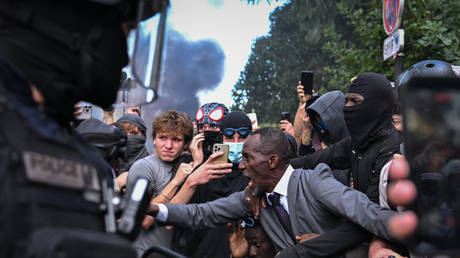
Tear gas doesn't care if you hold public office. When Saint-Denis Mayor Bally Bagayoko stepped directly into the chaos of a Parisian street demonstration, he found that out the hard way. Videos quickly flooded social media showing the local official getting his eyes treated with saline after inserting himself between riot police and crowds of angry students.
It is a striking visual that captures the boiling point of French civil unrest. But this wasn't just another random clash between police and agitators. It represents a systemic breakdown in how the state handles public education grievances, leaving elected municipal leaders caught in the crossfire.
The Spark Behind the French Student Protests
You can't understand why a mayor ended up gassed without looking at why the
When a French Mayor Steps Between Rioters and Police
news
Civil unrest in modern European cities rarely follows a predictable script. Sometimes it starts over pension reforms, sometimes over municipal grievances, and sometimes over high-profile tragedies that ignite national fury. When tensions boil over into the streets, the line between maintaining public order and protecting local citizens becomes dangerously thin. We saw a stark example of this fragile boundary when a French mayor stepped directly into the chaos, acting as a human shield for masked protesters, only to be caught in the crossfire of law enforcement crowd control tactics and sprayed with tear gas.
This incident raises difficult questions about the role of local elected officials during riots. Are mayors supposed to stand behind police cordons, or should they patrol the front lines to keep their constituents safe? The reality on the ground is messy, fast-moving, and often perilous.
The Anatomy of a Municipal Standoff
Town halls and local authorities across France operate on the front lines of social friction. When violent clashes break out, mayors are often called to the scene long before national riot police fully establish their perimeters. They arrive wearing their tricolor sashes, hoping their elected status will command enough respect to calm aggressive crowds or prevent police escalation.
Sometimes, that strategy backfires entirely.
Masked demonstrators do not always care about local politics. When projectiles start flying and police respond with tear gas canisters, rubber baton rounds, and heavy tactical maneuvers, sashes offer little protection. Standing between two opposing forces means absorbing the friction from both sides. Protesters might view a mayor's intervention as meddling or police protection in disguise, while law enforcement officers dealing with flying paving stones cannot always pause to check who is wearing official municipal regalia.
Why Mayors Take the Risk
Local leaders in France hold a unique position within the republic. They aren't just administrative bureaucrats pushing paper in quiet offices. They are hyper-visible community figures. When shops burn, windows shatter, and tear gas fills residential squares, it's their town burning.
Stepping into the street isn't just about grandstanding. It's often born out of sheer desperation. Mayors know their local police chiefs, they know the business owners whose shops are vulnerable, and they frequently recognize the teenagers and young adults standing behind makeshift barricades. They step forward because they believe personal presence can de-escalate a situation that remote command centers cannot control.
Yet, this hands-on approach runs headfirst into standard riot control protocol. Police units are trained to clear zones, disperse assemblies, and secure perimeters. They operate under intense pressure where hesitation can result in serious injury to officers. When a crowd refuses to disperse, chemical agents are deployed indiscriminately across the designated area. A tricolor sash does not form an impermeable force field against chemical irritants.
The Broader Fallout of Street Confrontations
Incidents like this ripple far beyond the immediate street corner. They expose deep fractures in how urban governance functions during national crises. When local authorities are incapacitated by the very state apparatus meant to restore order, trust erodes quickly.
Citizens watching the footage online form rapid, polarized opinions. Critics argue that mayors have no business playing amateur peacekeeper in the middle of a riot zone, pointing out that inserting untrained officials into violent zones creates unnecessary liabilities for emergency services. Supporters counter that such actions demonstrate genuine courage, proving that local leaders refuse to hide behind closed doors while their communities fracture.
The legal and institutional safety nets for these officials remain remarkably thin. French administrative law grants mayors broad powers regarding local policing and municipal safety, but those powers are designed for administrative oversight, not frontline riot containment. When an elected official gets gassed or injured while attempting to mediate a skirmish, it highlights an institutional vacuum. There is no clear operational playbook for an elected mayor caught between violent demonstrators and advancing tactical squads.
What Happens When the Smoke Clears
The tear gas eventually dissipates. The broken glass gets swept from the pavement. The political talking points cycle through the news networks for a few days, and then the town has to figure out how to function again.
If you want to understand why these confrontations keep happening, look closely at the communication breakdown between national ministries in Paris and local municipalities across the regions. National strategies for handling mass protests often prioritize rapid containment and crowd dispersal. Local strategies prioritize community preservation and dialogue. Those two goals collide violently on the pavement.
Real leadership during civil unrest requires more than wearing a sash for the cameras or issuing stern press releases after the fact. It demands systemic reform in how local authorities coordinate with national security forces before the first bottle is thrown. Until those communication channels improve, mayors will keep walking into the smoke, hoping their presence can outweigh the chaos. Most of the time, they just end up coughing alongside the very people they are trying to protect.