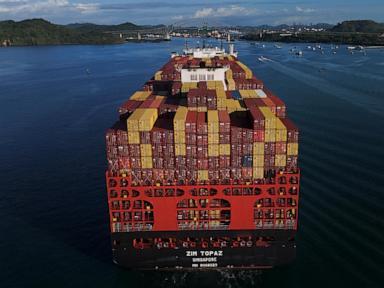
Captain Elias Thorne stands on the bridge of a vessel that feels less like a ship and more like a floating city. He isn't looking at the horizon. He is looking at a screen, his knuckles white against the railing. Below him, thousands of shipping containers are stacked like a child’s forgotten blocks, carrying the lifeblood of global commerce—electronics, textiles, machine parts—destined for shelves that are already running bare.
Outside, the water is dark, oily, and still.
Elias is currently navigating a geography of desperation. The Strait of Hormuz, that narrow, jagged throat of the Persian Gulf, has tightened. Global tensions have turned it into a chokehold. Insurance premiums for passage are skyrocketing, and the risk of seizing, sabotage, or worse hangs in the humid air like a physical weight. So, the ships are turning back. They are choosing the long way around. They are heading toward the Panama Canal, willing to pay a ransom that would have been unimaginable just a few months ago.
Four million dollars.
That is the price tag for a single transit slot. Not for the cargo, not for the crew, not for the fuel. Just for the privilege of skipping the queue and escaping the shadow of the Middle East.
Consider the physics of this panic. A massive tanker or container ship is not a sports car. It cannot dart away from trouble. It is a slow, methodical beast. When the Strait of Hormuz becomes a gamble, the alternative route—traversing the Atlantic to the Panama Canal—adds weeks to the journey. Weeks of fuel burn. Weeks of crew wages. Weeks of late penalties from retailers in the United States and Europe who cannot wait for their inventory.
This is where the math of the modern world collapses. If you are a shipping executive, you have a ledger. On one side, you have the potential total loss of a vessel and its contents in the Strait. On the other, you have the exorbitant cost of a priority passage through Panama.
Four million dollars.
Think about that number. It isn't just money. It is the cost of keeping a factory line moving in Ohio. It is the reason the price of a generic blender or a pair of sneakers inches upward by a few dollars, a silent tax levied by the volatility of the sea.
I remember watching the manifest printouts during my time as a junior analyst. We looked at these numbers as cold integers. We spoke about supply chain elasticity, as if the flow of goods were a rubber band that could stretch indefinitely. We were wrong. The rubber band doesn't stretch; it snaps.
The Panama Canal itself is struggling with the burden of this redirected traffic. Climate change has turned the Gatun Lake into a shallower, more temperamental basin. Rainfall has been erratic. The canal, which relies on a complex system of locks and freshwater buoyancy, has had to limit the number of ships passing through each day. The supply of water is finite. The demand for passage, however, is now infinite.
When you take a global bottleneck and try to force the volume of two lanes into one, you get a vacuum. And in that vacuum, money acts like air rushing into a pressurized room. It creates a shockwave.
The shipping companies are paying this bounty because they are terrified of the alternative. If they don't pay, they don't move. If they don't move, the contracts fail. If the contracts fail, the reputation of a decades-old logistics firm vanishes. It is an impossible choice presented as a business decision.
But look past the boardrooms. Look at the crew on that ship.
They are the ones who feel the vibration of the engine as they wait in the humid, tropical heat off the coast of Panama, idling for days because their slot, while expensive, is still contingent on the fickle machinery of the canal locks. They see the emails from the head office asking for status updates, not realizing that the captain has no more control over the queue than a commuter in a traffic jam. The stress isn't on a spreadsheet. It is in the heavy, lingering silence of the mess hall at 3:00 AM.
This is the hidden tax of modern globalization. We live in a world where we expect everything to be available, everywhere, all at once. We want the latest gadgets the day they are announced. We want fresh produce in the dead of winter. We treat the logistics of the planet as invisible, something that happens in the background, like electricity or clean water.
But the background is fraying.
The $4 million auction for a canal slot is the symptom of a system that has run out of slack. We have optimized our logistics so aggressively that there is no room left for the unexpected. When a region like the Strait of Hormuz falters, the entire global architecture shudders. The ships that avoid the danger zone are forced into the only remaining arteries, and those arteries are already clotting.
We assume that the market will fix it. We believe that if prices go high enough, someone will invent a solution. But you cannot invent more water for the Panama Canal overnight. You cannot build a new route through the Americas in a week.
The ships will continue to arrive. The captains will continue to stare at their screens. The owners will continue to wire millions of dollars into the accounts of canal authorities just to be allowed to move.
And somewhere, in a warehouse in a city you will never visit, a worker will unload a container. They will scan a barcode. They will have no idea that the piece of plastic they are handling was part of a desperate, multi-million-dollar gamble against the volatility of the sea.
The water moves, the locks open, and the ship slips through the narrow passage. For a moment, the tension breaks. The vessel enters the ocean on the other side, and the journey continues. But the cost remains, etched into the balance sheets, a permanent marker of a time when the world was far smaller and far more fragile than we ever dared to admit.
The sea is wide, but the paths are few. And right now, every single one of them is screaming.