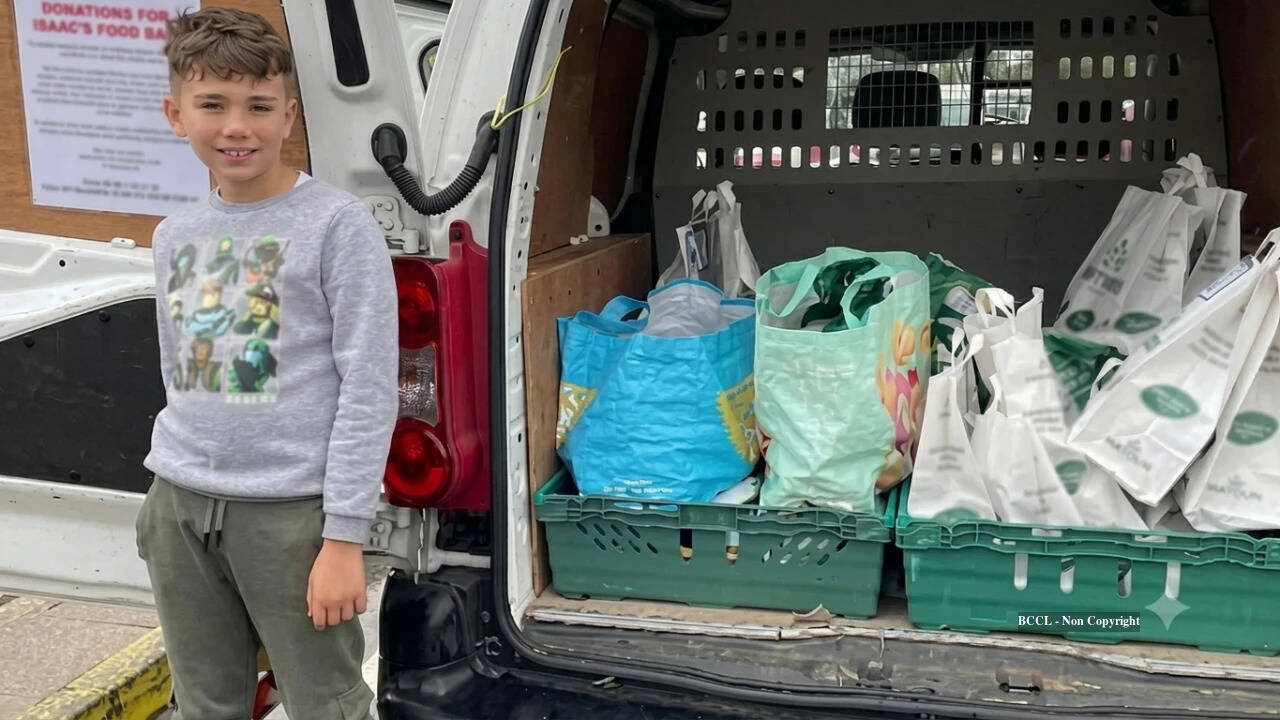
In 2020, a nine-year-old boy named Isaac Winfield used forty pounds of his own birthday money to buy groceries and set up a small wooden shed outside his family home in Redditch, Worcestershire, to feed neighbors struggling through the pandemic. Today, that single shed has multiplied into six permanent locations operating under the banner of Friends of Isaac Food Bank, distributing enough food and household essentials to support roughly 5,000 people every year. It is an extraordinary logistical feat built on grassroots grit, public generosity, and the relentless drive of a child who refused to look away from local poverty. Yet beneath the heartwarming headlines lies a much darker reality about modern Britain. When a teenager becomes a load-bearing pillar of municipal welfare, something in the social contract has fundamentally snapped.
Media outlets love a tidy narrative. They see a kid with a big heart, a pile of canned beans, and a community rallying together, and they hit publish on an uplifting human-interest piece. Those stories are accurate on the surface, yet they consistently miss the structural mechanics turning private charity into public infrastructure. Scaling a neighborhood shed into a multi-site distribution network requires ruthless operational discipline, cold-chain management, warehouse logistics, and constant fundraising. More importantly, it requires an endless supply of desperate people.
The Anatomy of a Grassroots Supply Chain
Most charitable impulses die within six weeks. Someone buys a few bags of pasta, drops them off at a local church, posts a photo online, and moves on with their life. Turning forty pounds into a six-site operation capable of serving 5,000 people annually requires treating charity like a mid-sized logistics firm rather than a hobby.
When Isaac started in Redditch, the model was hyper-local and friction-free. A shed in a front garden eliminates the crushing bureaucracy that keeps many working-poor families away from traditional aid. There were no means-tested vouchers, no interrogations about household income, and no humiliating queues outside a civic building during business hours. People walked up, took what they needed, and walked away with their dignity intact.
Scaling that model across six sites introduces massive operational headaches. Food banks do not run on good intentions; they run on pallet jacks, ambient storage temperatures, use-by date auditing, and fuel budgets. To sustain six hubs, an organization has to solve three brutal bottlenecks simultaneously:
- Inventory Volatility: Supermarkets donate surplus stock, not balanced nutritional profiles. A food bank might receive forty crates of bruised bananas and zero tins of baby formula on a Tuesday morning. Balancing those erratic inflows requires liquid cash reserves to buy staples wholesale.
- The Cold-Chain Trap: Dry goods like rice and tinned tomatoes sit safely on wooden shelves for months. Fresh produce, dairy, and protein require commercial refrigeration, strict food hygiene compliance, and rapid turnover before spoilage turns an asset into hazardous waste.
- Volunteer Burnout: Relying on unpaid labor to sort, pack, and distribute tons of food every week creates high turnover. Maintaining six sites means building shift rosters, training coordinators, and managing liability insurance for dozens of community volunteers.
Isaac and his family managed to crack this code by leaning heavily into community visibility and hyper-local partnerships. Local businesses, schools, and residents didn't just donate tins; they donated shelving, van space, and consistent monthly cash. The operation grew because it remained visibly tethered to the streets it served. Donors could see the exact shed, the exact shelves, and the exact kid hauling the crates.
Why Traditional Aid Systems Fail the Working Poor
To understand why thousands of people in a single English town rely on a teenager's food bank, you have to look at who actually uses these services. The stereotype of the food bank user—someone entirely detached from the labor market—is roughly a decade out of date.
Across the United Kingdom, the fastest-growing demographic inside food bank queues consists of in-work households. When rent consumes half a paycheck and energy bills double over two winters, a single unexpected expense—a broken boiler, a cut in zero-hours shifts, a delayed Universal Credit payment—pushes a functioning household straight off a financial cliff.
Traditional food banks, particularly those operating under rigid national frameworks, often rely on a referral voucher system. Under this model, a citizen in crisis must first convince a doctor, social worker, or advice bureau agent that they are genuinely destitute before receiving a paper voucher entitling them to three days of emergency food. Often, organizations cap the number of vouchers an individual can receive within a six-month window to prevent dependency.
That system contains a fatal flaw. Bureaucracy moves slower than hunger. If a single parent runs out of food on a Friday afternoon because a direct debit bounced, waiting until Tuesday morning to secure an appointment for a food voucher is useless. Furthermore, pride acts as a massive barrier. People who work forty hours a week and still cannot afford groceries often refuse to sit in front of a caseworker to beg for a voucher.
Open-access models like Friends of Isaac strip away that gatekeeping. By operating on a high-trust, low-barrier basis, these community hubs capture the people falling through the cracks of formal welfare. They serve the shift worker who finishes at 7 PM, the pensioner choosing between heating and eating, and the parent too embarrassed to ask a GP for a food slip.
The Moral Hazard of Feel-Good Philanthropy
There is an uncomfortable truth that rarely makes it into celebratory press coverage of young philanthropists. Every time a community celebrates a child for feeding the poor, politicians get a free pass.
In economics, moral hazard occurs when one party takes on excessive risk because another party will bear the cost of those consequences. In modern social policy, grassroots charities have become the ultimate cushion for state failure. When central and local governments hollow out statutory safety nets, cut municipal budgets, and allow real wages to stagnate against inflation, independent food banks step in to prevent literal starvation.
Consider the numbers. In the early 2010s, food banks were a marginal phenomenon in Britain, largely concentrated in pockets of severe post-industrial decline. Today, emergency food parcels are distributed in the millions annually, outnumbering branches of major supermarket chains. What was once an emergency patch for acute personal crises has hardened into a permanent, parallel welfare state funded entirely by public pity and volunteer sweat.
When a nine-year-old starts a food bank with forty pounds, that is an indictment of the adult world around him. When that same boy is still running six sites years later because demand has grown to 5,000 people a year, the story is no longer about a cute charitable project. It is about systemic abandonment.
Governments love grassroots heroes. Politicians hand out awards, pose for photographs beside crates of donated cereal, and praise the "Big Society" spirit of local resilience. What they rarely do is alter the macroeconomic policies—housing deregulation, inadequate statutory sick pay, benefit freezes—that keep the queues outside those sheds growing longer every winter. Applauding the child who bails out the sinking boat is a convenient way to avoid asking who drilled holes in the hull.
The Hidden Mechanics of Food Poverty
Walking through a distribution hub like the ones in Redditch reveals the granular reality of poverty that macroeconomic statistics routinely sanitize. Analysts talk about cost-of-living pressures and inflationary headwinds. On the ground, those abstract phrases translate into very specific, agonizing trade-offs.
Take hygiene poverty, an invisible shadow that trails right behind hunger. When a household budget shrinks to the bone, soap, toothpaste, toilet paper, and sanitary products are the first items cut from the shopping list because you cannot eat them. A teenager skipping school because they cannot afford period products, or an adult avoiding job interviews because they lack shampoo and laundry detergent, represents a compounding trap. Poverty stops being a temporary cash-flow shortage and becomes a physical barrier to earning an income.
Then there is the fuel-to-food ratio. Food banks routinely report that clients decline raw potatoes, dried beans, or uncooked pasta—not out of pickiness, but because they lack the credit on their prepayment energy meters to boil water for forty minutes. Giving a bag of raw ingredients to someone living in a cold flat with no gas credit is an exercise in futility. Multi-site operations have had to adapt by sourcing kettle-only foods, cold-consumption proteins, and pre-cooked items that require zero energy to prepare.
Even the geography of poverty has shifted. Towns like Redditch—commuter belts, light-industrial hubs, and suburban centers outside major metropolitan cores—often suffer from hidden deprivation. Because they lack the concentrated, visible inner-city blight of major urban centers, they frequently receive less targeted regeneration funding. Yet suburban poverty carries higher transport costs and fewer walkable services, trapping low-income residents in isolated pockets where a local shed becomes the only accessible lifeline.
What Actually Happens When a Charity Scales
Running one shed in a driveway is an act of kindness. Running six sites serving thousands of residents is a high-stakes balancing act that carries immense personal cost for the people at the center of it.
When a young person becomes the public face of a major community relief effort, the pressure does not turn off when the cameras leave. Unlike a paid charity executive who clocks out at five o'clock and passes responsibility to a board of trustees, a founder-led grassroots movement relies on the personal energy and reputation of its creator.
If a pallet delivery fails to arrive, the founder has to scramble. If a local landlord raises the rent on a storage unit, the founder has to launch an emergency appeal. If an online troll questions where the money goes, the founder has to produce receipts to protect the trust that keeps the entire enterprise afloat.
Furthermore, grassroots operations face a brutal scaling cliff. At a certain volume of distribution, informal networks break down. You can no longer rely on a neighbor's spare garage for storage or a cousin's hatchback to move twenty crates of milk. You need commercial leases, chartered accountants, safeguarding policies for vulnerable adults, and formal governance structures. Making that transition without losing the speed, warmth, and zero-red-tape ethos that made the original shed work in the first place is where most community charities fracture.
Friends of Isaac survived that transition because it kept its footprint modular. Rather than building one massive, intimidating central warehouse that forced impoverished residents to pay for bus fare across town, expanding through smaller, localized sites preserved neighborhood access. It brought the supply chain to the street corner rather than forcing the hungry to navigate an institution.
The Limits of Grassroots Grit
No amount of logistical brilliance from a community food bank can solve the root causes of economic deprivation. A food bank is an emergency room, not a cure. It stops the bleeding today so the patient survives until tomorrow, yet the underlying disease remains untouched.
If every citizen in Worcestershire doubled their donations tomorrow, and Isaac opened twelve more sites across the Midlands, the structural drivers of food insecurity would not budge by a single millimeter. Wages at the bottom of the labor market would still lag behind the cost of basic shelter. Child benefit caps would still push large families below the poverty line. Disability assessments would still strip vulnerable citizens of essential support.
There is a real danger in mistaking charitable efficiency for social progress. The better food banks get at sourcing surplus supermarket stock, managing cold chains, and distributing parcels without stigma, the easier it becomes for the state to treat them as a permanent fixture of civic life. Supermarket chains get to boast about reducing food waste and meeting environmental targets by offloading unsellable stock onto volunteers, while the government avoids the political cost of raising statutory welfare rates to match the actual cost of survival.
Isaac Winfield took forty pounds and built an extraordinary machine for human solidarity. He proved that age is irrelevant when matched with relentless execution, and he spared thousands of his neighbors the quiet terror of going to bed with an empty stomach. Every crate packed across those six sites represents a tangible victory against immediate suffering. Yet the true measure of a healthy society is not how many food banks a teenager can build, but how quickly a country makes his work unnecessary.