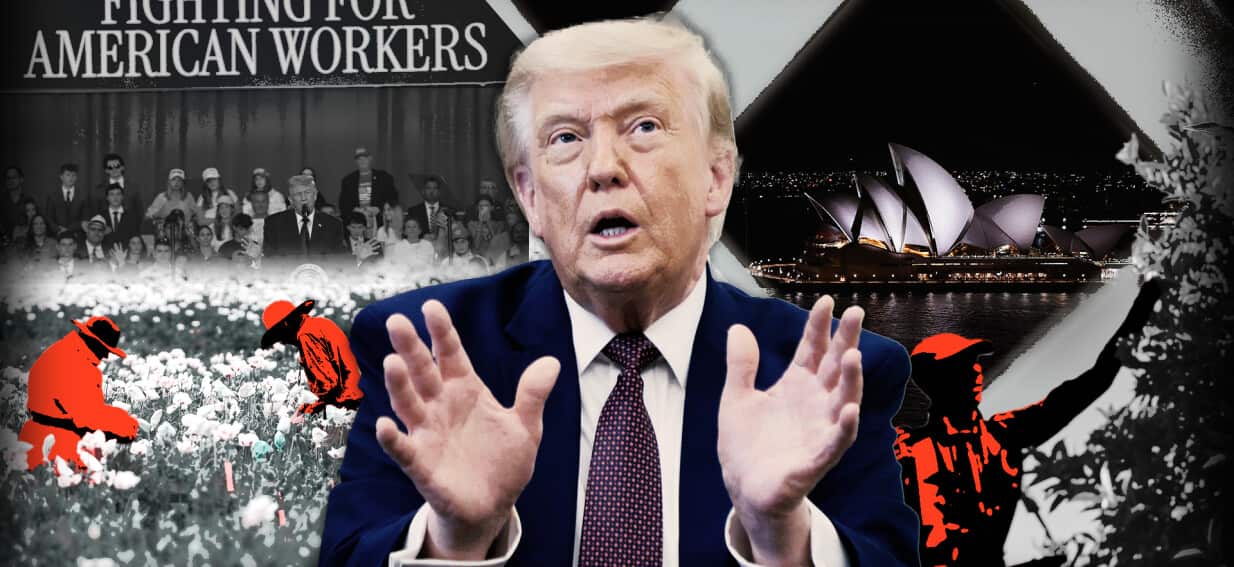
Washington just weaponized human rights to save a failing trade policy.
By threatening Australia and 53 other nations with a new 12.5% import tariff, the White House is not launching a righteous crusade against modern slavery. It is scrambling for cover.
The immediate trigger for Canberra’s outrage is a newly minted report from US Trade Representative Jamieson Greer, which claims Australia has "failed to impose and effectively enforce a forced labor import prohibition." Prime Minister Anthony Albanese quickly fired back, calling the policy an "ideological disagreement" that will ultimately burden American consumers.
But looking closely at the machinery of Washington's trade apparatus reveals a much messier reality. This entire maneuver is a political patch-job designed to bypass the US legal system, using a moral cudgel to salvage an aggressive tariff regime that the courts recently dismantled.
The Supreme Court Defeat and the Pivot to Ethics
To understand why Australia is suddenly sharing a economic blacklist with its primary geopolitical rivals, you have to look back at the administrative wreckage of early February.
When the US Supreme Court struck down the administration’s sweeping reciprocal tariffs as unlawful, it effectively broke the spine of the White House’s trade strategy. The administration’s immediate counter-move—a temporary 10% global import surcharge—was always an emergency stopgap, explicitly scheduled to expire on July 24.
Washington desperately needed a new legal anchor to keep its protectionist wall intact before that summer deadline.
The solution was a highly coordinated pivot to trade investigations rooted in domestic labor standards. By framing the new 12.5% levies around a universal failure to block goods produced via forced labor, the administration found a loophole. It shifted the battlefield from pure economic retaliation, which the courts rejected, to regulatory non-compliance, which is far harder to challenge legally.
It is a classic Washington shell game. The White House gets to keep its tariffs, the domestic manufacturing base gets its protection, and the administration can claim the high moral ground while penalizing its closest security partners.
Inside Australia’s Compliance Illusion
The diplomatic fury in Canberra stems from a deeply uncomfortable truth. While the US trade report is undoubtedly politically motivated, Australia's legislative armor against supply-chain exploitation is remarkably flimsy.
Australian officials have spent days defending their Modern Slavery Act as "world-leading." In reality, the law is toothless.
- The Reporting Trap: The current framework requires large corporations to submit annual statements detailing the risks of modern slavery in their supply chains.
- Zero Enforcement: The law does not mandate that companies actually fix those problems, nor does it penalize them for submitting inadequate reports.
- No Real Import Ban: Unlike the American Uyghur Forced Labor Prevention Act, which places the burden of proof on importers to prove their goods are clean, Australia possesses no equivalent nationwide import ban on forced-labor commodities.
This legislative gap made Australia an incredibly soft target for Greer’s investigators. Washington didn't need to dig up specific, scandalous evidence of slave labor in Australian factories. They merely had to point at the statute books and note the absence of a hard border ban.
+---------------------------+-----------------------------------+-----------------------------------+
| Metric                    | Australian Modern Slavery Act    | US Trade Enforcement Framework    |
+---------------------------+-----------------------------------+-----------------------------------+
| Primary Mechanism         | Corporate Risk Disclosures        | Border Seizures & Import Bans     |
+---------------------------+-----------------------------------+-----------------------------------+
| Penalty for Non-Action    | None                              | Forfeiture of Cargo & Fines       |
+---------------------------+-----------------------------------+-----------------------------------+
| Burden of Proof           | Placed on Regulator to Investigate| Placed on Importer to Prove Clean|
+---------------------------+-----------------------------------+-----------------------------------+
Exemption Politics and the Meat Lobby
Despite the high-stakes rhetoric coming out of Canberra, the immediate economic fallout for Australian industry will be highly uneven.
The White House understands that a total trade war with close intelligence allies is unsustainable. Consequently, the proposed tariff framework is riddled with carve-outs tailored to protect critical supply chains and powerful American domestic lobbies.
Australian beef, gold, energy, and critical minerals remain safely protected under existing exemptions. The American meat industry relies too heavily on Australian lean beef for blending to tolerate a 12.5% tax, and the Pentagon cannot afford to disrupt its pipeline for rare earths.
Instead, the economic pain will fall on mid-tier agricultural exports like lamb, mutton, and specialized manufacturing sectors.
Exporters face a far deeper structural crisis than a 2.5% marginal rate increase over the previous surcharge. The real damage lies in the deliberate injection of permanent unpredictability into allied trade.
When international commerce is governed by erratic executive decrees rather than stable treaties like the Australia-US Free Trade Agreement (AUSFTA), long-term corporate planning becomes impossible. Boards cannot approve ten-year capital investments when their primary export market can rewrite the rules of entry overnight under the guise of an administrative review.
The Strategic Cost of Protectionism
By treating its allies identical to its adversaries in trade policy, Washington is actively undermining its own foreign policy objectives.
For the past several years, the US has urged regional partners like Australia to diversify their economies away from economic dependence on China. Yet, when Washington penalizes Australian goods over regulatory technicalities, it actively punishes the exact behavior it claims to encourage.
When Washington closes its doors, it forces mid-sized trading nations to reconsider their options, inadvertently strengthening the appeal of alternative regional trade pacts that offer genuine market stability.
The July 24 deadline is fast approaching. As the public comment period plays out, Australian diplomats will undoubtedly spend the coming weeks in Washington begging for exceptions, pointing to decades of shared military history and joint strategic initiatives.
But the fundamental lesson of this dispute is already clear. In the current political landscape, strategic alignment is no longer a shield against economic nationalism. Washington’s trade policy is now driven entirely by domestic political survival, and even the closest allies are viewed as collateral damage.