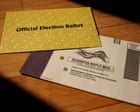
The envelope arrives in late September, smelling faintly of newsprint and dry air. Inside is a piece of cardstock, perforated along the edges, carrying a barcode and a small, square box where a pen is supposed to leave a mark. For millions of Americans, this little slip of paper is not just administrative paperwork. It is a quiet lifeline. It is the tangible proof that despite a grueling commute, an impossible caretaking schedule, or a fragile hip that refuses to trust the linoleum floors of a public school gymnasium on a Tuesday morning, a voice still counts.
Then comes the friction.
Every election cycle, the rules governing how that paper travels from a kitchen table back to a county clerk’s office shift like sand dunes in a high wind. Deadlines tighten. Witness signatures are added. Drop boxes vanish from municipal parking lots, replaced by locks and padlocks that click shut just as the work shift ends. To understand what happens when a court steps in to halt these restrictions, one must first understand what it feels like to stand outside a locked door, looking at a clipboard, wondering if your time on this earth has suddenly become too inconvenient for the ballot box.
Consider Maria, a hypothetical home health aide living just outside a sprawling industrial city. Her shifts start at six in the morning and end when the sun is already low and heavy on the horizon. By the time her feet touch her own porch, the local precinct has been dark for hours. For years, mail-in voting was the bridge between her sixty-hour workweek and her civic duty. She could fill out her choices at her kitchen table while a pot of beans simmered on the stove, sign the back flap, and drop the envelope into a secure slot on her way to the early morning bus.
When new restrictions arrive—demanding notarized signatures, shortening return windows, or banning ballot drop boxes altogether—Maria does not read legal briefs. She simply feels the door closing.
This is the human ecosystem of election law. It is rarely debated in terms of human fatigue; instead, it is fought in sleek courtrooms with high ceilings, where attorneys point to dusty precedents and argue about administrative burdens versus electoral integrity. The tension is ancient. On one side sits the argument for order, for chains of custody, for the comforting ritual of the single day of in-person voting where everyone stands in the same line. On the other side sits the modern reality of a mobile, exhausted, and deeply fractured workforce.
When the highest court in the land recently chose to let stand a lower court's rejection of strict mail ballot limitations ahead of the midterm elections, the immediate legal impact was precise. The restrictions would not go into effect. The rules would remain steady for the upcoming vote.
Yet, looking only at the legal mechanics misses the emotional pulse underneath. Courts do not often hand down sweeping moral victories; they issue narrow rulings, balancing statutory language and constitutional guarantees. But for the voter sitting at home, the refusal to block mail-in access feels less like a technicality and more like a reprieve. It is a moment of breathing room in a system that often feels designed to weed out anyone who cannot afford to take a Tuesday off.
To grasp why these battles matter so fiercely, we have to look past the political posturing and examine the architecture of participation. Democracy is heavy. It requires infrastructure, money, volunteers, paper, ink, and trust. When rules are altered abruptly close to an election, that trust frays. Voters begin to wonder if the instructions printed on the back of the envelope will change before the envelope even reaches the sorting machine. Confusion is a powerful deterrent. A confused voter is often a silent voter.
History teaches us that access to the ballot has never expanded through sheer goodwill. It is a continuous tug-of-war between those who wish to widen the circle and those who fear the unmanaged chaos of a larger crowd. In the wake of massive expansions in mail-in voting during recent election cycles, election administrators faced unprecedented logistical strain. Processing millions of paper signatures requires time, specialized optical scanners, and trained bipartisan teams.
Proponents of restrictions argue that these measures are necessary guardrails to protect against fraud and restore public confidence. They point to the need for standardized deadlines to ensure results are tabulated swiftly and accurately. There is logic in this desire for administrative neatness. A messy election breeds suspicion, and suspicion corrodes the legitimacy of the government that follows.
Yet, the remedy proposed by restriction advocates often creates a worse disease: disenfranchisement by friction. If you require a notary in a neighborhood where the nearest bank is three bus rides away, you have not secured the vote; you have priced out the poor. If you shorten the window for returning a ballot so drastically that a weekend postal delay spells disqualification, you have transformed a constitutional right into a timed obstacle course.
This is why judicial interventions regarding mail ballots carry such heavy emotional weight. When courts step in to block last-minute hurdles, they are acting as a brake on a runaway train of legislative tinkering. They are saying that the rules of the game cannot be rewritten while the players are already on the field.
Imagine standing on a running track. Halfway through the race, someone moves the finish line fifty yards back and adds a hurdle you weren't trained to jump. That is what sudden ballot restrictions feel like to communities that rely on alternative voting methods. It introduces a profound sense of instability.
The recent legal outcomes surrounding mail-in voting for the midterms do not solve the underlying debate. They merely buy time. They keep the door open a little longer for Maria and millions like her—the night-shift workers, the rural residents miles from the nearest polling place, the elderly citizens whose bones ache at the thought of standing in a November wind.
The debate will return. Legislatures will draft new bills with different phrasing, seeking the delicate equilibrium between security and accessibility. Lawsuits will be filed. Expert witnesses will testify about paper weights, postal sorting speeds, and historical turnout data.
But as the ballots begin to land in mailboxes across the country, folded neatly inside security sleeves, the immediate reality is simpler. The system bends, holds its breath, and accommodates the lives of the people it is meant to serve. For now, the kitchen table remains a valid precinct. The pencil marks count. And the invisible contract between the citizen and the state holds firm, anchored by a paper trail that traveled safely from a home to a counter, untouched by the sudden gusts of administrative change.