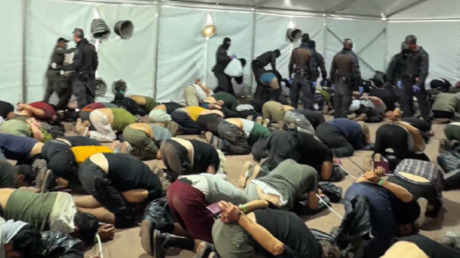
International law is not a court of appeals; it is a contact sport.
Every time a maritime interception hits the headlines, the same predictable script plays out. Activists launch a high-profile convoy. A state military intercepts it in international waters. Cue the immediate, thunderous announcements of impending war crimes lawsuits, universal jurisdiction filings, and strategic litigation meant to bring a sovereign nation to its knees. Read more on a connected subject: this related article.
The recent wave of legal threats surrounding the detention of Gaza flotilla participants follows this exact, tired playbook. The lazy consensus among human rights commentators is that these legal filings represent a turning point—a tightening norm of accountability that will force states to abandon aggressive maritime interdiction.
They are completely misreading the board. Additional reporting by Al Jazeera delves into related views on the subject.
Chasing sovereign states through international tribunals for high-seas blockades is a structural dead end. It does not deter military action. It does not protect activists. Instead, this reliance on lawfare actively sanitizes the very geopolitical conflicts it tries to resolve, turning raw political struggles into endless, teethless bureaucratic procedures.
The Sovereignty Shield: Why High-Seas Lawsuits Evaporate
The fundamental flaw in the "legal accountability" narrative stems from a misunderstanding of how maritime law and state sovereignty interact when the cameras stop rolling.
Commentators love to cite the United Nations Convention on the Law of the Sea (UNCLOS) or the San Remo Manual on International Law Applicable to Armed Conflicts at Sea. They point to provisions regarding freedom of navigation and the treatment of detainees, claiming an open-and-shut case.
But international courts do not operate like domestic civil suits. To actually hold a state liable for actions taken during a maritime blockade, litigants must clear three massive hurdles that almost always tank the case:
- The Jurisdiction Trap: Sovereign states must consent to be sued. When activists attempt to use the International Criminal Court (ICC) or third-party domestic courts via universal jurisdiction, they run headfirst into structural roadblocks. States routinely challenge the court’s jurisdiction, tie up the proceedings in preliminary objections for a decade, or simply ignore the rulings without facing economic or military consequences.
- The San Remo Loopholes: The San Remo Manual actually provides states with immense flexibility. If a state declares a blockade, it has the legal right to capture civilian vessels attempting to breach it. The moment an activist vessel states its intent to bypass an established blockade, the legal definition of "innocent passage" changes. The military intervention is no longer viewed as an arbitrary assault in international waters; it is categorized as the enforcement of a maritime security zone.
- The Evidentiary Void: High-seas interceptions happen in chaotic, isolated environments. By the time a case reaches a panel of judges in Europe, the state military has already classified the operational logs, video footage, and communication records under national security exemptions. Litigants are left trying to prove systematic abuse using fragmented smartphone videos and conflicting eyewitness testimonies.
I have watched legal teams pour millions of dollars into these international filings, convinced they have the smoking gun. Ten years later, the case gets dismissed on a technicality, or downgraded to a non-binding advisory opinion that state compliance officers file away in a drawer and forget.
The Cost of Transforming Politics into Paperwork
The true danger of treating maritime blockades as purely legal disputes is that it obscures the actual mechanics of power.
When an organization launches a flotilla, it is executing a political provocation designed to test a state's strategic resolve. It is a calculated gamble meant to shift public opinion and force a diplomatic crisis. This is a legitimate, historically proven method of resistance.
The mistake happens the moment activists try to retroactively frame this high-stakes political gamble as a routine tort claim.
Imagine a scenario where a civil rights movement in the mid-20th century focused entirely on filing administrative complaints against police departments for improper permit denials, rather than forcing a visible moral crisis through direct action. The momentum shifts from the streets to the filing cabinets.
By shifting the battleground from international diplomacy to international law firms, activists trade their most potent weapon—sustained political pressure—for a process designed from the ground up to protect state actors. International law is built by states, for states, to preserve the stability of the state system. Expecting that system to suddenly pivot and dismantle a state's core security apparatus because of a well-drafted legal brief is peak geopolitical naiveté.
Dismantling the "People Also Ask" Illusions
To understand how broken this discourse is, look at the standard questions that dominate public debate whenever a maritime detention case makes the rounds. The premises themselves are warped.
Can individuals successfully sue a foreign military for high-seas detention?
In theory, yes. In practice, almost never. While individuals can file claims in regional bodies like the European Court of Human Rights or use domestic statutes like the Alien Tort Statute in the United States, the payout is an illusion. States defend their military personnel fiercely. Even if a court rules that a detention violated international standards, the financial judgments are routinely blocked by sovereign immunity doctrines, and no foreign bailiff is going to march into a sovereign military base to enforce a collection order.
Doesn't the ICC prosecute war crimes committed during maritime interceptions?
Look at the history. When the Union of the Comoros referred the 2010 Mavi Marmara flotilla raid to the ICC, the Office of the Prosecutor spent years reviewing the incident. The final conclusion? Even though there was a reasonable basis to believe war crimes had been committed, the scale of the incident did not meet the "gravity threshold" required for the ICC to justify a full-blown prosecution. The case was closed without charges. The international legal system is explicitly calibrated to ignore isolated maritime skirmishes in favor of systemic, state-wide atrocities.
Do blockades become illegal if they cause economic hardship?
This is the most common misconception circulating in human rights circles. Under the San Remo Manual, a blockade is considered illegal if the damage to the civilian population is excessive in relation to the concrete and direct military advantage anticipated. That word—proportionate—is a legal black hole. States excel at producing intelligence briefs demonstrating that a blockade is a strictly targeted security measure designed to prevent weapons smuggling, easily neutralizing claims of illegal economic warfare in the eyes of international jurists.
The Actionable Alternative: Drop the Briefcase, Force the Diplomatic Hand
If the goal is to actually alter state behavior at sea, organizations need to stop treating international lawyers as a silver bullet. Lawsuits are where political energy goes to die.
Instead of funding decade-long legal expeditions to the Hague, resources must be shifted back to areas that impose real, immediate costs on sovereign decision-makers:
- Flag-State Leverage: Instead of registering activist vessels in small, politically weak nations that can be easily pressured or ignored, convoys must be registered under the flags of major economic powers. Intercepting a vessel flying the flag of a critical trade partner creates an immediate, high-stakes diplomatic crisis that bypasses the slow-moving court system entirely.
- Sustained Economic Disinvestment: States do not change maritime policy because a UN rapporteur writes a critical report. They change policy when their state-owned shipping lines face direct, coordinated pressure from international port unions, or when maritime insurance syndicates hike premiums for vessels operating out of their ports due to geopolitical instability.
- Direct Diplomatic Intercession: The only maritime litigations that yield results are those backed by a powerful state sponsor willing to retaliate through trade sanctions or diplomatic expulsions. If you do not have a state willing to break diplomatic china on your behalf, your legal filing is just noise.
Stop pretending the next international court filing will magically dissolve a naval blockade. Stop telling activists that international law will protect them when they sail into a military exclusion zone. It won't. The oceans remain a realm governed by leverage, raw power, and strategic calculated risk. Act accordingly.