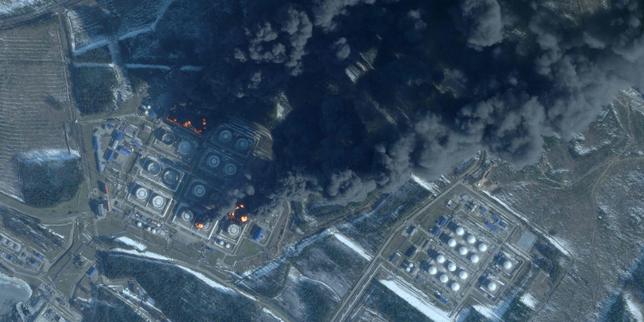
The black smoke does not billow; it towers. When an oil refinery burns, the fire eats with a heavy, rhythmic thudding sound that vibrates in the fillings of your teeth from three miles away. It is the sound of capital, history, and raw power being converted into soot.
For decades, the standard playbook of warfare dictated that you hit the front lines. You throw men into the mud, you trade artillery shells, and you measure victory in meters of bloody dirt. But wars are not won by the men in the dirt. They are won by the machines that feed them. And machines are deeply, desperately thirsty.
By the time Volodymyr Zelensky announced that Ukrainian drones had successfully struck fifteen Russian refineries since the beginning of the year, the calculus of modern conflict shifted permanently. It was not a boast. It was a autopsy of an empire’s vulnerability.
To understand why a burning distillation column thousands of miles from the trenches matters, you have to stop looking at the maps of the Donbas and start looking at the plumbing of global power.
The Anatomy of an Invisible Target
Imagine a refinery not as a factory, but as a giant, hyper-pressurized tea kettle.
Crude oil comes out of the ground as a thick, useless sludge. To turn it into the diesel that moves a T-90 tank, or the aviation fuel that keeps a Su-34 fighter jet in the sky, you have to boil it. You pump it into a fractionating column—a metallic tower standing fifteen stories high—and heat it to over three hundred degrees. The lightest vapors rise to the top; the heaviest sink to the bottom.
It is a miracle of industrial engineering. It is also a bomb waiting for a spark.
If you punch a hole in a tank of crude oil, you get an environmental disaster. If you punch a hole in the atmospheric distillation unit of a refinery, the entire system chokes on its own pressure. The fire that follows cannot be put out with water. You simply have to watch it burn until the fuel runs out.
When these strikes began, the initial reaction from global markets was a mix of skepticism and panic. Analysts predicted spiked gas prices. Western allies fretted behind closed doors about escalation. But the strategy was never about triggering a sudden, cinematic collapse of the Russian state. It was about friction.
Consider the logistics. A tank battalion requires tens of thousands of gallons of fuel every single day. If a refinery in Ryazan or Samara goes dark, that fuel doesn't disappear instantly, but the path it takes to get to the front changes. It must be diverted. It must travel via rail lines that are already choked with ammunition crates. It introduces a lag. In war, a three-day delay in fuel delivery is the difference between a successful counteroffensive and a mass grave.
The Men in the Control Rooms
We rarely think about the people who operate these structures. We see the satellite photos—the infrared heat signatures, the plumes of carbon—and we treat them as abstract points on a spreadsheet.
But there is a specific terror to working a shift in an industrial facility during a drone war.
Picture a technician sitting in a control room in Saratov, five hundred miles from the border. It is three o'clock in the morning. The coffee is stale. The monitors show a dozen green lines representing internal pressure and temperature. Then, a low, lawnmower-like buzz begins to echo through the reinforced glass windows. It is the sound of an explosive-laden canopy moving at ninety miles an hour, guided by a cheap commercial GPS chip and a prayer.
You do not have time to run. You can only watch the pressure gauges spike to red.
Ukraine’s campaign against these fifteen facilities did not rely on multimillion-dollar stealth bombers or Tomahawk cruise missiles. It relied on asymmetry. A drone built in a converted warehouse outside Kyiv, costing less than a used sedan, can travel hundreds of miles using automated terrain-mapping software. If Russian air defenses shoot down nine out of ten, the tenth one still finds the distillation column.
The math is brutal. A twenty-thousand-dollar drone destroys a thirty-million-dollar piece of equipment that takes eighteen months to manufacture in a sanctioned economy.
This is the reality that standard news bulletins miss when they simply list the names of targeted towns. They report the event, but they omit the panic. They leave out the fact that Russia has been forced to consider deploying its precious S-400 anti-aircraft batteries away from the active battlefields just to protect its civilian energy infrastructure. Every missile defense system parked next to a refinery is one less system protecting a command post in Crimea.
The Global Echo Chamber
Why did it take fifteen refineries for the world to notice the pattern?
Because we are conditioned to look for the spectacular. We want to see flags raised over ruined cities. We want the drama of a breakthrough. The systematic starvation of an enemy's industrial base is quiet, tedious work until the sky turns orange.
The skepticism surrounding this strategy was rooted in an old economic assumption: Russia is too big to plug. It has too much oil. The ground practically bleeds it. Surely, losing a fraction of its refining capacity is just a scratch on the back of a bear.
That argument collapses the moment you examine the difference between upstream and downstream economics.
Russia has plenty of crude oil. It can pump it out of the Siberian tundra until the end of the century. But you cannot pour raw crude into a drone's fuel tank. You cannot lubricate a helicopter rotor with unrefined bitumen. By targeting the refineries, Ukraine did not stop Russia from owning oil; they stopped Russia from using it.
Worse for Moscow, they stopped them from exporting refined products to lucrative markets in Asia and Africa. The economic bleeding is internal, slow, and incredibly difficult to patch with propaganda.
The psychological impact is even harder to quantify. For the average resident of a city like Nizhny Novgorod, the war was something that happened on television. It was a distant tragedy involving contract soldiers from impoverished regions. But when the local refinery explodes—when the windows of suburban apartments rattle at dawn and the smell of burning petroleum hangs over the morning commute—the illusion of distance vanishes. The war has come home, not in the form of an invading army, but as a persistent, fiery reminder of vulnerability.
The Broken Gears
What happens next is not a dramatic climax, but a grinding halt.
Western sanctions had already made it nearly impossible for Russian energy companies to source the specialized valves, catalysts, and computer components required to maintain modern refineries. Most of these plants were built or modernized using German, French, and American technology during the boom years of the early 2000s. You cannot fix a precision-engineered Western turbine with parts scavenged from a Soviet-era tractor.
Every strike compound the problem. The damage accumulates like plaque in an artery.
First, a facility drops its production by twenty percent. Then, it shuts down a secondary line to preserve parts for the primary one. Then, the train schedules become erratic. The civilian population begins to notice temporary shortages at the pump. The government imposes export bans to keep domestic prices stable. The revenue stream dries up.
It is a chain reaction of inconvenience that eventually hardens into paralysis.
Wars of attrition are rarely decided by a single, brilliant tactical stroke. They are decided by the slow accumulation of broken things. The broken axle that cannot be replaced. The trained engineer who cannot be duplicated. The fifteen burning refineries are not just fifteen successfully completed missions on a military whiteboard. They are fifteen severed tendons in the leg of a giant.
The smoke over the Volga will eventually clear, but the structural rot remains. The strategy has proven that in the twenty-first century, the ultimate weapon is not the heaviest hammer, but the sharpest scalpel, wielded by an adversary who knows exactly where it hurts to bleed.